
AI Drive-Thru Revolution: Fast Food’s Bold Bet on Voice Ordering

Layla Reed
Layla Reed

Fast-food chains are rapidly deploying AI voice systems at drive-thrus to cut errors, boost speed, and personalize orders. From McDonald's 2026 push to Papa Johns' Google partnership, this technology promises efficiency gains amid labor challenges, though early hiccups and customer reactions persist.

AI Drive-Thru Revolution: Fast Food’s Bold Bet on Voice Ordering

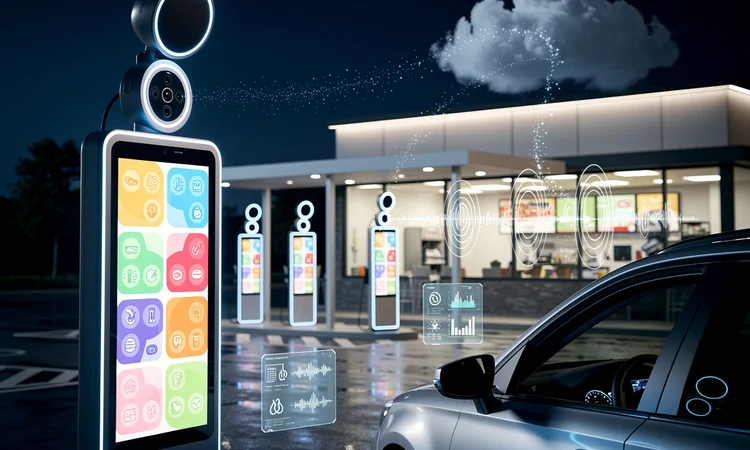
In the high-stakes world of quick-service restaurants, artificial intelligence is rewriting the rules of customer interaction. Major chains like McDonald’s, Papa Johns, and Taco Bell are deploying AI-powered voice systems at drive-thrus and kiosks, aiming to slash order errors, accelerate service times, and free staff for higher-value tasks. This shift, accelerating into 2026, promises operational efficiencies but raises questions about customer experience and workforce impacts.

Recent deployments highlight the momentum. Fox News reports that fast-food giants including McDonald’s and Papa Johns are racing to implement these systems to reduce errors and speed up service. Papa Johns, partnering with Google Cloud, launched an AI ordering assistant that personalizes orders in real time for its 150 million global customers, as detailed by QSR Magazine .

McDonald’s, after ending a prior test with IBM, is doubling down on AI for 2026. Yahoo Finance notes the chain’s focus on fixing drive-thru bottlenecks, where long lines and miscommunications plague peak hours.

From Experiments to Widespread Rollouts

The transition from pilot programs to full-scale adoption has been rapid. Taco Bell’s voice AI now processes millions of orders across hundreds of locations, allowing staff to prioritize food prep, according to posts found on X. Wendy’s FreshAI, developed with Google and tested in Ohio since 2023, continues to expand, handling drive-thru orders with improved accuracy.

Industry analysts predict dominance by 2026. QSR Web forecasts AI evolving from novelty to necessity, with back-of-house automation and personalized tools combating labor shortages. Precedence Research projects the restaurant AI market to grow from $129.2 million in 2024 to $1.32 billion by 2030 at a 47.8% CAGR, underscoring the financial stakes.

Voice technology’s appeal lies in its seamlessness. Systems like those from Valyant AI integrate with point-of-sale hardware, recognizing accents and noisy environments while upselling based on past orders.

Precision Gains and Error Reductions

Accuracy improvements are quantifiable. White Castle reported a 20% drop in order mistakes and 90-second service times using AI, per PYMNTS . Wendy’s FreshAI achieves over 85% hands-free order completion rates, enabling crew to focus on assembly.

These systems parse complex requests—’extra pickles, no onions’—with machine learning trained on vast datasets. GlobalEdge highlights how AI manages inventory in real time, predicting demand to minimize waste.

Customer data fuels personalization. Papa Johns’ Google-powered agent suggests add-ons like dipping sauces based on order history, boosting average ticket sizes.

Overcoming Early Stumbles

Not all launches were smooth. McDonald’s IBM partnership ended in 2025 amid accuracy issues, as covered by Restaurant Business . Yet, lessons learned propelled refinements, with newer models handling diverse accents and interruptions better.

Posts on X reveal mixed user reactions: some praise speed, others decry the loss of human touch, likening it to surveillance. Chains counter with hybrid models, where AI hands off to humans if needed.

Regulatory scrutiny emerges too. Instacart paused AI dynamic pricing amid FTC probes, per recent reports, signaling broader oversight on algorithmic decisions in food service.

Workforce Shifts and Economic Pressures

AI promises relief from labor woes. With U.S. restaurant turnover at 70%, systems reduce frontline staffing needs by 30-50%, allowing focus on hospitality. Tasting Table outlines 2026 changes, including AI to counter rising wages.

Training adapts quickly. Crews monitor AI via tablets, intervening seamlessly. This upskilling positions workers for oversight roles, potentially increasing job satisfaction.

Economic models show returns: payback in 3-6 months via higher throughput and upsells, with ROI exceeding 300% annually for leaders like Checkers and Rally’s.

Personalization at Scale

Hyper-personalization drives revenue. AI analyzes loyalty data for tailored offers—’your usual Big Mac with fries?’—lifting sales 15-20%. Domino’s and Starbucks pioneered voice commerce, now standard.

Integration with apps and delivery platforms amplifies reach. The Takeout details streamlined operations reducing waste through predictive ordering.

Future iterations promise multimodal AI, blending voice, vision for menu boards, and gesture recognition.

Competitive Edges and Global Expansion

Early adopters gain ground. Taco Bell’s nationwide push processes orders 8 seconds faster on average. Internationally, adaptations handle multilingual orders in Europe and Asia.

Competition intensifies with startups like Presto Voice offering plug-and-play solutions. Incumbents like SoundHound AI partner with White Castle for custom models.

Challenges persist: data privacy under GDPR and CCPA demands robust compliance, with anonymized processing key.

Looking to Full Integration

By late 2026, 50% of U.S. drive-thru orders could be AI-handled, per industry projections. Chains like Burger King and Popeyes already deploy in select markets.

Hybrid human-AI teams optimize peaks, with AI managing routine orders. This evolution positions fast food for sustained profitability amid inflation and talent wars.

Stakeholders watch closely as AI redefines service speed and precision, setting new benchmarks for the $400 billion industry.

About the Author

Layla Reed
Layla Reed

Known for clear analysis, Layla Reed follows retail operations and the people building it. They work through long‑form narratives grounded in real‑world metrics to make complex topics approachable. They believe good analysis should be specific, testable, and useful to practitioners. They avoid buzzwords, focusing instead on outcomes, incentives, and the human side of technology. They explore how policies, markets, and infrastructure intersect to create second‑order effects. They frequently compare approaches across industries to surface patterns that travel well. They are known for dissecting tools and strategies that improve execution without adding complexity. A recurring theme in their writing is how teams build repeatable systems and measure impact over time. Their reporting blends qualitative insight with data, highlighting what actually changes decision‑making. They often cover how organizations respond to change, from process redesign to technology adoption. They maintain a balanced tone, separating speculation from evidence. Outside of publishing, they track public datasets and industry benchmarks. Readers return for the clarity, the caution, and the actionable takeaways.

Comments

Join the discussion and share your thoughts.

No comments yet. Be the first to comment.

Leave a Reply

Your email address will not be published.

Related Posts

US Lawmakers Strip Right-to-Repair from 2026 NDAA, Boosting Defense Contractors

US Lawmakers Strip Right-to-Repair from 2026 NDAA, Boosting Defense Contractors

U.S. lawmakers removed right-to-repair provisions from the 2026 NDAA, preventing military personnel from independently fixing equipment and preserving defense contractors' lucrative service contracts. Critics decry industry influence, citing potential cost savings and improved readiness. This setback fuels ongoing advocacy for repair reforms in military and civilian sectors.

Posted on: by Jack Chen
Amazon Prime Air Struggles: Drone Incidents, Regulations, and Rivals

Amazon Prime Air Struggles: Drone Incidents, Regulations, and Rivals

Amazon's Prime Air drone delivery program, launched in 2013, faces setbacks including a 2025 Texas incident where a drone clipped a cable, triggering FAA scrutiny, regulatory hurdles, and technical glitches. Trailing rivals like Walmart and Zipline, Amazon is pivoting strategies amid fierce competition. Recovery hinges on innovations and safer operations.

Posted on: by Grace Wright
DOJ’s Appeal in Google Antitrust Case Signals Protracted Legal Battle Over Search Monopoly Remedies

DOJ’s Appeal in Google Antitrust Case Signals Protracted Legal Battle Over Search Monopoly Remedies

The DOJ and state attorneys general have appealed Judge Mehta's Google antitrust remedies ruling, challenging the decision to reject structural breakups including Chrome divestiture. The appeal argues behavioral restrictions are insufficient to dismantle Google's search monopoly, setting up a multi-year legal battle.

Retail Ecommerce
Google Launches Doppl: AI Virtual Try-Ons Transform Online Shopping

Google Launches Doppl: AI Virtual Try-Ons Transform Online Shopping

Google has launched Doppl, an AI-powered app enabling virtual clothing try-ons with personalized, dynamic models to reduce online shopping uncertainties and returns. Amid expanding AI shopping tools like agentic checkout, it faces regulatory scrutiny over data practices, yet promises to revolutionize e-commerce personalization and consumer behavior.

Retail Ecommerce
Microsoft 365 Prices to Rise Up to 33% in 2026 Amid AI and Security Upgrades

Microsoft 365 Prices to Rise Up to 33% in 2026 Amid AI and Security Upgrades

Microsoft is raising Microsoft 365 prices by up to 33% starting July 1, 2026, for commercial, frontline, and government users, driven by AI enhancements like Copilot and improved security features. This first major hike since 2022 aims to fund innovations amid cyber threats, though it sparks mixed reactions on affordability.

Retail Ecommerce
EU Court Upholds Intel Antitrust Ruling, Slashes Fine to €237M

EU Court Upholds Intel Antitrust Ruling, Slashes Fine to €237M

Europe's General Court upheld Intel's antitrust violation for using rebates and payments to exclude rivals like AMD in the chip market, but slashed the fine from €376 million to €237 million. This ruling, part of a decades-long saga, highlights evolving EU antitrust standards amid Intel's competitive challenges.

Retail Ecommerce
MasterClass 2025 Holiday Deal: 40% Off Annual Subscriptions

MasterClass 2025 Holiday Deal: 40% Off Annual Subscriptions

MasterClass's 2025 holiday promotion offers 40% off annual subscriptions, reducing Standard to $72, Plus to $108, and Premium to $144, including gifts. This strategy enhances accessibility to celebrity-led courses amid market competition. It boosts subscriber growth and democratizes elite education during economic uncertainties.

Retail Ecommerce
NYC’s 2025 Congestion Pricing Slashes Traffic 11%, Pollution 22% in Manhattan

NYC’s 2025 Congestion Pricing Slashes Traffic 11%, Pollution 22% in Manhattan

New York City's 2025 congestion pricing in Manhattan charges drivers to enter south of 60th Street, reducing traffic by 11% and PM2.5 pollution by 22%. This has improved air quality citywide, cut noise and accidents, funded transit upgrades, and serves as a model for urban sustainability.

Retail Ecommerce
2025 RAM Prices Skyrocket Amid AI-Driven Shortages

2025 RAM Prices Skyrocket Amid AI-Driven Shortages

In 2025, RAM prices have skyrocketed due to explosive AI demand for high-bandwidth memory in data centers, causing shortages and doubling or tripling costs for consumer DDR5 and DDR4 modules. This crisis disrupts PC building, smartphones, and industries, with experts forecasting prolonged volatility through 2027-2028 as production lags behind.

Retail Ecommerce
Nvidia Pilots AI Chip Tracking Software to Curb Smuggling to China

Nvidia Pilots AI Chip Tracking Software to Curb Smuggling to China

Nvidia is piloting software that uses telemetry data to track the locations of its AI chips, like the Blackwell series, to combat smuggling into restricted markets such as China amid US export bans. This initiative addresses geopolitical tensions and black-market operations, enhancing compliance without hardware changes.

Retail Ecommerce