
AI’s 693% Holiday Traffic Explosion: Retail’s New Commerce Frontier

Emily Chen
Emily Chen

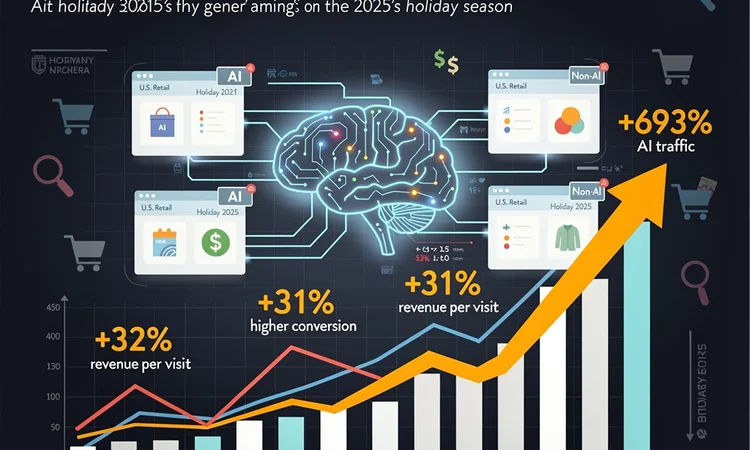
Generative AI traffic to U.S. retail sites exploded 693% during 2025 holidays, converting 31% higher and driving 32% more revenue per visit than non-AI sources, Adobe data shows. This reversal from 2024 underscores AI's transformation of shopping discovery into a core revenue channel.

AI’s 693% Holiday Traffic Explosion: Retail’s New Commerce Frontier

Generative AI tools like ChatGPT, Gemini and Perplexity propelled a staggering 693% year-over-year surge in traffic to U.S. retail sites during the 2025 holiday season from November 1 to December 31, according to Adobe’s Quarterly AI Traffic Report. Analyzing over one trillion visits to retail sites and more than 100 million stock-keeping units, the data reveals AI referrals not only flooded sites but delivered superior performance, converting 31% higher than non-AI sources overall—54% more on Thanksgiving and 38% more on Black Friday.

This shift marks a reversal from 2024, when non-AI traffic outperformed AI by 51% in revenue per visit. In 2025, AI-sourced visitors drove 32% more revenue per visit, alongside 14% higher engagement, 45% longer session times and 13% more pages viewed per session. “AI-driven traffic surged across industries. This means for marketers and retailers alike, we saw deeper engagement is translating directly into higher conversion during the 2025 holiday season,” said Vivek Pandya, director of Adobe Digital Insights, in remarks to Marketing Dive .

The retail boom extended beyond holidays, with triple-digit AI referral growth in travel (539%), financial services (266%) and tech/software sectors. Total U.S. online holiday sales hit a record $257.8 billion, up 6.8% from $241.4 billion in 2024, fueled by 25 days exceeding $4 billion in daily spend—up from 18 days the prior year—as reported by Adobe .

From Novelty to Revenue Engine

AI’s evolution from experimental tool to commerce powerhouse accelerated post-2024’s 1,300% holiday traffic spike. By mid-2025, AI revenue per visit had climbed 84% from January to July versus non-AI sources, narrowing the value gap to 27%. Holiday data confirms consumers trust these channels: 47% expressed confidence in AI results per Adobe’s survey of over 1,000 shoppers. “Traffic from tools like ChatGPT, Gemini and Perplexity is growing rapidly. More importantly, it’s high-quality traffic that converts,” Pandya told Marketing Dive .

Retailers felt the impact acutely. On Black Friday, AI traffic rose 805% year-over-year, per Retail Dive . Mobile dominated, claiming 56.4% of transactions—peaking at 66.5% on Christmas—while buy-now-pay-later hit $20 billion, up 9.8%. Salesforce data echoed the trend, with AI influencing 20% of U.S. holiday retail sales, or $262 billion globally, as shoppers from AI search converted nine times more than social referrals ( Retail TouchPoints ).

Demographics sharpened the picture. High-income states like Virginia, Washington, New York, California and Massachusetts generated twice the national AI engagement average, accounting for 52% of U.S. AI traffic. Urban consumers showed 80% awareness of AI assistants, 48% usage in shopping and 63% planning increased 2026 adoption; rural figures lagged at 67%, 27% and 42%.

Geographic and Economic Divides Emerge

Adoption hinged on exposure over access—Mississippi boasted high online activity but low AI engagement. Nationwide, just 2% of consumers remain unaware of AI assistants, with 46% having used them for shopping and 58% intending to in 2026. High-income areas led, while South and Appalachia trailed, highlighting a digital divide in AI commerce uptake ( Marketing Dive ).

Broader surveys reinforced consumer embrace. Talkdesk’s post-holiday poll found 88% used AI during 2025 holidays, with 56% happier for it and 69% more likely to adopt AI shopping in future seasons. Deloitte noted 33% planned generative AI use—double 2024’s rate—with 26% reporting heightened trust. Salesforce’s Caila Schwartz described it as a “definitive shift to a new era of ‘agentic’ shopping,” powering $1.29 trillion global online holiday sales, up 7% year-over-year ( WWD ).

Tools like Perplexity and Claude gained traction for research, deal-hunting and gift ideas. Adobe observed prompts for phones peaking 40% above 2024 averages pre-Thanksgiving, toys surging 50% in Christmas week. Retailers adapted: Target launched conversational AI gift finders; Amazon enhanced agentic tools for sellers ( Retail Dive ).

Marketers Race to Optimize for AI Discovery

“For retailers and brands, this signals a lasting shift in how consumers discover and evaluate products. Generative AI’s role in commerce isn’t a passing trend. It’s becoming a core part of the digital shopping journey,” Pandya emphasized to Adobe . Marketers must pivot: 75% plan AI for deals per Talkdesk, up from 66% in 2024. Zeta Global saw 25x AI agent growth in holiday campaigns.

X discussions amplified urgency. @KobeissiLetter highlighted the $257.8 billion spend and 693% AI surge, while @NVIDIAAI noted 89% of retail leaders reporting revenue gains from AI. @dsteinberg10000 of Zeta Global touted 153% platform usage jump and 87% time savings via AI agents. Practical Ecommerce cautioned that while percentages dazzle off small bases, AI’s direct visits remain tiny—but influence looms large ( Practical Ecommerce ).

Challenges persist: High returns at 28% pressured margins, per Salesforce, amid tariffs and price sensitivity. Yet AI’s momentum—projected 520% pre-holiday growth—positions it as retail’s next battleground. Winners will embed AI in sites, optimize for LLMs and bridge divides to capture this high-intent traffic.

Charting AI’s Enduring Retail Path

Adobe’s data, drawn from 215 top retailers, signals optimization imperatives. Bounce rates fell as relevance rose; desktop still led AI traffic at 86% early 2025, but mobile share climbed toward one-third. Forrester predicted AI aiding one in five for gifts; Visa and Zeta found 40-83% planning AI use. Global sales hit $1.29 trillion, with U.S. at $294 billion per Salesforce ( Yahoo Finance ).

As 2026 unfolds, 58% of consumers eye more AI shopping. Retailers ignoring this risk obsolescence; adapters like those leveraging NVIDIA’s AI—95% cost reductions—stand to gain. Pandya’s final word: “Marketers should continue to adapt as more consumers turn to large language models to research products, compare options, and make decisions.” The commerce era of AI assistants has arrived.

About the Author

Emily Chen
Emily Chen

Known for clear analysis, Emily Chen follows retail operations and the people building it. They work through clear frameworks, case studies, and practical checklists to make complex topics approachable. They often cover how organizations respond to change, from process redesign to technology adoption. Readers appreciate their ability to connect strategic goals with everyday workflows. They examine how customer expectations evolve and how organizations adapt to meet them. They value transparent sourcing and prefer primary data when it is available. A recurring theme in their writing is how teams build repeatable systems and measure impact over time. They also highlight cultural factors that determine whether change sticks. They avoid buzzwords, focusing instead on outcomes, incentives, and the human side of technology. They explore how policies, markets, and infrastructure intersect to create second‑order effects. They believe good analysis should be specific, testable, and useful to practitioners. They tend to favor small experiments over sweeping predictions. They value transparency, practical advice, and honest uncertainty.

Comments

Join the discussion and share your thoughts.

No comments yet. Be the first to comment.

Leave a Reply

Your email address will not be published.

Related Posts

AI Search Erodes Organic Traffic by 30-40% in 2026, Publishers Adapt

AI Search Erodes Organic Traffic by 30-40% in 2026, Publishers Adapt

In 2026, AI-driven search features like Google's AI Overviews are eroding organic web traffic, with declines of 30-40% in referrals from Google and social media, severely impacting publishers and e-commerce. Causes include zero-click searches and algorithm shifts. Adaptation strategies emphasize diversification and content optimization for sustainability.

Posted on: by Aria Brooks
Meta Launches Ads on Threads Globally Next Week for Revenue Boost

Meta Launches Ads on Threads Globally Next Week for Revenue Boost

Meta Platforms is launching ads on Threads globally next week, following successful tests in select markets, to monetize its 400 million+ user base amid competition with X. This integrates Threads into Meta's advertising ecosystem, promising revenue growth while prioritizing seamless user experience and retention.

Posted on: by Claire Bell
YouTube TV Launches Custom Multiview for Personalized Viewing

YouTube TV Launches Custom Multiview for Personalized Viewing

YouTube TV is enhancing its multiview feature, enabling subscribers to customize up to four live channels from sports, news, and more, moving beyond preselected bundles. This upgrade, paired with upcoming genre-specific plans in 2026, boosts personalization and viewer engagement in a competitive streaming market.

Advertising Marketing
Vimeo’s Post-Acquisition Purge: Bending Spoons Axes Jobs in Israel and Beyond

Vimeo’s Post-Acquisition Purge: Bending Spoons Axes Jobs in Israel and Beyond

Vimeo faces global layoffs months after Bending Spoons' $1.38 billion acquisition, dismantling its Israeli development center and cutting staff worldwide. The moves follow a prior 10% reduction and signal aggressive cost-cutting by the new owner.

Advertising Marketing
YouTube CEO Unveils 2026 AI Roadmap for Creators and Ethical Tools

YouTube CEO Unveils 2026 AI Roadmap for Creators and Ethical Tools

YouTube CEO Neal Mohan outlines a 2026 AI roadmap to empower creators with tools like AI avatars for Shorts, autodubbing, and monetization analytics, while combating "AI slop" through detection and safeguards. This vision enhances user experiences, global reach, and ethical AI use, positioning YouTube as an innovative entertainment hub.

Advertising Marketing
Will.i.am’s AI Reckoning: From Music Slop to Personal Agents

Will.i.am’s AI Reckoning: From Music Slop to Personal Agents

Will.i.am warns of AI music's evolution from slop to originals, urging personal agents and likeness ownership amid fragmentation. Live performances regain value as regulations loom.

Advertising Marketing
X’s Starterpacks: Copying Bluesky to Fix Onboarding Woes

X’s Starterpacks: Copying Bluesky to Fix Onboarding Woes

X launches Starterpacks, Bluesky-inspired curated account lists to boost onboarding and retention. Curated for niches like crypto, the feature rolls out soon, drawing on proven discovery tactics amid fierce social media competition.

Advertising Marketing
Paramount’s High-Stakes Wager: Will EU Block Netflix’s Warner Bros. Grab?

Paramount’s High-Stakes Wager: Will EU Block Netflix’s Warner Bros. Grab?

Paramount gambles on EU regulators torpedoing Netflix's $83 billion Warner Bros. Discovery bid, amid simultaneous reviews and U.S. pushback. WBD favors Netflix's all-cash offer, but antitrust hurdles could hand victory to David Ellison's hostile play.

Advertising Marketing
Spotify’s AI Playlists Hand Listeners the Reins

Spotify’s AI Playlists Hand Listeners the Reins

Spotify launched AI-driven prompted playlists for U.S. and Canada premium users, enabling custom mixes via natural language prompts tied to vibes and memories. The feature empowers listeners to direct algorithms, boosting engagement amid streaming competition.

Advertising Marketing
Grammy Stars Collaborate with AI on ‘The Eleven Album

Grammy Stars Collaborate with AI on ‘The Eleven Album

Grammy-winning artists like Liza Minnelli and Art Garfunkel collaborate with ElevenLabs' AI on "The Eleven Album," blending human creativity with generated tracks. This project showcases AI's role in efficient music production across genres, while sparking debates on authorship, ethics, and industry innovation. It positions AI as a tool amplifying artistry.

Advertising Marketing