
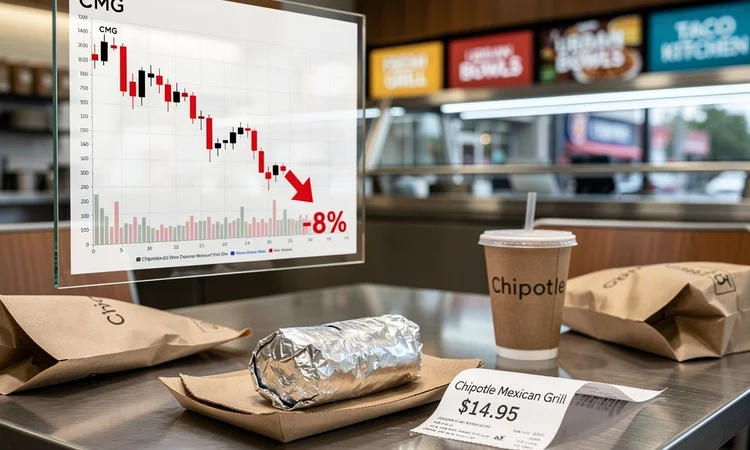
Chipotle Mexican Grill, long celebrated as a Wall Street darling and a bellwether for the fast-casual dining sector, confronted investors with a sobering reality check in early February 2026. The restaurant chain’s fourth-quarter earnings report revealed declining customer traffic and tepid forward guidance, triggering a sharp selloff that erased billions in market capitalization and raised fundamental questions about the sustainability of its premium pricing strategy in an increasingly price-sensitive consumer environment.
According to CNBC , Chipotle reported that comparable restaurant sales growth decelerated significantly, driven primarily by negative traffic trends that offset modest pricing gains. The company’s same-store sales increased just 3.4% in the fourth quarter, falling short of analyst expectations and marking a notable slowdown from previous quarters. More concerning for investors was management’s guidance for the first quarter of 2026, which projected low-to-mid single-digit comparable sales growth—a stark departure from the double-digit growth rates that characterized much of the company’s recent history.
The stock plummeted more than 8% in after-hours trading following the earnings announcement, reflecting investor anxiety about whether Chipotle has finally hit a ceiling in its ability to command premium prices while maintaining customer loyalty. The decline represented one of the sharpest single-session drops for the burrito chain in more than two years, wiping out approximately $5 billion in market value and raising questions about valuation levels that had previously seemed justified by the company’s consistent execution.
The Traffic Conundrum: When Premium Positioning Meets Consumer Resistance
The heart of Chipotle’s current challenge lies in a metric that restaurant industry analysts watch with particular intensity: traffic, or the number of customer transactions. While the company has successfully implemented multiple rounds of price increases over the past several years—citing elevated ingredient costs, wage pressures, and investments in digital infrastructure—the fourth-quarter results suggest that consumers are beginning to push back against burrito bowls that now frequently exceed $12 in many markets.
Traffic declined approximately 2% during the quarter, according to company disclosures, marking the first significant negative traffic reading in years for a chain that had previously managed to grow both prices and customer visits simultaneously. This bifurcation between pricing power and customer frequency represents a critical inflection point: Chipotle can no longer rely on simply raising prices to drive revenue growth, as each incremental increase appears to be driving away a corresponding segment of price-conscious diners.
Industry observers note that Chipotle’s predicament reflects broader pressures facing the restaurant sector, where middle-income consumers have been particularly squeezed by cumulative inflation across multiple spending categories. The chain’s value proposition—fresh ingredients, customizable meals, and a perception of healthier fast food—has historically justified a premium over traditional quick-service competitors. However, when a typical Chipotle meal approaches or exceeds $15 per person, the psychological barrier becomes significant, particularly for families and younger consumers who constitute core customer segments.
Operational Execution Under Scrutiny: Portion Sizes and Perceived Value
Compounding Chipotle’s traffic challenges has been a persistent narrative around portion sizes that gained significant traction on social media platforms throughout 2025. Customers increasingly complained on TikTok, Instagram, and X (formerly Twitter) that serving sizes had diminished, particularly for proteins and guacamole, leading to accusations that the company was quietly reducing portions to protect margins while maintaining or increasing prices.
Chipotle’s management has repeatedly denied any systematic changes to portion protocols, with CEO Brian Niccol and other executives emphasizing during earnings calls that the company maintains strict standards for ingredient quantities. However, the perception problem proved difficult to contain, as viral videos comparing portion sizes across different locations and time periods fueled customer skepticism and likely contributed to traffic declines among value-conscious consumers who felt they were receiving less food for higher prices.
The portion controversy highlights a fundamental tension in Chipotle’s operational model: the company empowers individual employees to customize orders and control serving sizes, which creates variability across locations and even across different visits to the same restaurant. While this approach supports the brand’s emphasis on fresh preparation and personalization, it also creates opportunities for inconsistency that can erode customer trust, particularly when combined with aggressive pricing strategies.
Digital Dominance Delivers Mixed Results
One of the few bright spots in Chipotle’s quarterly report was the continued strength of its digital business, which now represents more than 35% of total sales. The company’s investments in mobile ordering, delivery partnerships, and dedicated pickup infrastructure—including “Chipotlanes” drive-through lanes exclusively for digital orders—have created a substantial competitive moat and improved unit economics at many locations.
However, even this digital success story contains cautionary elements. The growth in digital sales has been accompanied by increased promotional activity and third-party delivery commissions that compress margins. Additionally, as digital ordering becomes table stakes across the restaurant industry rather than a differentiating feature, Chipotle’s first-mover advantage in this channel may be diminishing, particularly as competitors like Qdoba, Moe’s Southwest Grill, and even traditional fast-food chains enhance their own digital capabilities.
The company’s digital infrastructure also requires ongoing capital investment to maintain technological relevance and cybersecurity standards, creating a fixed cost structure that becomes more burdensome during periods of slowing sales growth. Management indicated during the earnings call that technology spending would remain elevated in 2026, further pressuring near-term profitability even as the long-term strategic rationale remains sound.
Labor Costs and Wage Pressures Create Margin Headwinds
Beyond customer-facing challenges, Chipotle continues to grapple with structural cost pressures that limit its pricing flexibility. Labor costs, which represent the largest expense category for restaurant operators, have increased substantially across Chipotle’s footprint, driven by minimum wage increases in key states like California, New York, and Colorado, as well as competitive pressures for workers in a still-tight employment market.
California’s implementation of a $20 minimum wage for fast-food workers in 2024, which has since been indexed to inflation, created particular challenges for Chipotle’s extensive California operations. While the company passed along much of this cost increase to customers through higher menu prices, the cumulative effect of multiple price increases has clearly contributed to the traffic declines now evident in the quarterly results. Management faces a difficult balancing act: absorb cost increases and accept margin compression, or continue raising prices and risk further traffic deterioration.
Food costs have also remained elevated, particularly for key ingredients like avocados, chicken, and steak. While Chipotle’s scale provides some procurement advantages, the company’s commitment to responsibly sourced ingredients and its “Food with Integrity” positioning limits its ability to trade down to cheaper suppliers during periods of commodity price spikes. This philosophical commitment to quality ingredients represents both a brand strength and a financial constraint, particularly when consumers are simultaneously becoming more price-sensitive.
Competitive Pressures Intensify Across Multiple Fronts
Chipotle’s challenges are unfolding against a backdrop of intensifying competition across multiple segments of the restaurant industry. Traditional fast-food chains have upgraded their offerings with premium ingredients and customization options that encroach on Chipotle’s positioning, while fast-casual competitors have expanded aggressively and often undercut Chipotle on price while offering similar quality perceptions.
Regional chains and independent operators have also proliferated in the Mexican and Tex-Mex fast-casual category, many of them offering portion sizes and value propositions that compare favorably to Chipotle. In markets where consumers have multiple options for customizable burrito bowls and tacos, Chipotle’s brand strength alone may be insufficient to command the premium pricing that has driven its financial performance in recent years.
The competitive threat extends beyond direct Mexican food rivals. Consumers making decisions about where to spend their restaurant dollars are comparing Chipotle not only to Qdoba or Moe’s but also to the full spectrum of fast-casual options, from Mediterranean concepts like Cava to Asian fast-casual chains like Sweetgreen. In this broader competitive context, Chipotle’s value proposition must be compelling enough to win against diverse alternatives, making pricing discipline and portion generosity increasingly important.
Management Response and Strategic Adjustments
In response to the fourth-quarter disappointment, Chipotle’s management team has signaled several strategic adjustments, though details remained limited in the immediate aftermath of the earnings release. The company indicated plans to enhance value perceptions through limited-time offers and potential adjustments to its loyalty program, though executives stopped short of committing to across-the-board price reductions that might be interpreted as a sign of weakness.
Management also emphasized plans to accelerate unit development, targeting approximately 300 new restaurant openings in 2026. This expansion strategy reflects confidence in the long-term unit economics of Chipotle locations, even as same-store sales growth moderates. New units in underpenetrated markets may offer better growth prospects than attempting to drive additional traffic to mature locations in saturated markets, though this approach requires substantial capital investment and creates near-term earnings pressure.
The company’s response to the portion size controversy has included enhanced training protocols and management oversight to ensure consistency across locations. Some analysts have suggested that Chipotle might benefit from more standardized portioning tools or procedures, though such changes would represent a philosophical shift away from the empowerment of individual employees that has characterized the company’s operational culture.
Investor Implications and Valuation Recalibration
Prior to the fourth-quarter earnings disappointment, Chipotle shares had traded at premium valuations relative to both the broader restaurant sector and the overall market, reflecting investor confidence in the company’s growth trajectory and operational execution. The stock had commanded a forward price-to-earnings multiple above 40 times, a valuation that assumed continued robust sales growth and margin expansion.
The combination of negative traffic trends and cautious guidance has forced a reassessment of these valuation assumptions. If Chipotle can no longer deliver consistent high-single-digit or double-digit comparable sales growth, the premium multiple becomes harder to justify, potentially leading to further multiple compression even if absolute earnings continue to grow modestly. Several Wall Street analysts downgraded their ratings or reduced price targets in the days following the earnings release, citing concerns about the sustainability of historical growth rates.
For long-term investors, the key question centers on whether the current challenges represent a temporary cyclical downturn or a more fundamental structural shift in Chipotle’s competitive position. Bulls argue that the company’s brand strength, unit economics, and digital capabilities position it to weather near-term headwinds and resume growth as consumer spending patterns normalize. Bears counter that the combination of premium pricing, portion controversies, and intensifying competition has permanently impaired the company’s ability to grow traffic, limiting it to low-single-digit comparable sales growth that doesn’t support current valuation levels.
The Path Forward: Balancing Growth, Value, and Profitability
Chipotle’s management faces difficult strategic choices in the quarters ahead. The company must decide whether to prioritize traffic recovery through enhanced value offerings and larger portions, potentially accepting near-term margin pressure, or to defend current pricing and margins while accepting slower traffic growth and focusing on new unit development as the primary growth driver.
The optimal path likely involves elements of both approaches: selective value offerings to address the most price-sensitive customer segments, continued digital innovation to improve convenience and reduce friction, and operational improvements to ensure portion consistency and enhance perceived value. The company’s strong balance sheet and cash flow generation provide flexibility to invest in these initiatives while maintaining an aggressive unit development schedule.
Whatever strategic direction management chooses, the fourth-quarter results serve as a reminder that even the most successful restaurant concepts face limits to pricing power and must continuously earn customer loyalty through value, quality, and experience. For Chipotle, the challenge will be rediscovering the formula that previously allowed it to grow both traffic and average check simultaneously—a combination that now appears more elusive in an environment where consumers are making increasingly deliberate choices about where to spend their dining dollars. The coming quarters will reveal whether this stumble represents a temporary setback or the beginning of a more prolonged period of slower growth for one of the restaurant industry’s most closely watched companies.


Leave a Reply
Your email address will not be published.