Content Engine Overhaul: Why CreativeOps and MOps Demand Fusion in 2026

Grace Wright
Grace Wright

Shrinking budgets and AI-driven workflows force CreativeOps and MOps convergence into a single content engine, eliminating silos for efficiency and scale amid 2026 pressures.

Content Engine Overhaul: Why CreativeOps and MOps Demand Fusion in 2026

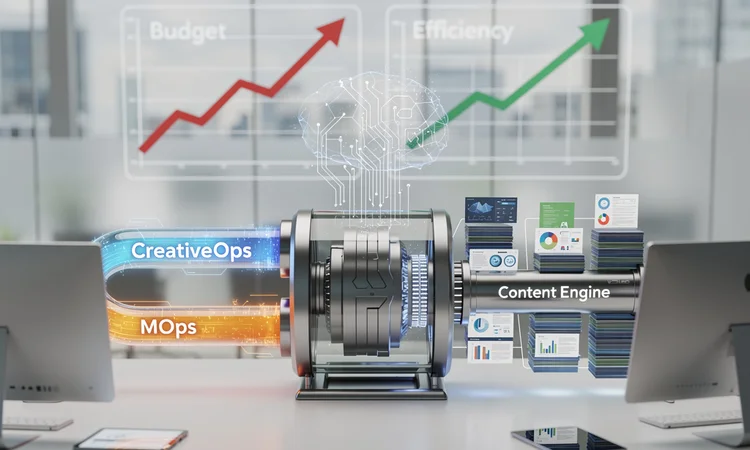
In the tightening grip of budget constraints, marketing leaders face a stark reality: CreativeOps and Marketing Operations (MOps) can no longer function as isolated silos. As Gareth Chilton argues in MarTech , “Creation, decisioning and activation now operate as one engine. Separating creative and marketing operations adds cost, complexity and operational drag.” Digitized workflows powered by generative AI, automation tools, and integrated platforms have rendered traditional handoffs obsolete, forcing a convergence that promises efficiency amid shrinking resources.

Marketing budgets plummeted to 7.7% of company revenue in 2024, a 15% drop from 9.1% the prior year, according to Gartner’s 2024 CMO Spend Survey . This “era of less,” as Gartner terms it, amplifies the friction of divided operations. CreativeOps, once focused on studio throughput like briefing and approvals, now designs modular assets with metadata for automated assembly. MOps, handling campaign launches and data fixes, increasingly governs decision logic and feedback loops. Their separation breeds duplicate processes and middleware reconciliation, eroding ROI.

Macro Pressures Driving Unity

AI acceleration intensifies this shift. McKinsey’s 2025 State of AI reveals 62% of organizations experimenting with AI agents that redefine workflows across functions, moving bottlenecks from production to governance. Forrester’s 2024 Digital Asset Management Wave positions DAM platforms as omnichannel infrastructure, enabling AI-driven personalization that blurs creative and ops boundaries. Adobe’s trends highlight surging content demands—more volume, variants, and speeds—necessitating integrated systems with templates and real-time loops.

Chilton notes, “The content problem is more volume across more variants, for more contexts, at higher speeds.” Without unity, teams duplicate leadership and platforms, funding internal fixes over customer impact. Consolidated models promise shared stewardship of templates, metadata, and KPIs like responsiveness and error rates.

Evolving Roles in the Unified Engine

CreativeOps evolves from job management to system architecture: encoding guardrails, taxonomy stewardship, and quality loops. MOps shifts to real-time system health, integrating data, content, and channels. Sue Wolski, in MarTech , urges mutual learning: CreativeOps precision for campaign SLAs, MOps analytics for briefs. “When MOps and CreativeOps learn from each other, marketing becomes an intelligent, interconnected system,” she writes.

Reporting structures amplify these tensions. Nickole Brown, in another MarTech piece, weighs options: Creative autonomy risks silos, while MOps alignment unlocks tools and data. Cella’s 2024 CIR shows only 39% of in-house creatives in planning, underscoring gaps. Brown advises integration for elevation: “If you’re considering moving creative ops under MOps, do it to elevate creative’s influence.”

Practical Paths to Consolidation

Leaders must assign senior accountability for the end-to-end engine. Pilots with cross-functional teams, shared dashboards, and system metrics map handoffs and codify wins. Screendragon’s 2025 trends , drawn from summit leaders, emphasize data flywheels: “Connect briefing, creative development, and performance data into one seamless process,” says Tom Blenkin. Fergus Ashe adds, “Modern tools link project planning with resourcing and delivery for real-time alignment.”

Hybrid roles emerge—creatives versed in metadata, ops in journeys—as AI multipliers. Events like MOps-Apalooza and Creative Operations Summit highlight community momentum toward unified ops. Chilton warns, “In most enterprise environments, CreativeOps and MOps must either consolidate… or quietly become the most significant source of operational drag.”

Cultural and Structural Hurdles Ahead

The real barrier is cultural: function-first mindsets versus system outcomes. Org charts lag martech reality, fostering shadow operations. Wolski recommends joint planning and retrospectives to validate forecasts against capacity. Brown stresses partnerships: shared goals, transparency, data flows.

2026 demands action. High-performers redesign workflows, invest in hybrids, and measure holistically. As Chilton concludes, “Over the next five years, the organizations that perform best will be those that can move past the old divide and operate content as what it already is—one interconnected system.”

About the Author

Grace Wright
Grace Wright

As a writer, Grace Wright covers platform engineering with an eye for detail. They work through clear frameworks, case studies, and practical checklists to make complex topics approachable. Readers appreciate their ability to connect strategic goals with everyday workflows. They also highlight cultural factors that determine whether change sticks. They examine how customer expectations evolve and how organizations adapt to meet them. Their coverage includes guidance for teams under resource or time constraints. They write about both the promise and the cost of transformation, including risks that are easy to overlook. A recurring theme in their writing is how teams build repeatable systems and measure impact over time. They value transparent sourcing and prefer primary data when it is available. They are known for dissecting tools and strategies that improve execution without adding complexity. They look for overlooked details that differentiate sustainable success from short‑term wins. They watch the policy landscape closely when it affects product strategy. They prefer evidence over hype and explain trade‑offs plainly.

Comments

Join the discussion and share your thoughts.

No comments yet. Be the first to comment.

Leave a Reply

Your email address will not be published.

Related Posts

AI Search Erodes Organic Traffic by 30-40% in 2026, Publishers Adapt

AI Search Erodes Organic Traffic by 30-40% in 2026, Publishers Adapt

In 2026, AI-driven search features like Google's AI Overviews are eroding organic web traffic, with declines of 30-40% in referrals from Google and social media, severely impacting publishers and e-commerce. Causes include zero-click searches and algorithm shifts. Adaptation strategies emphasize diversification and content optimization for sustainability.

Posted on: by Aria Brooks
Meta Launches Ads on Threads Globally Next Week for Revenue Boost

Meta Launches Ads on Threads Globally Next Week for Revenue Boost

Meta Platforms is launching ads on Threads globally next week, following successful tests in select markets, to monetize its 400 million+ user base amid competition with X. This integrates Threads into Meta's advertising ecosystem, promising revenue growth while prioritizing seamless user experience and retention.

Posted on: by Claire Bell
YouTube TV Launches Custom Multiview for Personalized Viewing

YouTube TV Launches Custom Multiview for Personalized Viewing

YouTube TV is enhancing its multiview feature, enabling subscribers to customize up to four live channels from sports, news, and more, moving beyond preselected bundles. This upgrade, paired with upcoming genre-specific plans in 2026, boosts personalization and viewer engagement in a competitive streaming market.

Advertising Marketing
Vimeo’s Post-Acquisition Purge: Bending Spoons Axes Jobs in Israel and Beyond

Vimeo’s Post-Acquisition Purge: Bending Spoons Axes Jobs in Israel and Beyond

Vimeo faces global layoffs months after Bending Spoons' $1.38 billion acquisition, dismantling its Israeli development center and cutting staff worldwide. The moves follow a prior 10% reduction and signal aggressive cost-cutting by the new owner.

Advertising Marketing
YouTube CEO Unveils 2026 AI Roadmap for Creators and Ethical Tools

YouTube CEO Unveils 2026 AI Roadmap for Creators and Ethical Tools

YouTube CEO Neal Mohan outlines a 2026 AI roadmap to empower creators with tools like AI avatars for Shorts, autodubbing, and monetization analytics, while combating "AI slop" through detection and safeguards. This vision enhances user experiences, global reach, and ethical AI use, positioning YouTube as an innovative entertainment hub.

Advertising Marketing
Will.i.am’s AI Reckoning: From Music Slop to Personal Agents

Will.i.am’s AI Reckoning: From Music Slop to Personal Agents

Will.i.am warns of AI music's evolution from slop to originals, urging personal agents and likeness ownership amid fragmentation. Live performances regain value as regulations loom.

Advertising Marketing
X’s Starterpacks: Copying Bluesky to Fix Onboarding Woes

X’s Starterpacks: Copying Bluesky to Fix Onboarding Woes

X launches Starterpacks, Bluesky-inspired curated account lists to boost onboarding and retention. Curated for niches like crypto, the feature rolls out soon, drawing on proven discovery tactics amid fierce social media competition.

Advertising Marketing
Paramount’s High-Stakes Wager: Will EU Block Netflix’s Warner Bros. Grab?

Paramount’s High-Stakes Wager: Will EU Block Netflix’s Warner Bros. Grab?

Paramount gambles on EU regulators torpedoing Netflix's $83 billion Warner Bros. Discovery bid, amid simultaneous reviews and U.S. pushback. WBD favors Netflix's all-cash offer, but antitrust hurdles could hand victory to David Ellison's hostile play.

Advertising Marketing
Spotify’s AI Playlists Hand Listeners the Reins

Spotify’s AI Playlists Hand Listeners the Reins

Spotify launched AI-driven prompted playlists for U.S. and Canada premium users, enabling custom mixes via natural language prompts tied to vibes and memories. The feature empowers listeners to direct algorithms, boosting engagement amid streaming competition.

Advertising Marketing
Grammy Stars Collaborate with AI on ‘The Eleven Album

Grammy Stars Collaborate with AI on ‘The Eleven Album

Grammy-winning artists like Liza Minnelli and Art Garfunkel collaborate with ElevenLabs' AI on "The Eleven Album," blending human creativity with generated tracks. This project showcases AI's role in efficient music production across genres, while sparking debates on authorship, ethics, and industry innovation. It positions AI as a tool amplifying artistry.

Advertising Marketing