Cracker Barrel’s Biscuit Mandate: The Rise of Corporate Travel Penny-Pinching

Zoe Wright
Zoe Wright

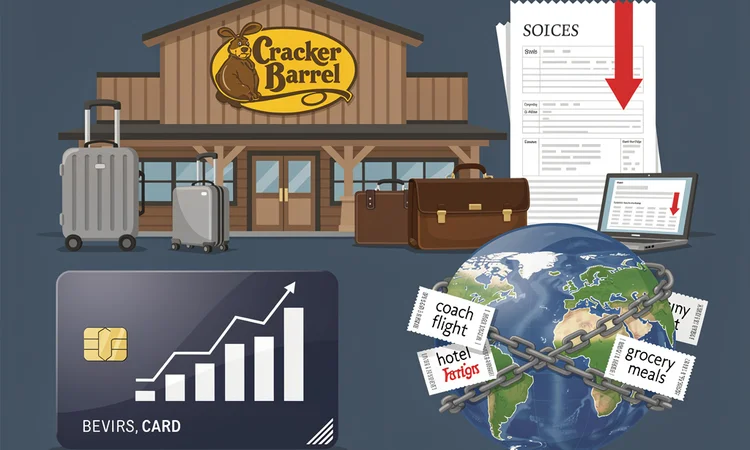
Cracker Barrel mandates staff dine at its stores on work trips amid sales woes, spotlighting corporate 'travelscrimping' where firms slash expenses, from coach flights to grocery meals, as budgets tighten across industries.

Cracker Barrel’s Biscuit Mandate: The Rise of Corporate Travel Penny-Pinching

The message from Cracker Barrel management landed like a stale biscuit amid the chain’s sales slump. Employees were told to delay work trips until later this year. If travel proved unavoidable, they should stick to the company’s meatloaf and country fried steak for meals. “Employees are expected to dine at a Cracker Barrel store for all or the majority of meals while traveling, whenever practical based on location and schedule,” the internal directive stated, as reported by the Wall Street Journal .

This policy exemplifies a broader shift dubbed “travelscrimping,” where firms across America scrutinize road warrior outlays. After years of austerity, business journeys shed their last vestiges of allure, forcing staff to hunt $100 hotel rooms, assemble grocery meals, and visit laundromats instead of using hotel services.

Cracker Barrel also banned company reimbursement for alcohol on trips, requiring personal payment unless pre-approved for special occasions by executives. Recent layoffs at the chain made some employees dismissive, noting they rarely drank on the road anyway, given alcohol’s recent addition to menus.

Tightening the Reins on Road Costs

A Corporate Business Travel analysis of the SAP Concur Global Business Travel Research Report revealed steady budgets but rising employee expectations to shoulder more costs. Justin Salerno, a Milwaukee engineer at an acquired aerospace startup, now adheres to federal per diem rates for lodging and meals. In Utah, he caps rooms at $110 nightly, occasionally exceeding during events and justifying overruns.

“I’m a bit loosey goosey about it,” Salerno admitted. Finance leaders like Jeff Oscarson in construction have rejected odd claims, such as $500 wine bottles, jeans pairs, and chairs. “Why would you do something to poke the bear by expensing a chair?” he asked.

Amazon’s longstanding frugality pushes coach seats, sparking debates on thresholds like height for international business class. David Markley, a former Amazon executive coach, endured long-haul coach flights from Seattle to Europe, Japan, and Bengaluru, avoiding bulkheads due to bassinets. “When one baby wakes up, they all tend to wake up,” he said.

Survival Tactics for Budget Journeys

Travelers forage groceries for hotel assembly or ration allowances for dinners. Chicago consultant Leroy Craighead skips Starbucks beyond coffee, opts for sparse lunches, and leverages hotel loyalty lounges. “There’s tricks,” he said. European firms prove stingier; consultant Michael Paci charges $50 steaks casually, but colleagues receipt drip coffee for two euros reimbursements. “They are going to get you two euros at a time. There is a degree of absurdity,” Paci noted.

Ex-consultant Joe Fenti quit amid reimbursement drudgery, turning it into comedy. His skit mocks policy changes via “smoke signals and bird calls,” with employees fumbling codes in desperation.

Cracker Barrel’s directive coincides with fiscal pressures, including plans to shutter 14 Maple Street Biscuit units in fiscal 2026 after impairments, per FSR magazine . Broader trends show 30% of travelers facing premium seat cuts, fewer overnights, and nonstop reluctance, according to the Concur report.

Frugality’s Roots in Tough Times

Expense abuse justifies scrutiny; companies cap amid economic strain. Per diem simplifies but tests bargain skills. As 2026 looms, TCJA expirations threaten meal deductions—50% now, potentially zero post-2025 for employer-provided meals, noted in analyses from Forvis Mazars and others.

Travelers adapt with early bookings, rideshares, and policy adherence. CBTravel’s report shows 89% of travelers, 93% of managers, and 90% of CFOs foresee no budget slashes, yet costs climb, prompting consolidation.

Cracker Barrel’s self-dining rule, while extreme, mirrors this penny-pinching ethos, blending cost control with brand loyalty in a squeezed market.

About the Author

Zoe Wright
Zoe Wright

As a writer, Zoe Wright covers retail operations with an eye for detail. Their approach combines field reporting paired with technical explainers. They write about both the promise and the cost of transformation, including risks that are easy to overlook. They explore how policies, markets, and infrastructure intersect to create second‑order effects. Their perspective is shaped by interviews across engineering, operations, and leadership roles. They examine how customer expectations evolve and how organizations adapt to meet them. A recurring theme in their writing is how teams build repeatable systems and measure impact over time. They look for overlooked details that differentiate sustainable success from short‑term wins. Their coverage includes guidance for teams under resource or time constraints. They believe good analysis should be specific, testable, and useful to practitioners. They maintain a balanced tone, separating speculation from evidence. They value transparency, practical advice, and honest uncertainty. They avoid buzzwords, focusing instead on outcomes, incentives, and the human side of technology.

Comments

Join the discussion and share your thoughts.

No comments yet. Be the first to comment.

Leave a Reply

Your email address will not be published.

Related Posts

US Lawmakers Strip Right-to-Repair from 2026 NDAA, Boosting Defense Contractors

US Lawmakers Strip Right-to-Repair from 2026 NDAA, Boosting Defense Contractors

U.S. lawmakers removed right-to-repair provisions from the 2026 NDAA, preventing military personnel from independently fixing equipment and preserving defense contractors' lucrative service contracts. Critics decry industry influence, citing potential cost savings and improved readiness. This setback fuels ongoing advocacy for repair reforms in military and civilian sectors.

Posted on: by Jack Chen
Amazon Prime Air Struggles: Drone Incidents, Regulations, and Rivals

Amazon Prime Air Struggles: Drone Incidents, Regulations, and Rivals

Amazon's Prime Air drone delivery program, launched in 2013, faces setbacks including a 2025 Texas incident where a drone clipped a cable, triggering FAA scrutiny, regulatory hurdles, and technical glitches. Trailing rivals like Walmart and Zipline, Amazon is pivoting strategies amid fierce competition. Recovery hinges on innovations and safer operations.

Posted on: by Grace Wright
DOJ’s Appeal in Google Antitrust Case Signals Protracted Legal Battle Over Search Monopoly Remedies

DOJ’s Appeal in Google Antitrust Case Signals Protracted Legal Battle Over Search Monopoly Remedies

The DOJ and state attorneys general have appealed Judge Mehta's Google antitrust remedies ruling, challenging the decision to reject structural breakups including Chrome divestiture. The appeal argues behavioral restrictions are insufficient to dismantle Google's search monopoly, setting up a multi-year legal battle.

Retail Ecommerce
Google Launches Doppl: AI Virtual Try-Ons Transform Online Shopping

Google Launches Doppl: AI Virtual Try-Ons Transform Online Shopping

Google has launched Doppl, an AI-powered app enabling virtual clothing try-ons with personalized, dynamic models to reduce online shopping uncertainties and returns. Amid expanding AI shopping tools like agentic checkout, it faces regulatory scrutiny over data practices, yet promises to revolutionize e-commerce personalization and consumer behavior.

Retail Ecommerce
Microsoft 365 Prices to Rise Up to 33% in 2026 Amid AI and Security Upgrades

Microsoft 365 Prices to Rise Up to 33% in 2026 Amid AI and Security Upgrades

Microsoft is raising Microsoft 365 prices by up to 33% starting July 1, 2026, for commercial, frontline, and government users, driven by AI enhancements like Copilot and improved security features. This first major hike since 2022 aims to fund innovations amid cyber threats, though it sparks mixed reactions on affordability.

Retail Ecommerce
EU Court Upholds Intel Antitrust Ruling, Slashes Fine to €237M

EU Court Upholds Intel Antitrust Ruling, Slashes Fine to €237M

Europe's General Court upheld Intel's antitrust violation for using rebates and payments to exclude rivals like AMD in the chip market, but slashed the fine from €376 million to €237 million. This ruling, part of a decades-long saga, highlights evolving EU antitrust standards amid Intel's competitive challenges.

Retail Ecommerce
MasterClass 2025 Holiday Deal: 40% Off Annual Subscriptions

MasterClass 2025 Holiday Deal: 40% Off Annual Subscriptions

MasterClass's 2025 holiday promotion offers 40% off annual subscriptions, reducing Standard to $72, Plus to $108, and Premium to $144, including gifts. This strategy enhances accessibility to celebrity-led courses amid market competition. It boosts subscriber growth and democratizes elite education during economic uncertainties.

Retail Ecommerce
NYC’s 2025 Congestion Pricing Slashes Traffic 11%, Pollution 22% in Manhattan

NYC’s 2025 Congestion Pricing Slashes Traffic 11%, Pollution 22% in Manhattan

New York City's 2025 congestion pricing in Manhattan charges drivers to enter south of 60th Street, reducing traffic by 11% and PM2.5 pollution by 22%. This has improved air quality citywide, cut noise and accidents, funded transit upgrades, and serves as a model for urban sustainability.

Retail Ecommerce
2025 RAM Prices Skyrocket Amid AI-Driven Shortages

2025 RAM Prices Skyrocket Amid AI-Driven Shortages

In 2025, RAM prices have skyrocketed due to explosive AI demand for high-bandwidth memory in data centers, causing shortages and doubling or tripling costs for consumer DDR5 and DDR4 modules. This crisis disrupts PC building, smartphones, and industries, with experts forecasting prolonged volatility through 2027-2028 as production lags behind.

Retail Ecommerce
Nvidia Pilots AI Chip Tracking Software to Curb Smuggling to China

Nvidia Pilots AI Chip Tracking Software to Curb Smuggling to China

Nvidia is piloting software that uses telemetry data to track the locations of its AI chips, like the Blackwell series, to combat smuggling into restricted markets such as China amid US export bans. This initiative addresses geopolitical tensions and black-market operations, enhancing compliance without hardware changes.

Retail Ecommerce