CTOs’ High-Wire Act: Taming AI Speed, Cyber Threats and Talent Crunch

Isabella Reed
Isabella Reed

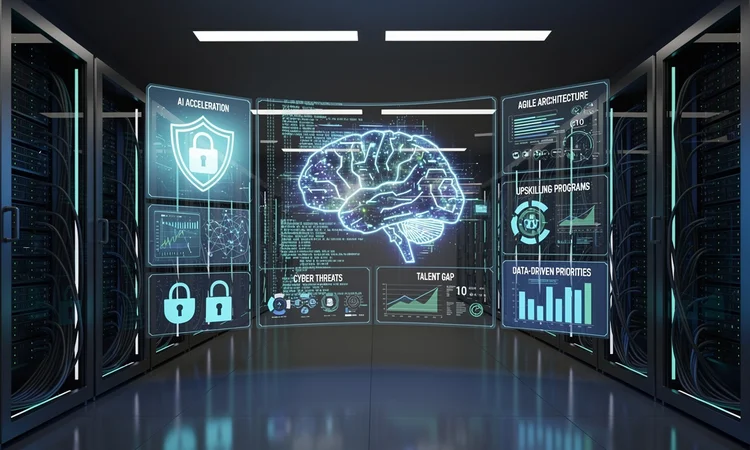
Chief technology officers grapple with AI acceleration, cyber threats, legacy integration and talent shortages amid breakneck tech shifts. Strategic upskilling, agile architectures and data-driven priorities help them deliver value without disruption.

CTOs’ High-Wire Act: Taming AI Speed, Cyber Threats and Talent Crunch

As artificial intelligence surges forward and quantum computing looms on the horizon, chief technology officers confront an unrelenting barrage of technological shifts that threaten to upend corporate operations. A CTO Magazine analysis warns that by 2030, over 85 million jobs could go unfilled globally due to skills mismatches in cybersecurity, data analytics and cloud computing, exacerbated by innovations outpacing education systems. Meanwhile, technical debt hampers agility, with more than 20% of assets mired in outdated code, according to a McKinsey report on consumer sector tech leaders.

Legacy systems integration poses another formidable barrier. Enterprises struggle to mesh cutting-edge AI with entrenched infrastructure, risking disruptions and ballooning remediation costs that stretch years. “By 2025, more than 91% of CTOs believe that technical debt slows down the adoption of new technologies,” notes a AVI Latinoamérica piece citing industry surveys. This friction stifles scalability, forcing executives to balance immediate business needs against long-term modernization.

Cybersecurity demands intensify amid AI proliferation. Vulnerabilities span servers, cloud services, IoT devices and AI models themselves, with sophisticated threats leveraging the same tools defenders employ. A The CTO Club compilation highlights cyber resiliency as paramount, quoting Brian Spanswick, CIO and CISO at Cohesity: “Cyber Resiliency needs to be a primary objective of every organization – not just protecting your organization from a breach but having the ability to rapidly recover if breached.”

Cyber Vulnerabilities Multiply in AI Era

Generative AI amplifies risks by enabling real-time threat detection but also empowering attackers. McKinsey urges proactive measures: “Some consumer players have taken a proactive approach to cybersecurity by adopting advanced threat detection and response systems, improving employee data privacy training, and collaborating with cybersecurity firms to conduct vulnerability assessments.” Guardrails like fairness toolkits to debias models and masking personally identifiable information before large language model inputs are essential.

Talent acquisition compounds these woes. A persistent shortage grips emerging fields, with ISC2 reporting mere 0.1% year-over-year cybersecurity workforce growth in 2024 amid budget cuts. Rob Kim, CTO at Presidio, laments in InformationWeek : “Challenges include the scarcity of skilled professionals in emerging technologies [including] Gen AI, data/lake house modernization and cybersecurity.” Outsourcing rates hover at 40-50% in retail, draining in-house expertise.

Information overload from hype further muddles priorities. CTOs must sift genuine value from fleeting trends, justifying investments amid fiscal scrutiny. Budget balancing remains acute, as AI-driven cloud expenses soar unpredictably.

Talent Wars Demand Bold Reskilling Plays

To counter shortages, leaders pivot to upskilling. Amazon’s Upskilling 2025 initiative trains 100,000 employees in AI, machine learning and cloud computing for higher-paying roles, per CTO Magazine. McKinsey advocates insourcing: “Strategically insource tech talent to retain intellectual property, reduce costs by up to 50%, and increase tech release speed by 50% annually.” Partnerships with startups and academia accelerate access to expertise.

Agile methodologies and scalable architectures prove vital. DevOps and cloud-native microservices enable flexibility, while modular designs facilitate legacy integration without operational halts. Data-driven decisions via analytics forecast trends, prioritizing high-ROI innovations aligned to core goals.

Cultural shifts foster adaptability. Continuous learning via workshops, certifications and mentorship builds resilient teams. As Sreedhar Kajeepeta, CTO at Innova Solutions, states in The CTO Club: “A human-in-the-loop approach will be crucial to ensure ethical and responsible AI usage.”

Architectures Evolve to Bridge Old and New

Proactive cybersecurity frameworks incorporate AI-powered defenses and regular audits. Gartner analyst Nick Jones reveals in CIO.com that over a third of CTOs lack clear CEO vision: “It was surprising that over a third of CTOs we surveyed felt they weren’t getting clear vision and guidance.” Execution authority empowers delivery, as Anurag Dhingra, SVP engineering and CTO at Webex, affirms: “I’m on the hook to deliver value… Where CTOs have execution responsibility and not just vision makes [the job] easier.”

Federated AI centers of excellence standardize practices while empowering business units. McKinsey notes gen AI can halve product development documentation and coding time, with baselines measuring productivity gains. Platforms treating data as products—complete with owners and APIs—slash implementation hurdles.

User adoption hinges on change management. Embedding tech in business agendas merges metrics, like tying AI promotions to sales volume, ensuring innovations solve real pain points without workflow disruptions.

Strategic Alliances Fuel Innovation Edge

Jim Broome, president and CTO at DirectDefense, warns in InformationWeek of burnout from skill demands: “This all requires more staff with advanced skill sets and an ability to learn and adapt to constant changes, which can lead to burnout.” Competitive compensation, flexible arrangements and inclusive cultures retain talent.

Forward-looking CTOs eye quantum threats, per Softtek’s white paper on 2025 challenges, preparing for disruptions in encryption and simulations. Vendor reassessments favor insourcing commoditized tasks, reserving specialists for differentiation.

Ultimately, triumph demands focusing on business value. As X posts from tech leaders like Arpit Bhayani emphasize, bottlenecks lie in processes, not code: “The real drag is non-tech stuff – planning, periodic status updates, cross-team coordination.” CTOs mastering this forge resilient enterprises amid ceaseless change.


About the Author

Isabella Reed
Isabella Reed

Isabella Reed is a journalist who focuses on sustainability in business. Their approach combines long‑form narratives grounded in real‑world metrics. Their perspective is shaped by interviews across engineering, operations, and leadership roles. They believe good analysis should be specific, testable, and useful to practitioners. They frequently translate research into action for policy readers, prioritizing clarity over buzzwords. They examine how customer expectations evolve and how organizations adapt to meet them. They often cover how organizations respond to change, from process redesign to technology adoption. Readers appreciate their ability to connect strategic goals with everyday workflows. They write about both the promise and the cost of transformation, including risks that are easy to overlook. They are known for dissecting tools and strategies that improve execution without adding complexity. Their reporting blends qualitative insight with data, highlighting what actually changes decision‑making. They watch the policy landscape closely when it affects product strategy. They value transparency, practical advice, and honest uncertainty.

Comments

Join the discussion and share your thoughts.

No comments yet. Be the first to comment.

Leave a Reply

Your email address will not be published.

Related Posts

Formae’s Multi-Cloud Leap: Platform Engineering Labs Arms Builders Against IaC Gridlock

Formae’s Multi-Cloud Leap: Platform Engineering Labs Arms Builders Against IaC Gridlock

Platform Engineering Labs' formae surges to multi-cloud with GCP, Azure, OCI, and OVH beta support plus a Plugin SDK, empowering infrastructure builders to extend IaC without vendor delays. This upgrade redefines extensibility in a fragmented cloud era.

Posted on: by Ivy Bailey
Sky47’s Sovereign Surge: Pakistan’s Massive AI Cloud Bet

Sky47’s Sovereign Surge: Pakistan’s Massive AI Cloud Bet

Sky47's January 2026 launch marks Pakistan's boldest sovereign cloud move, with 3,000 racks and 50MW for AI workloads. Backed by Mari Energies and Fauji Foundation, it eyes hyperscalers amid rising data sovereignty demands.

Posted on: by Zoe Patel
Cloud’s Complexity Trap: How Tool Overload and AI-Wielding Attackers Are Fracturing Security Defenses

Cloud’s Complexity Trap: How Tool Overload and AI-Wielding Attackers Are Fracturing Security Defenses

Fortinet's 2026 Cloud Security Report exposes a widening complexity gap in hybrid clouds, where tool sprawl, AI-driven attacks, and skills shortages overwhelm teams despite rising budgets. Nearly 70% cite fragmentation as the top barrier, urging platform shifts and MSSP aid.

IT Management
NordVPN’s Sixth Consecutive Audit Validates Zero-Logs Promise as Privacy Scrutiny Intensifies

NordVPN’s Sixth Consecutive Audit Validates Zero-Logs Promise as Privacy Scrutiny Intensifies

NordVPN completes its sixth consecutive independent audit by Deloitte, confirming its zero-logs policy amid intensifying privacy scrutiny. The verification highlights industry trends toward verifiable transparency as regulatory pressure mounts and consumer skepticism grows regarding VPN privacy claims.

IT Management
Upwind’s Runtime Revolution: $250M Fuels $1.5B Cloud Security Unicorn

Upwind’s Runtime Revolution: $250M Fuels $1.5B Cloud Security Unicorn

Upwind's $250 million Series B catapults it to $1.5 billion valuation, powering runtime-first cloud security amid 900% revenue surge. Backed by Bessemer and all-stars, the ex-Spot.io team targets AI-era threats for giants like Siemens and Roku.

IT Management
Mesh Security’s $12M Bet: Unifying Cyber Chaos into Enterprise Powerhouse

Mesh Security’s $12M Bet: Unifying Cyber Chaos into Enterprise Powerhouse

Mesh Security's $12M Series A funds its CSMA platform to unify enterprise cyber tools across clouds and SaaS, eliminating silos agentlessly. Backed by Lobby Capital and SentinelOne's CVC, it gains traction with Paychex and Nutanix amid tool sprawl crisis.

IT Management
Abstract Security and Netskope Forge Real-Time Threat Pipeline, Slicing Through Data Delays

Abstract Security and Netskope Forge Real-Time Threat Pipeline, Slicing Through Data Delays

Abstract Security and Netskope's new partnership embeds real-time detection into security data streams, eliminating indexing delays and slashing costs for joint customers. By processing Netskope telemetry in motion, it boosts threat response while preserving data control.

IT Management
Nationwide’s AI Fortress: AWS Bolsters Fraud Defenses for 17 Million Clients

Nationwide’s AI Fortress: AWS Bolsters Fraud Defenses for 17 Million Clients

Nationwide Building Society expands its AWS partnership to deploy AI-driven cloud security and fraud prevention, powering tools like Call Checker against impersonation scams affecting 17% of incidents. Workforce training boosts cloud literacy for enhanced service to 17 million customers.

IT Management
CISOs’ Hidden Roadblocks: Why 58% See Their Firms Unready for Cyber Onslaught

CISOs’ Hidden Roadblocks: Why 58% See Their Firms Unready for Cyber Onslaught

Despite rising budgets, 58% of CISOs deem their organizations unready for cyberattacks, hindered by team overload, AI gaps, talent shortages, and tool sprawl. Experts urge prioritization training, governance, and resilience focus.

IT Management
Security Chiefs Gear Up for AI Agents and Poly-Threats in 2026

Security Chiefs Gear Up for AI Agents and Poly-Threats in 2026

Security leaders brace for 2026's AI agents, poly-threats, and quantum risks, shifting from reactive defenses to governance, identity controls, and resilient architectures amid record attacks and regulatory mandates.

IT Management