
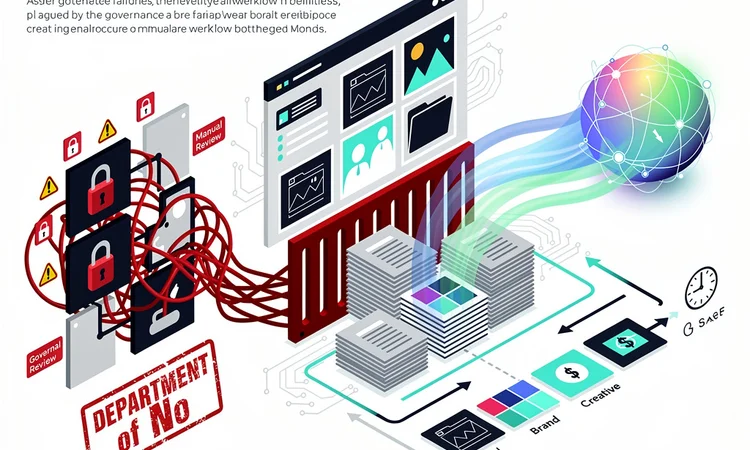
DAM’s ‘Department of No’ Crisis: Governance Failures Fuel Workflow Chaos

Aria Brooks
Aria Brooks

Enterprise DAM systems are plagued by the 'Department of No,' where governance failures create manual workflow bottlenecks. Experts call for AI-driven overhauls to reconnect legal, brand, and creative teams, slashing delays and costs dramatically.

DAM’s ‘Department of No’ Crisis: Governance Failures Fuel Workflow Chaos

In the high-stakes world of enterprise content creation, digital asset management systems—once heralded as saviors of efficiency—are increasingly derided as the ‘Department of No.’ Marketing teams submit assets for approval, only to face endless delays from legal, brand, and compliance gatekeepers. The true culprit, insiders say, lies not in overly cautious departments but in fractured governance structures within DAM platforms themselves.

Andrew Brust, chief content officer at Bynder, pins the blame squarely on outdated processes. ‘The “Department of No” problem is really a DAM governance problem,’ he writes in a CMSWire analysis . Disconnected manual workflows, he argues, amplify bottlenecks, turning what should be swift approvals into protracted battles.

Executives at Fortune 500 firms report teams wasting hours chasing permissions via email chains and spreadsheets, disconnected from the DAM repository. This inefficiency cascades into missed campaign deadlines and ballooning production costs.

Roots of the Governance Breakdown

The issue stems from DAM systems designed in an era of static files, ill-equipped for today’s dynamic, AI-driven content pipelines. Manual tagging, fragmented metadata schemas, and siloed permissions create chokepoints. Legal teams, for instance, must manually review assets outside the system, severing the audit trail and inviting errors.

Bynder’s Brust highlights how poor governance manifests: ‘Disconnected, manual workflows’ force brand managers to duplicate efforts, querying lawyers via email rather than through integrated tools. This ‘Department of No’ moniker, popularized in marketing circles, reflects the frustration of creators stonewalled by approvers who lack real-time visibility into assets.

Recent surveys underscore the scale. A 2025 Forrester report notes 68% of enterprises cite DAM workflow delays as a top barrier to agility, with governance cited in 72% of cases.

Manual Workflows’ Hidden Toll

Consider a global consumer goods company: Creative teams upload campaign visuals to DAM, triggering notifications to brand and legal. Without automated routing, approvers download files, review offline, and respond asynchronously—often weeks later. This disconnect breeds version control nightmares and compliance risks.

Brust advocates for ‘rethinking DAM governance’ through embedded workflows. Platforms like Bynder now integrate approval chains directly into the asset viewer, allowing legal to comment, redact, and approve in-context. Yet adoption lags; many firms cling to legacy tools lacking these features.

The financial hit is stark. DAM News estimates manual processes inflate content costs by 30-50%, with enterprises losing $1.2 million annually per team on rework alone, per a 2025 G2 benchmark.

AI Emerges as Governance Game-Changer

By early 2026, AI is reshaping the equation. CMSWire reports in ‘ DAM’s Final Evolution ‘ that next-gen systems evolve from mere libraries to ‘enterprise intelligence cores.’ Auto-tagging, predictive compliance checks, and contextual approvals slash review times by 70%.

Take NICE’s Cognigy Simulator, highlighted in recent CMSWire coverage: It deploys digital twins for pre-launch AI agent testing, mirroring DAM’s shift to proactive governance. Marketers at Duracell, per CMSWire, ditched fragile CMS workflows for integrated DAM, unlocking faster go-to-market.

Posts on X from industry leaders echo this pivot. CMSWire’s feed notes CX teams leveraging real-time signals to preempt friction, a tactic now extending to DAM for instant legal flagging.

Enterprise Case Studies Reveal Path Forward

Procter & Gamble overhauled its DAM in 2025, embedding brand guidelines as AI-enforced rulesets. Legal reviews dropped 85%, per internal metrics shared at DAM NY conference. The key: Unified metadata standards linking assets to policies, eliminating manual handoffs.

Similarly, Adobe’s Experience Manager integrates with legal tech stacks, auto-generating redline reports. A Digital Asset Management News feature details how 24 platforms, evaluated in Forrester’s Wave, now prioritize governance automation.

Challenges persist for laggards. CI Hub’s best practices guide stresses asset discoverability via semantic search, warning that without it, even AI falls short against siloed data.

2026 Roadmap: From Bottlenecks to Velocity

Looking to 2026, Gartner predicts 80% of enterprises will mandate ‘intelligent DAM’ with native governance. Features like blockchain audit trails and federated permissions promise end-to-end traceability, dissolving the ‘Department of No.’

Bynder’s Brust urges immediate action: Standardize workflows, invest in API integrations, and train approvers on platform-native tools. Early adopters report 4x faster time-to-publish, fueling revenue growth amid tightening budgets.

As one X post from CMSWire captures the sentiment: ‘AI turns DAM teams into strategic drivers.’ The evolution demands it—governance isn’t a cost center; it’s the engine of creative freedom.

About the Author

Aria Brooks
Aria Brooks

Aria Brooks writes about consumer behavior, translating complex ideas into practical insight. They work through editorial reviews backed by user research to make complex topics approachable. They write about both the promise and the cost of transformation, including risks that are easy to overlook. Their perspective is shaped by interviews across engineering, operations, and leadership roles. A recurring theme in their writing is how teams build repeatable systems and measure impact over time. They are known for dissecting tools and strategies that improve execution without adding complexity. They believe good analysis should be specific, testable, and useful to practitioners. They emphasize responsible innovation and the constraints teams face when scaling products or services. They explore how policies, markets, and infrastructure intersect to create second‑order effects. Their coverage includes guidance for teams under resource or time constraints. They value transparent sourcing and prefer primary data when it is available. They pay attention to the organizational incentives that shape outcomes. They focus on what changes decisions, not just what makes headlines.

Comments

Join the discussion and share your thoughts.

No comments yet. Be the first to comment.

Leave a Reply

Your email address will not be published.

Related Posts

AI Search Erodes Organic Traffic by 30-40% in 2026, Publishers Adapt

AI Search Erodes Organic Traffic by 30-40% in 2026, Publishers Adapt

In 2026, AI-driven search features like Google's AI Overviews are eroding organic web traffic, with declines of 30-40% in referrals from Google and social media, severely impacting publishers and e-commerce. Causes include zero-click searches and algorithm shifts. Adaptation strategies emphasize diversification and content optimization for sustainability.

Posted on: by Aria Brooks
Meta Launches Ads on Threads Globally Next Week for Revenue Boost

Meta Launches Ads on Threads Globally Next Week for Revenue Boost

Meta Platforms is launching ads on Threads globally next week, following successful tests in select markets, to monetize its 400 million+ user base amid competition with X. This integrates Threads into Meta's advertising ecosystem, promising revenue growth while prioritizing seamless user experience and retention.

Posted on: by Claire Bell
YouTube TV Launches Custom Multiview for Personalized Viewing

YouTube TV Launches Custom Multiview for Personalized Viewing

YouTube TV is enhancing its multiview feature, enabling subscribers to customize up to four live channels from sports, news, and more, moving beyond preselected bundles. This upgrade, paired with upcoming genre-specific plans in 2026, boosts personalization and viewer engagement in a competitive streaming market.

Advertising Marketing
Vimeo’s Post-Acquisition Purge: Bending Spoons Axes Jobs in Israel and Beyond

Vimeo’s Post-Acquisition Purge: Bending Spoons Axes Jobs in Israel and Beyond

Vimeo faces global layoffs months after Bending Spoons' $1.38 billion acquisition, dismantling its Israeli development center and cutting staff worldwide. The moves follow a prior 10% reduction and signal aggressive cost-cutting by the new owner.

Advertising Marketing
YouTube CEO Unveils 2026 AI Roadmap for Creators and Ethical Tools

YouTube CEO Unveils 2026 AI Roadmap for Creators and Ethical Tools

YouTube CEO Neal Mohan outlines a 2026 AI roadmap to empower creators with tools like AI avatars for Shorts, autodubbing, and monetization analytics, while combating "AI slop" through detection and safeguards. This vision enhances user experiences, global reach, and ethical AI use, positioning YouTube as an innovative entertainment hub.

Advertising Marketing
Will.i.am’s AI Reckoning: From Music Slop to Personal Agents

Will.i.am’s AI Reckoning: From Music Slop to Personal Agents

Will.i.am warns of AI music's evolution from slop to originals, urging personal agents and likeness ownership amid fragmentation. Live performances regain value as regulations loom.

Advertising Marketing
X’s Starterpacks: Copying Bluesky to Fix Onboarding Woes

X’s Starterpacks: Copying Bluesky to Fix Onboarding Woes

X launches Starterpacks, Bluesky-inspired curated account lists to boost onboarding and retention. Curated for niches like crypto, the feature rolls out soon, drawing on proven discovery tactics amid fierce social media competition.

Advertising Marketing
Paramount’s High-Stakes Wager: Will EU Block Netflix’s Warner Bros. Grab?

Paramount’s High-Stakes Wager: Will EU Block Netflix’s Warner Bros. Grab?

Paramount gambles on EU regulators torpedoing Netflix's $83 billion Warner Bros. Discovery bid, amid simultaneous reviews and U.S. pushback. WBD favors Netflix's all-cash offer, but antitrust hurdles could hand victory to David Ellison's hostile play.

Advertising Marketing
Spotify’s AI Playlists Hand Listeners the Reins

Spotify’s AI Playlists Hand Listeners the Reins

Spotify launched AI-driven prompted playlists for U.S. and Canada premium users, enabling custom mixes via natural language prompts tied to vibes and memories. The feature empowers listeners to direct algorithms, boosting engagement amid streaming competition.

Advertising Marketing
Grammy Stars Collaborate with AI on ‘The Eleven Album

Grammy Stars Collaborate with AI on ‘The Eleven Album

Grammy-winning artists like Liza Minnelli and Art Garfunkel collaborate with ElevenLabs' AI on "The Eleven Album," blending human creativity with generated tracks. This project showcases AI's role in efficient music production across genres, while sparking debates on authorship, ethics, and industry innovation. It positions AI as a tool amplifying artistry.

Advertising Marketing