InfoSec’s Broader Shield: Why It Outspans Cybersecurity in 2026’s Threat Surge

Liam Price
Liam Price

InfoSec broadly protects all data via the CIA triad, encompassing cybersecurity's digital focus amid AI phishing, ransomware, and skill shortages projected for 2026.

InfoSec’s Broader Shield: Why It Outspans Cybersecurity in 2026’s Threat Surge

In the high-stakes arena of data defense, information security—known as InfoSec—stands as the encompassing guardian of all data forms, digital and physical alike, while cybersecurity zeroes in on digital fortification. The National Institute of Standards and Technology (NIST) delineates InfoSec as the “protection of information and information systems from unauthorized access, use, disclosure, disruption, modification or destruction,” rendering it synonymous with IT and information systems security. Cybersecurity, by contrast, NIST frames as safeguarding “computers and electronic communications systems, including the digital information stored in these systems and devices.” This distinction sharpens as threats evolve, with Forbes Advisor noting, “Information security takes this broader view, ensuring data protection and integrity whether the information in question is stored in the cloud, on a backup disc, on paper or even in a person’s mind.”

Cybersecurity operates as a vital subset, laser-focused on repelling online incursions like malware and phishing through tools such as firewalls and intrusion detection systems. Yet InfoSec extends to physical safeguards—locked filing cabinets, surveillance, and access controls—ensuring the CIA triad’s pillars endure across mediums. As Coursera explains, InfoSec deploys “policies, processes, and controls organizations use to protect all their information from unauthorized access, alteration, or loss,” underpinning confidentiality, integrity, and availability.

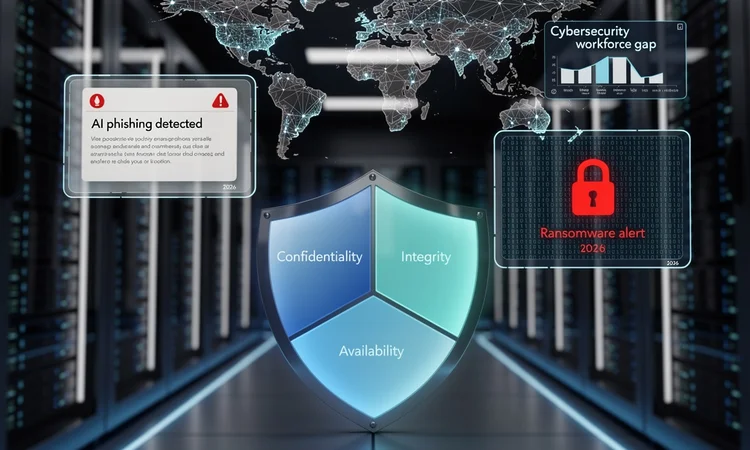
The overlap is profound: both fields wield the CIA triad as their bedrock. Confidentiality bars unauthorized eyes via encryption and access limits; integrity preserves data accuracy against tampering with checksums and signatures; availability guarantees timely access through redundancies and recovery plans. TechTarget underscores its timeless role: “Confidentiality, integrity and availability are considered the three most important concepts in infosec.”

Triad’s Enduring Pillars Under Siege

InfoSec’s breadth shines in specialized domains: cloud security shields virtual stores, network security barricades infrastructure, application security patches software flaws, physical security guards tangible assets, and incident response orchestrates breach countermeasures. Cybersecurity dovetails here but skips non-digital realms, as SecurityScorecard clarifies: “Cybersecurity focuses on protecting data found in a digital format from being compromised and attacked… Unlike cybersecurity, information security extends beyond digital concerns, addressing the security landscape in its entirety.”

Threats pierce both shields with escalating ferocity. Phishing and social engineering, now AI-enhanced for hyper-realism, snag credentials; malware and ransomware encrypt or corrupt; breaches pilfer secrets; insiders betray trust. The World Economic Forum’s Global Cybersecurity Outlook 2026 reveals CEOs pegging cyber-enabled fraud as paramount, with 73% impacted personally in 2025, while CISOs fret ransomware persistence.

AI ignites the powder keg: 94% of executives foresee it reshaping defenses, yet 87% flag AI vulnerabilities as the swiftest-rising peril. WEF notes, “AI is anticipated to be the most significant driver of change in cybersecurity in the year ahead.”

AI’s Double-Edged Onslaught

Remote work amplifies exposures—home networks lack corporate rigor—while skill voids persist, with 3.5 million global vacancies lingering into 2026 per Cybersecurity Ventures . Trend Micro’s 2026 forecast warns of “AI-fication,” where agentic AI automates ransomware reconnaissance to extortion, as researcher Numaan Huq cautions: “Vibe coding is a double-edged sword… deploying vibe-coded modules into production software… carries significant risk.” Geopolitics fuels targeted strikes, with 64% bracing for infrastructure sabotage.

Careers thrive amid demand: InfoSec analysts monitor breaches at a median $120,360 salary (BLS 2023 via Forbes ); ethical hackers probe flaws; architects blueprint defenses; compliance officers align with regs like GDPR. Cybersecurity mirrors with penetration testers and SOC analysts, but InfoSec’s governance edge suits CISOs, whose ranks hit 32,000 globally.

Tools arm the fight: firewalls repel, IDS/IPS detect/block, DLP stems leaks, SIEM correlates events. Yet as Trend Micro predicts, “Ransomware will become increasingly autonomous, using AI to automate exploitation, data analysis, and negotiation.”

Career Arenas and Tool Arsenals

Global spending surges to $522 billion in 2026 ( Cybersecurity Ventures ), yet gaps yawn: 68% lack cloud experts, 37% penetration testers. Projections show 32% U.S. analyst growth by 2032, near-zero unemployment for veterans. Women eye 30% workforce share by 2025.

InfoSec’s holistic vigilance—blending CIA across realms—positions it as indispensable amid 2026’s AI-fueled chaos, where digital alone falters. As threats morph, mastering this expanse defines resilience.


About the Author

Liam Price
Liam Price

Liam Price is a journalist who focuses on cloud infrastructure. Their approach combines long‑form narratives grounded in real‑world metrics. Readers appreciate their ability to connect strategic goals with everyday workflows. Their coverage includes guidance for teams under resource or time constraints. They emphasize responsible innovation and the constraints teams face when scaling products or services. They value transparent sourcing and prefer primary data when it is available. They write about both the promise and the cost of transformation, including risks that are easy to overlook. They maintain a balanced tone, separating speculation from evidence. They avoid buzzwords, focusing instead on outcomes, incentives, and the human side of technology. They explore how policies, markets, and infrastructure intersect to create second‑order effects. They look for overlooked details that differentiate sustainable success from short‑term wins. They believe good analysis should be specific, testable, and useful to practitioners. They tend to favor small experiments over sweeping predictions. They prefer evidence over hype and explain trade‑offs plainly.

Comments

Join the discussion and share your thoughts.

No comments yet. Be the first to comment.

Leave a Reply

Your email address will not be published.

Related Posts

Formae’s Multi-Cloud Leap: Platform Engineering Labs Arms Builders Against IaC Gridlock

Formae’s Multi-Cloud Leap: Platform Engineering Labs Arms Builders Against IaC Gridlock

Platform Engineering Labs' formae surges to multi-cloud with GCP, Azure, OCI, and OVH beta support plus a Plugin SDK, empowering infrastructure builders to extend IaC without vendor delays. This upgrade redefines extensibility in a fragmented cloud era.

Posted on: by Ivy Bailey
Sky47’s Sovereign Surge: Pakistan’s Massive AI Cloud Bet

Sky47’s Sovereign Surge: Pakistan’s Massive AI Cloud Bet

Sky47's January 2026 launch marks Pakistan's boldest sovereign cloud move, with 3,000 racks and 50MW for AI workloads. Backed by Mari Energies and Fauji Foundation, it eyes hyperscalers amid rising data sovereignty demands.

Posted on: by Zoe Patel
Cloud’s Complexity Trap: How Tool Overload and AI-Wielding Attackers Are Fracturing Security Defenses

Cloud’s Complexity Trap: How Tool Overload and AI-Wielding Attackers Are Fracturing Security Defenses

Fortinet's 2026 Cloud Security Report exposes a widening complexity gap in hybrid clouds, where tool sprawl, AI-driven attacks, and skills shortages overwhelm teams despite rising budgets. Nearly 70% cite fragmentation as the top barrier, urging platform shifts and MSSP aid.

IT Management
NordVPN’s Sixth Consecutive Audit Validates Zero-Logs Promise as Privacy Scrutiny Intensifies

NordVPN’s Sixth Consecutive Audit Validates Zero-Logs Promise as Privacy Scrutiny Intensifies

NordVPN completes its sixth consecutive independent audit by Deloitte, confirming its zero-logs policy amid intensifying privacy scrutiny. The verification highlights industry trends toward verifiable transparency as regulatory pressure mounts and consumer skepticism grows regarding VPN privacy claims.

IT Management
Upwind’s Runtime Revolution: $250M Fuels $1.5B Cloud Security Unicorn

Upwind’s Runtime Revolution: $250M Fuels $1.5B Cloud Security Unicorn

Upwind's $250 million Series B catapults it to $1.5 billion valuation, powering runtime-first cloud security amid 900% revenue surge. Backed by Bessemer and all-stars, the ex-Spot.io team targets AI-era threats for giants like Siemens and Roku.

IT Management
Mesh Security’s $12M Bet: Unifying Cyber Chaos into Enterprise Powerhouse

Mesh Security’s $12M Bet: Unifying Cyber Chaos into Enterprise Powerhouse

Mesh Security's $12M Series A funds its CSMA platform to unify enterprise cyber tools across clouds and SaaS, eliminating silos agentlessly. Backed by Lobby Capital and SentinelOne's CVC, it gains traction with Paychex and Nutanix amid tool sprawl crisis.

IT Management
Abstract Security and Netskope Forge Real-Time Threat Pipeline, Slicing Through Data Delays

Abstract Security and Netskope Forge Real-Time Threat Pipeline, Slicing Through Data Delays

Abstract Security and Netskope's new partnership embeds real-time detection into security data streams, eliminating indexing delays and slashing costs for joint customers. By processing Netskope telemetry in motion, it boosts threat response while preserving data control.

IT Management
Nationwide’s AI Fortress: AWS Bolsters Fraud Defenses for 17 Million Clients

Nationwide’s AI Fortress: AWS Bolsters Fraud Defenses for 17 Million Clients

Nationwide Building Society expands its AWS partnership to deploy AI-driven cloud security and fraud prevention, powering tools like Call Checker against impersonation scams affecting 17% of incidents. Workforce training boosts cloud literacy for enhanced service to 17 million customers.

IT Management
CISOs’ Hidden Roadblocks: Why 58% See Their Firms Unready for Cyber Onslaught

CISOs’ Hidden Roadblocks: Why 58% See Their Firms Unready for Cyber Onslaught

Despite rising budgets, 58% of CISOs deem their organizations unready for cyberattacks, hindered by team overload, AI gaps, talent shortages, and tool sprawl. Experts urge prioritization training, governance, and resilience focus.

IT Management
Security Chiefs Gear Up for AI Agents and Poly-Threats in 2026

Security Chiefs Gear Up for AI Agents and Poly-Threats in 2026

Security leaders brace for 2026's AI agents, poly-threats, and quantum risks, shifting from reactive defenses to governance, identity controls, and resilient architectures amid record attacks and regulatory mandates.

IT Management