
Lowe’s Gambit: Kids’ Events and Loyalty Perks Target Delayed Homebuyers

Leo Rossi
Leo Rossi

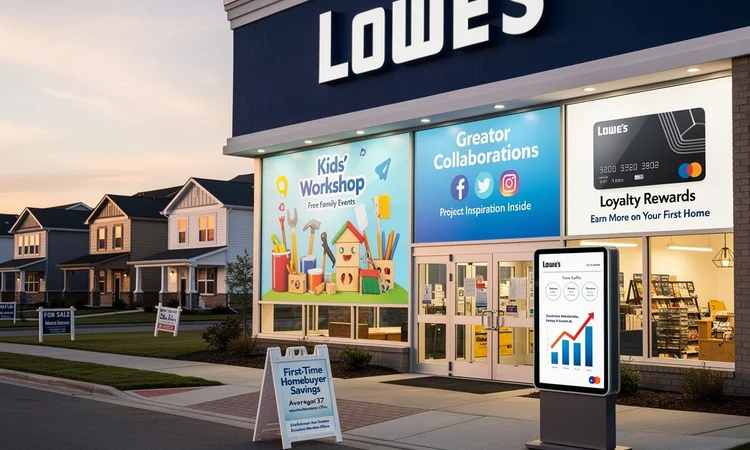
Lowe’s counters delayed U.S. homebuying with kids’ events, influencer collaborations, and a revamped loyalty program to drive traffic and sales in a sluggish market. Targeting families averaging 37 years old for first homes, the retailer aims for growth amid housing slowdown.

Lowe’s Gambit: Kids’ Events and Loyalty Perks Target Delayed Homebuyers

As Americans push home purchases into their late 30s and beyond, Lowe’s Cos. is pivoting to family-oriented tactics to lure customers into stores and onto its app. The home-improvement giant, facing a sluggish housing market, is rolling out kids’ events and an enhanced loyalty program to boost foot traffic and spending amid postponed renovations.

Chief Executive Marvin Ellison highlighted the shift during a recent earnings call, noting that first-time homebuyers now average 37 years old, up from 29 two decades ago. “People are buying homes later in life, which means they have kids and different needs,” Ellison said, according to CNBC . Lowe’s strategy aims to capture these families by turning stores into community hubs.

Kids’ Clinics Drive Family Visits

Starting this spring, Lowe’s will host free monthly kids’ workshops, dubbed “Little Builders,” featuring hands-on projects like birdhouses and planters. These events, held in over 1,700 stores, target parents juggling child-rearing and home projects. “We’re seeing families delay big purchases but still need small fixes,” said Lowe’s marketing executive Jen Wilson in a recent interview. The initiative builds on past successes, where similar clinics drew 500,000 participants annually pre-pandemic.

Attendance data from 2025 shows a 20% uptick in family visits during event weekends, correlating with higher basket sizes. Lowe’s plans to integrate digital tie-ins, like app check-ins for exclusive coupons, to convert one-time visitors into regulars. This mirrors broader retail trends where experiential marketing combats e-commerce dominance.

Influencer Partnerships Amplify Reach

To engage younger parents scrolling social media, Lowe’s is expanding its creator network with influencers focusing on “later-life nesting.” Partnerships with family vloggers and millennial renovators, such as those in the “House of Curators” program, showcase kid-friendly upgrades. A recent campaign featuring actor Milo Ventimiglia drove a 15% sales lift in featured products, per internal metrics cited in Marketing Dive .

Gen Alpha parents, entering peak spending years, prioritize authenticity, prompting Lowe’s to allocate 25% of its 2026 marketing budget to TikTok and Instagram Reels. Posts found on X from Lowe’s official account emphasize backyard transformations and homegating ideas, resonating with delayed buyers seeking affordable updates. “Influencers help us reach shoppers where they dream about their homes,” Wilson added.

Loyalty Overhaul Rewards Patience

Lowe’s MyLowe’s loyalty program, revamped in late 2025, now offers tiered perks like free kids’ event priority access and personalized project recommendations powered by AI. Members earn 5% back on purchases, with pros getting contractor-specific tools. Enrollment hit 80 million in 2025, up 12% year-over-year, as reported by CX Dive .

The program’s AI engine analyzes purchase history to suggest family-focused bundles, such as playground kits bundled with loyalty points. Amid housing stagnation—existing home sales down 5% in 2025 per National Association of Realtors—Lowe’s expects loyalty to drive 10% of incremental sales. Free offers, including delivery waivers, rolled out in January 2026 to counter spending pullbacks, per TheStreet .

Total Home Strategy Anchors Expansion

Unveiled at the 2024 Investor Day, Lowe’s “2025 Total Home Strategy” underpins these moves, targeting $3 billion in synergies through pro-segment growth and digital tools. The plan includes 150 new stores by 2028 and AI-driven inventory, as detailed in Lowe’s Corporate . For later homebuyers, it emphasizes modular upgrades suited to multi-generational living.

Competitor Home Depot faces similar headwinds, but Lowe’s differentiates with family-centric events. Recent X sentiment around Lowe’s kids’ initiatives shows positive buzz, with users praising community engagement. Ellison projects 4-6% comparable sales growth in 2026, banking on these tactics to outpace the industry’s 2% forecast.

Pro Segment and Tech Integration

Beyond consumers, Lowe’s is doubling down on pros via the reimagined loyalty program, offering bulk pricing and job-site delivery. At Investor Day, executives touted generative AI for custom quotes, reducing bid times by 40%. This appeals to contractors serving older first-time buyers with complex reno needs.

Market data from Hardware Retailing indicates Lowe’s pro sales grew 8% in 2025, outstripping DIY by double digits. Integration with events includes pro-led demos at kids’ clinics, fostering leads among attending parents who own small businesses.

Navigating Market Headwinds

U.S. housing starts fell 3% in 2025, per Census Bureau, as high rates deter early buyers. Lowe’s counters with micro-projects promoted via influencers, like $200 backyard makeovers shared on X. CNBC reports these efforts aim for 2 million additional store visits quarterly.

Financially, Lowe’s posted 2025 revenue of $86.4 billion, flat year-over-year, but margins expanded to 9.1% via cost controls. Analysts at JPMorgan forecast earnings per share of $13.50 in 2026, crediting loyalty and events. Rivals like Home Depot grapple with a new entrant in the space, as noted by TheStreet .

Measuring Success Metrics

Lowe’s tracks event ROI via net promoter scores, averaging 75 for kids’ clinics, and app downloads spiking 30% post-promotion. Social-first pushes, including Gen Alpha holiday campaigns, yielded 2.5x engagement rates, per Marketing Dive. X posts from Lowe’s highlight real customer stories, amplifying organic reach.

Long-term, the strategy aligns with demographic shifts: Census data shows median first-time buyer age at 38 in 2025. By blending events, influencers, and loyalty, Lowe’s positions as the family home-improvement destination, potentially capturing 1% market share gain.

About the Author

Leo Rossi
Leo Rossi

Known for clear analysis, Leo Rossi follows developer productivity and the people building it. Their approach combines editorial reviews backed by user research. They frequently translate research into action for founders and operators, prioritizing clarity over buzzwords. They value transparent sourcing and prefer primary data when it is available. They explore how policies, markets, and infrastructure intersect to create second‑order effects. They often cover how organizations respond to change, from process redesign to technology adoption. Readers appreciate their ability to connect strategic goals with everyday workflows. They believe good analysis should be specific, testable, and useful to practitioners. Their perspective is shaped by interviews across engineering, operations, and leadership roles. They write about both the promise and the cost of transformation, including risks that are easy to overlook. Their reporting blends qualitative insight with data, highlighting what actually changes decision‑making. They tend to favor small experiments over sweeping predictions. Readers return for the clarity, the caution, and the actionable takeaways.

Comments

Join the discussion and share your thoughts.

No comments yet. Be the first to comment.

Leave a Reply

Your email address will not be published.

Related Posts

US Lawmakers Strip Right-to-Repair from 2026 NDAA, Boosting Defense Contractors

US Lawmakers Strip Right-to-Repair from 2026 NDAA, Boosting Defense Contractors

U.S. lawmakers removed right-to-repair provisions from the 2026 NDAA, preventing military personnel from independently fixing equipment and preserving defense contractors' lucrative service contracts. Critics decry industry influence, citing potential cost savings and improved readiness. This setback fuels ongoing advocacy for repair reforms in military and civilian sectors.

Posted on: by Jack Chen
Amazon Prime Air Struggles: Drone Incidents, Regulations, and Rivals

Amazon Prime Air Struggles: Drone Incidents, Regulations, and Rivals

Amazon's Prime Air drone delivery program, launched in 2013, faces setbacks including a 2025 Texas incident where a drone clipped a cable, triggering FAA scrutiny, regulatory hurdles, and technical glitches. Trailing rivals like Walmart and Zipline, Amazon is pivoting strategies amid fierce competition. Recovery hinges on innovations and safer operations.

Posted on: by Grace Wright
DOJ’s Appeal in Google Antitrust Case Signals Protracted Legal Battle Over Search Monopoly Remedies

DOJ’s Appeal in Google Antitrust Case Signals Protracted Legal Battle Over Search Monopoly Remedies

The DOJ and state attorneys general have appealed Judge Mehta's Google antitrust remedies ruling, challenging the decision to reject structural breakups including Chrome divestiture. The appeal argues behavioral restrictions are insufficient to dismantle Google's search monopoly, setting up a multi-year legal battle.

Retail Ecommerce
Google Launches Doppl: AI Virtual Try-Ons Transform Online Shopping

Google Launches Doppl: AI Virtual Try-Ons Transform Online Shopping

Google has launched Doppl, an AI-powered app enabling virtual clothing try-ons with personalized, dynamic models to reduce online shopping uncertainties and returns. Amid expanding AI shopping tools like agentic checkout, it faces regulatory scrutiny over data practices, yet promises to revolutionize e-commerce personalization and consumer behavior.

Retail Ecommerce
Microsoft 365 Prices to Rise Up to 33% in 2026 Amid AI and Security Upgrades

Microsoft 365 Prices to Rise Up to 33% in 2026 Amid AI and Security Upgrades

Microsoft is raising Microsoft 365 prices by up to 33% starting July 1, 2026, for commercial, frontline, and government users, driven by AI enhancements like Copilot and improved security features. This first major hike since 2022 aims to fund innovations amid cyber threats, though it sparks mixed reactions on affordability.

Retail Ecommerce
EU Court Upholds Intel Antitrust Ruling, Slashes Fine to €237M

EU Court Upholds Intel Antitrust Ruling, Slashes Fine to €237M

Europe's General Court upheld Intel's antitrust violation for using rebates and payments to exclude rivals like AMD in the chip market, but slashed the fine from €376 million to €237 million. This ruling, part of a decades-long saga, highlights evolving EU antitrust standards amid Intel's competitive challenges.

Retail Ecommerce
MasterClass 2025 Holiday Deal: 40% Off Annual Subscriptions

MasterClass 2025 Holiday Deal: 40% Off Annual Subscriptions

MasterClass's 2025 holiday promotion offers 40% off annual subscriptions, reducing Standard to $72, Plus to $108, and Premium to $144, including gifts. This strategy enhances accessibility to celebrity-led courses amid market competition. It boosts subscriber growth and democratizes elite education during economic uncertainties.

Retail Ecommerce
NYC’s 2025 Congestion Pricing Slashes Traffic 11%, Pollution 22% in Manhattan

NYC’s 2025 Congestion Pricing Slashes Traffic 11%, Pollution 22% in Manhattan

New York City's 2025 congestion pricing in Manhattan charges drivers to enter south of 60th Street, reducing traffic by 11% and PM2.5 pollution by 22%. This has improved air quality citywide, cut noise and accidents, funded transit upgrades, and serves as a model for urban sustainability.

Retail Ecommerce
2025 RAM Prices Skyrocket Amid AI-Driven Shortages

2025 RAM Prices Skyrocket Amid AI-Driven Shortages

In 2025, RAM prices have skyrocketed due to explosive AI demand for high-bandwidth memory in data centers, causing shortages and doubling or tripling costs for consumer DDR5 and DDR4 modules. This crisis disrupts PC building, smartphones, and industries, with experts forecasting prolonged volatility through 2027-2028 as production lags behind.

Retail Ecommerce
Nvidia Pilots AI Chip Tracking Software to Curb Smuggling to China

Nvidia Pilots AI Chip Tracking Software to Curb Smuggling to China

Nvidia is piloting software that uses telemetry data to track the locations of its AI chips, like the Blackwell series, to combat smuggling into restricted markets such as China amid US export bans. This initiative addresses geopolitical tensions and black-market operations, enhancing compliance without hardware changes.

Retail Ecommerce