
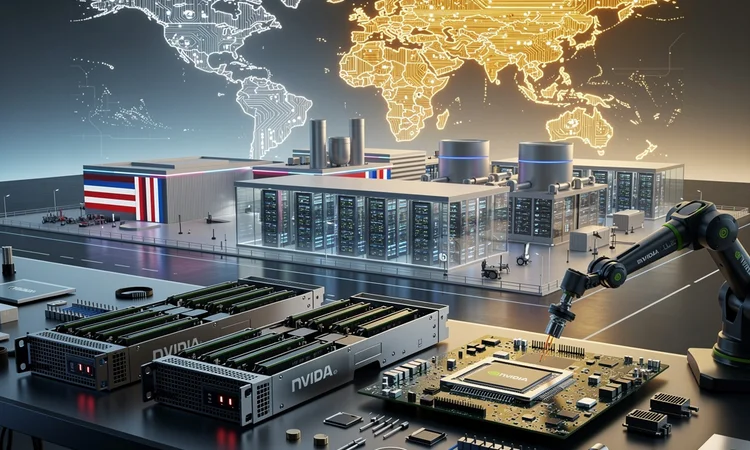
In a recent address that has sent ripples through the tech and manufacturing sectors, Nvidia Corp. CEO Jensen Huang delivered a stark critique of America’s decades-long offshoring practices, labeling them a “great disservice” to the nation. Speaking at a high-profile event, Huang emphasized the urgent need to repatriate manufacturing jobs, leveraging the explosive growth of artificial intelligence infrastructure as a catalyst. His comments come at a pivotal moment when the U.S. is grappling with economic inequality, supply chain vulnerabilities, and the geopolitical tensions surrounding advanced technology production.
Huang’s remarks, detailed in a report by Barchart , highlight how offshoring has hollowed out the American middle class, particularly in manufacturing—the largest segment of the economy. “We’ve done our country a great disservice by offshoring,” Huang stated, pointing to the loss of prosperous jobs that once supported communities without requiring advanced degrees. He argues that the current AI industrial revolution presents a unique “flashpoint” to reverse this trend, potentially creating widespread prosperity that extends beyond elite PhD holders to everyday workers.
The Nvidia chief’s vision is not merely rhetorical; it’s backed by substantial commitments. Through partnerships, Nvidia is spearheading the buildout of at least $500 billion in AI infrastructure during the current presidential term, aiming to position the U.S. as the global hub for AI manufacturing. This initiative, as Huang describes, involves using Nvidia’s central role in the AI ecosystem to ensure that data centers, chip fabrication, and related industries are domiciled stateside, fostering job creation across skill levels.
The AI Boom as a Reshoring Engine
Huang’s push aligns with broader industry shifts, where AI’s voracious demand for computing power is driving massive investments in domestic facilities. Recent news from FinancialContent echoes this, noting how governments must respond to AI-driven structural changes by bolstering energy supplies and industrial capacity rather than relying solely on regulations. Huang’s strategy focuses on eliminating inefficiencies in the supply chain, such as margin stacking by overseas manufacturers, to make U.S.-based production competitive.
Industry insiders see this as a direct response to past policy failures. For over two decades, offshoring to low-cost regions like Asia has eroded America’s manufacturing base, leading to job losses and economic disparities. Huang’s comments underscore a growing consensus that AI could be the lever to pull manufacturing back home. Posts on X (formerly Twitter) reflect public sentiment, with users highlighting Nvidia’s loss of market share in China due to U.S. export controls, which has inadvertently spurred domestic innovation elsewhere but left American firms scrambling.
Moreover, Huang’s emphasis on “creating prosperity for all” challenges the tech industry’s elitist tendencies. He advocates for inclusive growth, where AI infrastructure projects generate roles for welders, electricians, and assembly line workers alongside engineers. This approach could address the skills gap, providing pathways for non-college-educated Americans to thrive in a high-tech economy.
Geopolitical Undercurrents and Export Challenges
The backdrop to Huang’s statements includes escalating U.S.-China tensions over technology. As reported in Yahoo Finance , Nvidia has been hit hard by export restrictions, plummeting from 95% market share in China to zero. Huang has publicly questioned the wisdom of such policies, suggesting they fuel competitors’ determination rather than securing U.S. dominance. X posts from users like tech analysts amplify this, noting how local Chinese firms are gaining ground with government backing, potentially eroding Nvidia’s global edge.
Huang’s advocacy for reshoring also ties into national security concerns. By building AI infrastructure domestically, the U.S. can safeguard critical technologies from foreign dependencies. This resonates with recent developments, such as Nvidia’s collaborations on massive data centers that require robust power grids and skilled labor—all elements that Huang insists must be cultivated at home to avoid repeating offshoring mistakes.
Critics, however, question the feasibility. Bringing back manufacturing involves overcoming hurdles like higher labor costs and regulatory burdens. Yet Huang points to the AI sector’s scale: with trillions in potential investments, the economic incentives could outweigh these challenges. He envisions a model where Nvidia’s leverage ensures partners prioritize U.S. sites, creating a virtuous cycle of innovation and employment.
Nvidia’s Broader Strategy Amid Competition
Looking ahead, Huang’s comments preview Nvidia’s role in the evolving tech arena. At the upcoming CES 2026 keynote, as previewed by Benzinga , he is expected to unveil next-generation GPUs and AI advancements that could further solidify U.S. leadership. This event, set for January 5, 2026, will likely elaborate on how these technologies enable reshoring, with live streams available for global audiences.
Nvidia’s strategy extends beyond hardware. Huang has emphasized focusing on “problems that cannot be solved today,” as quoted in The Economic Times , fostering long-term innovation. This mindset drives investments in robotics and automation, which could automate routine tasks while creating higher-value jobs in design and oversight—aligning with his prosperity-for-all ethos.
Competition is mounting, with rivals like AMD and emerging players in Asia challenging Nvidia’s dominance. Huang’s reshoring push may serve as a defensive maneuver, ensuring supply chain resilience. X discussions reveal skepticism, with some users accusing Nvidia of hyping AI to sustain revenues amid softening demand from regions like China.
Economic Implications for Workers and Communities
The potential impact on American workers is profound. Huang’s vision could revitalize rust-belt towns by establishing AI factories that demand a diverse workforce. Unlike traditional tech jobs concentrated in coastal hubs, these facilities could distribute economic benefits nationwide, reducing urban-rural divides.
Education and training will be key. Huang advocates for programs that equip non-PhDs with skills in AI-related manufacturing, such as operating advanced machinery or maintaining data centers. This contrasts with offshoring’s legacy, which displaced millions without retraining, leading to social unrest.
Economists note that successful reshoring could boost GDP by trillions, per projections tied to AI growth. However, it requires policy support, including incentives for domestic investment and infrastructure upgrades. Huang’s call echoes sentiments in Inkl , stressing the opportunity to build inclusive prosperity through AI.
Global Ramifications and Strategic Alliances
Internationally, Huang’s stance influences alliances. Nvidia’s deepening ties with Taiwan, as detailed in Igor’s Lab , underscore strategic shifts amid U.S. export curbs. By embracing partners like TSMC while pushing for U.S. manufacturing, Nvidia navigates a complex web of dependencies.
This dual approach mitigates risks from geopolitical hotspots. Huang’s recent visits and “trillion-dollar dinners” signal commitments to secure supply chains, potentially blending Taiwanese expertise with American scale.
Critics on X argue that such moves could exacerbate tensions, but supporters see it as pragmatic leadership. Ultimately, Huang’s framework positions Nvidia as a bridge between innovation and equitable growth.
Industry Responses and Future Trajectories
Reactions from peers vary. Some executives applaud Huang’s boldness, viewing it as a blueprint for the sector. Others caution that without government buy-in, reshoring efforts may falter.
Looking forward, the CES 2026 presentation, as outlined in Wccftech , could reveal specifics on how Nvidia plans to integrate reshoring into its roadmap, including updates on RTX GPUs and AI chips.
Huang’s philosophy, rooted in his immigrant success story, emphasizes grit and vision. As he told the House Foreign Affairs Committee, per X sentiments, America must lead in AI or risk retreat. This drive could redefine not just Nvidia, but the entire U.S. economy.
Challenges Ahead in Implementation
Implementing this vision faces obstacles, including energy demands for AI data centers. Huang stresses building domestic capacity to meet these needs sustainably.
Labor unions and policymakers are watching closely, pushing for protections to ensure new jobs offer fair wages and stability.
Despite hurdles, the momentum is building. With AI’s transformative potential, Huang’s call to action could mark a turning point, fostering an era where technological advancement benefits all strata of society, healing the wounds of offshoring and paving the way for renewed American prosperity.


Leave a Reply
Your email address will not be published.