
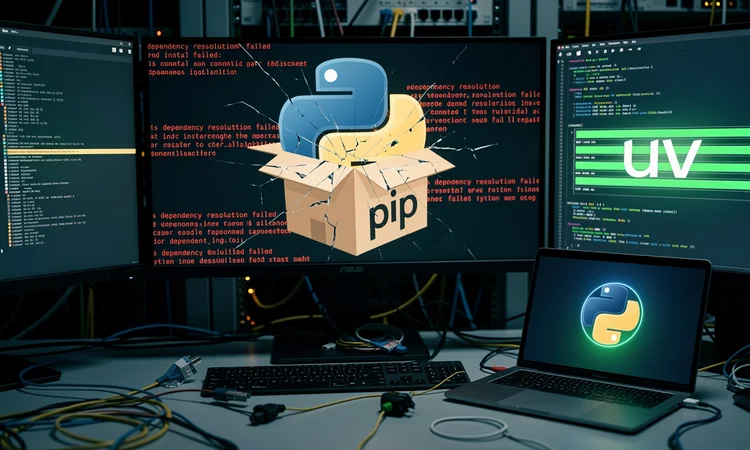
The Python programming community is experiencing a seismic shift in how developers manage dependencies and package installations, with growing frustration over traditional tools like pip driving mass adoption of alternative solutions. What began as isolated complaints on forums has evolved into a full-scale reconsideration of Python’s packaging infrastructure, threatening the dominance of tools that have been industry standards for over a decade.
According to discussions on Reddit’s Python community , developers are increasingly vocal about pip’s performance limitations and reliability issues in production environments. The conversation reveals a pattern of experienced engineers abandoning pip in favor of newer tools like uv, developed by Astral, which promises installation speeds up to 100 times faster than traditional package managers. This exodus represents more than mere preference—it signals fundamental problems with Python’s dependency management ecosystem that have accumulated over years of incremental patches rather than comprehensive solutions.
The frustration extends beyond speed concerns. Developers report that pip’s dependency resolution mechanism frequently fails to handle complex package trees, leading to version conflicts that can take hours to debug. In enterprise environments where time translates directly to cost, these inefficiencies have become untenable. One senior developer noted in the Reddit thread that their team wasted approximately 40 hours per quarter troubleshooting pip-related issues alone, prompting a company-wide mandate to explore alternatives.
The Performance Gap That Changed Everything
The emergence of uv has fundamentally altered expectations for what Python package management should deliver. Built in Rust rather than Python itself, uv leverages modern programming paradigms to achieve performance metrics that seemed impossible just two years ago. Benchmarks shared across developer communities demonstrate that uv can install a typical data science stack—including NumPy, pandas, and scikit-learn—in under 10 seconds, compared to pip’s average of 3-5 minutes for the same operation.
This performance differential becomes even more pronounced in continuous integration and deployment pipelines, where package installation occurs dozens or hundreds of times daily. DevOps teams have reported that switching to uv reduced their CI/CD pipeline execution times by 60-70%, translating to significant cost savings on cloud computing resources. The economic argument for migration has become so compelling that even organizations with substantial investments in pip-based tooling are reconsidering their infrastructure.
Dependency Resolution: The Achilles Heel of Traditional Tools
Beyond raw speed, the quality of dependency resolution has emerged as a critical differentiator. Python’s packaging ecosystem has long struggled with what developers call “dependency hell”—situations where different packages require incompatible versions of shared dependencies. Pip’s resolver, while improved in recent versions, still employs a backtracking algorithm that can take exponentially longer as dependency trees grow more complex.
Modern alternatives approach this problem differently. Tools like uv and Poetry implement more sophisticated constraint solving algorithms borrowed from the operations research field, treating dependency resolution as an optimization problem rather than a search problem. This architectural difference means these tools can often find valid solutions in seconds where pip would fail or require manual intervention. For machine learning engineers working with frameworks like TensorFlow or PyTorch—which have notoriously complex dependency requirements—this improvement alone justifies the switch.
The Security Implications of Package Management Evolution
Security considerations have also driven the migration away from traditional tools. The Python Package Index (PyPI) has experienced several high-profile incidents involving malicious packages, and pip’s architecture provides limited protection against supply chain attacks. Newer tools incorporate features like lockfile generation by default, ensuring that installations are reproducible and auditable—critical requirements for organizations subject to compliance regulations.
The lockfile approach, standard in ecosystems like Node.js and Rust for years, creates a cryptographic record of exact package versions and their checksums. This means that if a package is compromised after initial installation, the lockfile prevents automatic updates to the malicious version. Pip only recently added experimental support for this functionality, while tools like uv and Poetry have made it central to their design philosophy from inception.
Corporate Adoption Accelerates Despite Ecosystem Fragmentation
Major technology companies have begun standardizing on alternative package managers for new projects, though legacy systems remain on pip due to migration costs. This bifurcation has created an unusual situation where the Python ecosystem now supports multiple incompatible approaches to the same fundamental problem. While some view this as healthy competition driving innovation, others worry about fragmentation that could confuse newcomers and complicate educational resources.
The Python Software Foundation has acknowledged these concerns but maintains that pip remains the recommended tool for most users. However, the foundation’s own surveys show declining satisfaction with packaging tools, with only 58% of respondents in their most recent developer survey expressing satisfaction with dependency management—down from 72% three years ago. This erosion of confidence has prompted discussions about whether Python needs a more fundamental rethinking of its packaging architecture.
The Virtual Environment Debate Intensifies
Compounding the packaging tool debate is growing dissatisfaction with Python’s virtual environment system. Tools like venv and virtualenv, while solving the problem of project isolation, add complexity that developers in other languages don’t face. The need to activate and deactivate environments, remember which environment is active, and manage multiple Python versions has led some developers to describe Python’s workflow as “stuck in 2010.”
Newer tools attempt to abstract away these complexities. Uv, for instance, can automatically detect and use project-specific environments without explicit activation, similar to how Node.js handles node_modules directories. This “it just works” philosophy resonates particularly with developers coming from other ecosystems who find Python’s manual environment management archaic. The Reddit discussion highlighted numerous cases where junior developers spent their first week simply learning environment management rather than writing code.
Performance Benchmarks Tell a Compelling Story
Quantitative comparisons between package managers reveal stark differences that go beyond anecdotal evidence. Independent benchmarks show that for a typical web application with 50 dependencies, pip requires approximately 90 seconds for a clean install, while uv completes the same operation in under 2 seconds. For data science projects with heavier dependencies, the gap widens further—pip installations that take 5-7 minutes can complete in 15-20 seconds with uv.
These metrics have real-world implications for developer productivity. A team of 20 engineers performing 5 package installations daily would collectively save approximately 120 hours monthly by switching from pip to uv—equivalent to three full-time employees’ worth of time. When multiplied across an organization with hundreds or thousands of developers, the productivity gains become impossible to ignore. Financial services firms and technology giants have cited these numbers in internal memos advocating for tool migrations.
Compatibility Concerns and Migration Challenges
Despite the compelling advantages, migration from pip to alternative tools isn’t without friction. Many organizations have built extensive tooling around pip’s command-line interface and behavior, from deployment scripts to monitoring systems. These dependencies create switching costs that can outweigh performance benefits, particularly for mature products with established deployment pipelines.
Additionally, some packages on PyPI include installation scripts that assume pip’s specific behavior, potentially breaking when installed with alternative tools. While compatibility has improved significantly—uv now successfully installs over 99% of PyPI packages—edge cases remain. Organizations must weigh the risk of encountering these edge cases against the benefits of improved performance and reliability. For startups and new projects, the choice is straightforward; for enterprises with decades of Python code, the calculation is more complex.
The Future of Python Packaging Infrastructure
The current ferment in Python’s packaging ecosystem represents both crisis and opportunity. The emergence of high-performance alternatives has exposed limitations in traditional tools that the community can no longer ignore. However, it has also sparked innovation and competition that may ultimately benefit all users, regardless of which tools they choose.
Industry observers predict that within two years, the majority of new Python projects will use something other than pip as their primary package manager. Whether pip can evolve quickly enough to retain relevance remains an open question. The Python Software Foundation has indicated that major architectural changes to pip are under consideration, but implementation timelines remain uncertain. Meanwhile, tools like uv continue to gain market share and mindshare, particularly among developers who prioritize performance and modern workflows.
The packaging debate also reflects broader questions about Python’s evolution as a language. As Python has grown from a scripting language to a primary tool for web development, data science, and machine learning, its tooling has struggled to keep pace with enterprise requirements. The packaging crisis may ultimately force a reckoning about whether Python’s philosophy of simplicity and backwards compatibility can coexist with the demands of modern software engineering at scale. How the community resolves this tension will shape Python’s trajectory for the next decade.





Leave a Reply
Your email address will not be published.