
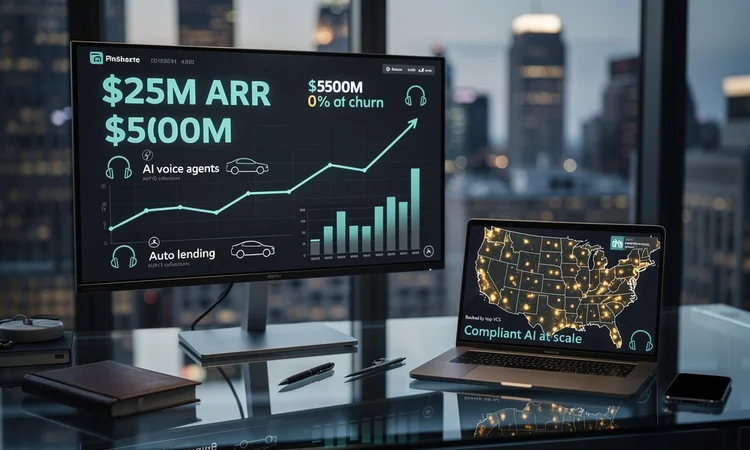
Salient’s AI Collections Surge: $25M ARR, Zero Churn in Two Years

Leo Rossi
Leo Rossi

Salient's AI voice agents have driven $25M ARR and $500M valuation in two years with zero customer churn, revolutionizing loan collections for auto lenders. Backed by top VCs, the startup proves compliant AI can thrive amid sector turbulence.

Salient’s AI Collections Surge: $25M ARR, Zero Churn in Two Years

In the cutthroat world of loan servicing, where customer attrition often exceeds 20% annually, Salient has engineered a rare feat: perfect retention since its 2023 founding. The San Francisco-based startup, which deploys AI voice agents to handle collections calls for auto lenders, has rocketed to $25 million in annual recurring revenue while maintaining every client. Cofounder Ari Malik’s bet on compliant automation is now valued at around $500 million, following a fresh $10 million raise on top of a $60 million Series A in July.

Salient’s ascent comes amid investor fatigue with AI hype, yet its metrics stand out. Backed by Fortune ‘s reporting, the company grew ARR from zero to $25 million in under two years without losing a single customer—a stark contrast to industry norms plagued by integration failures and compliance pitfalls. Investors including Andreessen Horowitz and Matrix Partners see Salient as a survivor in a field littered with overpromised startups.

From Y Combinator to AI Voice Pioneer

Launched via Y Combinator’s Winter 2023 batch, Salient targeted a mundane but massive pain point: the labor-intensive process of loan collections. Traditional call centers for auto finance firms, which manage billions in delinquent payments, suffer from high agent turnover and regulatory scrutiny. Salient’s platform uses AI agents that conduct natural-sounding phone conversations, negotiating payments while adhering to rules like the Fair Debt Collection Practices Act.

Ari Malik, who previously built tech at Stripe and Affirm, teamed with Mukund Tibrewala to focus on voice AI’s edge in empathy and persistence. As detailed on Y Combinator’s site , the 40-person team now serves major auto lenders, automating what Fortune describes as ‘the drudgery of collections calls into a high-growth business.’

Funding Momentum Builds Amid AI Skepticism

The $60 million Series A, led by Andreessen Horowitz with participation from Matrix Partners, Michael Ovitz, and Y Combinator, valued Salient at over $400 million post-money in July, per Pulse 2.0 . A subsequent $10 million extension, reported by Fortune, lifted the figure to roughly $500 million, fueling platform expansion as demand surges from lenders facing rising delinquencies.

This capital arrives as broader AI valuations cool, but Salient’s traction—$25 million ARR with 100% net retention—validates the model. Fintech Global notes the raise will scale automation tools, transforming how lenders manage compliance and borrower outreach without human agents.

Zero Churn in a High-Turnover Sector

Loan servicing providers typically battle 15-25% annual churn due to poor performance or integration woes, yet Salient reports none. WebProNews highlights this in a December 18 piece, attributing it to AI agents that outperform humans in recovery rates while ensuring compliance. Customers, primarily subprime auto lenders, stick because Salient boosts cash flow: agents make thousands of calls daily, securing payments faster than scripted humans.

The startup’s edge lies in proprietary voice models trained on lending data, handling objections like ‘I’m unemployed’ with tailored responses. As WebProNews explains, this has created a moat amid industry consolidation, with Salient now processing millions in collections volume monthly.

Technical Backbone Powers Compliance and Scale

Salient’s agents integrate with lender CRMs, pulling real-time account data to personalize calls. Unlike generalist AI like those from OpenAI, Salient’s are fine-tuned for finance regs, logging every interaction for audits. Crunchbase profiles confirm its focus on consumer finance and auto lending, with recent hires in engineering to handle surging compute needs.

Posts on X, including from Fortune’s Alyson Shontell ( here ), amplify the buzz, linking to the ARR milestone. Industry insiders whisper of pilots with top-tier banks, signaling expansion beyond auto into personal loans.

Challenges Ahead: Regulation and Competition

Regulatory headwinds loom as U.S. agencies scrutinize AI in finance. Salient counters with built-in safeguards, but scaling voice AI demands vast datasets, raising privacy concerns. Competitors like TrueAccord use similar tech, yet Salient’s retention suggests superior execution.

Fortune quotes Malik emphasizing profitability over growth-at-all-costs, a nod to bubble-proofing. With $70 million total raised and ARR tripling yearly, Salient eyes $100 million by 2026, per investor projections.

Broader Implications for Fintech AI

Salient’s run underscores AI’s shift from hype to revenue in verticals like lending. As delinquencies climb—U.S. auto loan defaults hit 4% this year—lenders crave tools like Salient’s, which Fortune says turned collections into a $500 million-valued engine. Its formula: deep domain focus, flawless retention, and metrics-first growth.

About the Author

Leo Rossi
Leo Rossi

Known for clear analysis, Leo Rossi follows developer productivity and the people building it. Their approach combines editorial reviews backed by user research. They frequently translate research into action for founders and operators, prioritizing clarity over buzzwords. They value transparent sourcing and prefer primary data when it is available. They explore how policies, markets, and infrastructure intersect to create second‑order effects. They often cover how organizations respond to change, from process redesign to technology adoption. Readers appreciate their ability to connect strategic goals with everyday workflows. They believe good analysis should be specific, testable, and useful to practitioners. Their perspective is shaped by interviews across engineering, operations, and leadership roles. They write about both the promise and the cost of transformation, including risks that are easy to overlook. Their reporting blends qualitative insight with data, highlighting what actually changes decision‑making. They tend to favor small experiments over sweeping predictions. Readers return for the clarity, the caution, and the actionable takeaways.

Comments

Join the discussion and share your thoughts.

No comments yet. Be the first to comment.

Leave a Reply

Your email address will not be published.

Related Posts

US Lawmakers Strip Right-to-Repair from 2026 NDAA, Boosting Defense Contractors

US Lawmakers Strip Right-to-Repair from 2026 NDAA, Boosting Defense Contractors

U.S. lawmakers removed right-to-repair provisions from the 2026 NDAA, preventing military personnel from independently fixing equipment and preserving defense contractors' lucrative service contracts. Critics decry industry influence, citing potential cost savings and improved readiness. This setback fuels ongoing advocacy for repair reforms in military and civilian sectors.

Posted on: by Jack Chen
Amazon Prime Air Struggles: Drone Incidents, Regulations, and Rivals

Amazon Prime Air Struggles: Drone Incidents, Regulations, and Rivals

Amazon's Prime Air drone delivery program, launched in 2013, faces setbacks including a 2025 Texas incident where a drone clipped a cable, triggering FAA scrutiny, regulatory hurdles, and technical glitches. Trailing rivals like Walmart and Zipline, Amazon is pivoting strategies amid fierce competition. Recovery hinges on innovations and safer operations.

Posted on: by Grace Wright
DOJ’s Appeal in Google Antitrust Case Signals Protracted Legal Battle Over Search Monopoly Remedies

DOJ’s Appeal in Google Antitrust Case Signals Protracted Legal Battle Over Search Monopoly Remedies

The DOJ and state attorneys general have appealed Judge Mehta's Google antitrust remedies ruling, challenging the decision to reject structural breakups including Chrome divestiture. The appeal argues behavioral restrictions are insufficient to dismantle Google's search monopoly, setting up a multi-year legal battle.

Retail Ecommerce
Google Launches Doppl: AI Virtual Try-Ons Transform Online Shopping

Google Launches Doppl: AI Virtual Try-Ons Transform Online Shopping

Google has launched Doppl, an AI-powered app enabling virtual clothing try-ons with personalized, dynamic models to reduce online shopping uncertainties and returns. Amid expanding AI shopping tools like agentic checkout, it faces regulatory scrutiny over data practices, yet promises to revolutionize e-commerce personalization and consumer behavior.

Retail Ecommerce
Microsoft 365 Prices to Rise Up to 33% in 2026 Amid AI and Security Upgrades

Microsoft 365 Prices to Rise Up to 33% in 2026 Amid AI and Security Upgrades

Microsoft is raising Microsoft 365 prices by up to 33% starting July 1, 2026, for commercial, frontline, and government users, driven by AI enhancements like Copilot and improved security features. This first major hike since 2022 aims to fund innovations amid cyber threats, though it sparks mixed reactions on affordability.

Retail Ecommerce
EU Court Upholds Intel Antitrust Ruling, Slashes Fine to €237M

EU Court Upholds Intel Antitrust Ruling, Slashes Fine to €237M

Europe's General Court upheld Intel's antitrust violation for using rebates and payments to exclude rivals like AMD in the chip market, but slashed the fine from €376 million to €237 million. This ruling, part of a decades-long saga, highlights evolving EU antitrust standards amid Intel's competitive challenges.

Retail Ecommerce
MasterClass 2025 Holiday Deal: 40% Off Annual Subscriptions

MasterClass 2025 Holiday Deal: 40% Off Annual Subscriptions

MasterClass's 2025 holiday promotion offers 40% off annual subscriptions, reducing Standard to $72, Plus to $108, and Premium to $144, including gifts. This strategy enhances accessibility to celebrity-led courses amid market competition. It boosts subscriber growth and democratizes elite education during economic uncertainties.

Retail Ecommerce
NYC’s 2025 Congestion Pricing Slashes Traffic 11%, Pollution 22% in Manhattan

NYC’s 2025 Congestion Pricing Slashes Traffic 11%, Pollution 22% in Manhattan

New York City's 2025 congestion pricing in Manhattan charges drivers to enter south of 60th Street, reducing traffic by 11% and PM2.5 pollution by 22%. This has improved air quality citywide, cut noise and accidents, funded transit upgrades, and serves as a model for urban sustainability.

Retail Ecommerce
2025 RAM Prices Skyrocket Amid AI-Driven Shortages

2025 RAM Prices Skyrocket Amid AI-Driven Shortages

In 2025, RAM prices have skyrocketed due to explosive AI demand for high-bandwidth memory in data centers, causing shortages and doubling or tripling costs for consumer DDR5 and DDR4 modules. This crisis disrupts PC building, smartphones, and industries, with experts forecasting prolonged volatility through 2027-2028 as production lags behind.

Retail Ecommerce
Nvidia Pilots AI Chip Tracking Software to Curb Smuggling to China

Nvidia Pilots AI Chip Tracking Software to Curb Smuggling to China

Nvidia is piloting software that uses telemetry data to track the locations of its AI chips, like the Blackwell series, to combat smuggling into restricted markets such as China amid US export bans. This initiative addresses geopolitical tensions and black-market operations, enhancing compliance without hardware changes.

Retail Ecommerce