
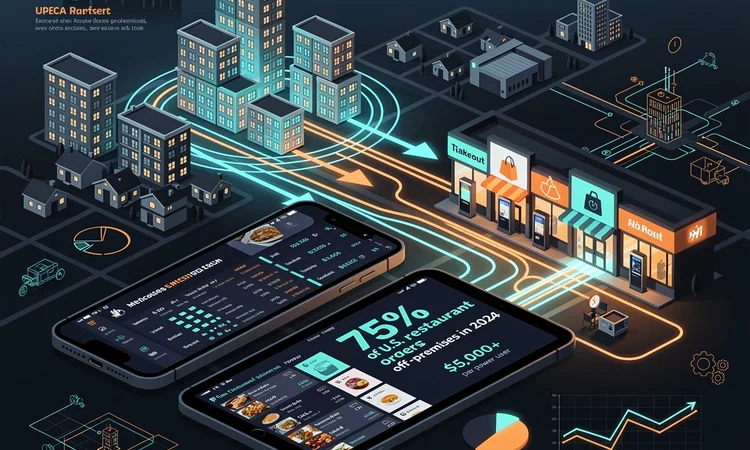
The American restaurant experience has undergone a seismic shift that would have seemed unimaginable just a decade ago. According to recent data from the National Restaurant Association, nearly 75% of all restaurant orders in 2024 were consumed somewhere other than the restaurant itself—a statistic that represents nothing less than a fundamental reimagining of how Americans eat. This transformation, driven by the explosive growth of food delivery platforms like DoorDash, Uber Eats, and Grubhub, has created a new category of consumer: the power user who spends thousands of dollars annually on delivered meals, reshaping not just the restaurant industry but the very fabric of American mealtimes.
The economics of this shift are staggering. The New York Times reports that heavy users of delivery apps are now spending upwards of $5,000 per year on delivered restaurant food, with some exceeding that figure significantly. These aren’t occasional convenience orders during busy weeks—they represent a wholesale replacement of traditional dining habits. For context, the average American household spent approximately $3,000 on food away from home in 2019, according to Bureau of Labor Statistics data. The new delivery-dependent consumer is spending nearly double that amount on delivery alone, not counting any meals eaten in restaurants or prepared at home.
The Platform Wars Heat Up as Market Matures
The competition among delivery platforms has intensified dramatically as growth rates begin to plateau and companies fight for market share. In a notable development, Marketing Dive reported that Grubhub made its Super Bowl advertising debut featuring George Clooney, with a campaign focused on “eating the fees”—a direct response to consumer frustration with the high costs associated with delivery services. The campaign represents a strategic pivot for Grubhub, which has struggled to compete with DoorDash’s dominant market position and Uber Eats’ integration with the broader Uber ecosystem.
The fee structure of these platforms has become a flashpoint in the broader debate about their sustainability and consumer value proposition. Delivery fees, service fees, small order fees, and tips can add 30-50% to the base cost of a meal, creating what economists call a “friction point” in consumer behavior. Yet despite these costs, usage continues to climb, suggesting that for many Americans, the convenience factor outweighs price sensitivity—at least among those with sufficient disposable income to absorb the premium.
Economic Implications Beyond the Restaurant Industry
The macroeconomic implications of this shift extend far beyond the restaurant sector. Economist Ernie Tedeschi noted on X that the delivery app phenomenon represents a significant reallocation of consumer spending, with potential implications for everything from urban planning to labor markets. The rise of delivery has created an entirely new category of gig economy workers—delivery drivers—while simultaneously reducing the need for front-of-house restaurant staff in traditional dining establishments. This labor market reshuffling has profound implications for wage structures, benefits, and worker protections across the hospitality industry.
The delivery economy has also accelerated the trend toward what some economists call the “stay-home economy”—a broader pattern of consumer behavior where services are increasingly brought to the home rather than requiring consumers to venture out. This pattern, which accelerated dramatically during the COVID-19 pandemic, shows no signs of reversing even as pandemic-related restrictions have long since lifted. The persistence of these habits suggests a more fundamental shift in American lifestyle preferences, with potential long-term implications for commercial real estate, urban density patterns, and community social dynamics.
The Restaurant Industry’s Existential Reckoning
For restaurant operators, the 75% off-premises figure represents both an opportunity and an existential challenge. Many establishments have had to fundamentally rethink their business models, with some pivoting entirely to delivery and takeout operations, eliminating dining rooms altogether to reduce overhead costs. These “ghost kitchens” or “virtual restaurants” operate solely through delivery platforms, existing only as listings in apps with no physical storefront for customers to visit. The model allows for lower capital requirements and operational costs, but also means restaurants become entirely dependent on platform algorithms and customer ratings within apps for their survival.
Traditional full-service restaurants face a different calculus. While delivery provides an additional revenue stream, the economics are often unfavorable. Platforms typically take 15-30% commission on each order, eating into already thin restaurant profit margins. Many restaurateurs complain that they’re essentially paying platforms to access their own customers, while also dealing with quality control issues inherent in food that must travel before being consumed. Hot food arrives lukewarm, crispy items become soggy, and carefully plated presentations are reduced to jumbled containers—all potentially damaging to a restaurant’s reputation despite being largely beyond their control.
The Power User Phenomenon and Behavioral Economics
The emergence of delivery “power users” who spend thousands annually on the service represents a fascinating case study in behavioral economics and habit formation. These users, often young urban professionals or busy families, have effectively outsourced meal preparation and planning to algorithms and apps. The convenience of having meals appear at their door with a few taps has proven so compelling that price sensitivity diminishes dramatically—a phenomenon economists call “convenience premium elasticity.”
Social media commentary reflects the cultural normalization of heavy delivery app usage. Users on X have shared screenshots of annual spending totals that exceed $10,000, often with a mix of shock and resignation. One thread noted the psychological trick of small, frequent purchases feeling less significant than they are in aggregate—the same behavioral pattern that makes subscription services and microtransactions so profitable for companies. The frictionless nature of app-based ordering, combined with saved payment information and one-click reordering of favorite meals, removes traditional barriers to impulse purchases.
Demographic Divides and Access Questions
The delivery app revolution has not affected all Americans equally, raising important questions about access and equity. The heaviest users tend to be affluent urban dwellers with high incomes and demanding careers—people for whom the time saved is worth the premium paid. In contrast, lower-income Americans and those in rural or suburban areas with limited delivery availability remain largely outside this ecosystem, continuing to cook at home or visit restaurants in person out of economic necessity or lack of service availability.
This divide has implications for how we think about food access and urban development. Areas with robust delivery coverage become more attractive to certain demographics, potentially accelerating gentrification patterns. Meanwhile, neighborhoods deemed unprofitable for delivery services may find themselves further isolated from the conveniences that characterize modern urban life. The platforms’ algorithmic decisions about where to operate and which restaurants to feature carry significant power in shaping local food economies and access patterns.
The Technology Arms Race and Future Innovations
As the delivery market matures, platforms are investing heavily in technology to improve efficiency and reduce costs. DoorDash and Uber Eats have both experimented with autonomous delivery vehicles and drones, though regulatory and practical challenges have slowed widespread deployment. More immediately impactful have been improvements in routing algorithms, demand prediction, and driver assignment systems that squeeze additional efficiency from existing infrastructure.
The platforms are also expanding beyond restaurant delivery into grocery, convenience store, and retail delivery, attempting to become comprehensive logistics networks rather than just meal delivery services. This expansion represents an attempt to increase order frequency and customer lifetime value—if a platform can handle your dinner, groceries, drugstore run, and retail purchases, it becomes more deeply embedded in daily life and harder to displace. The ultimate vision appears to be something like Amazon’s dominance in e-commerce, but for local, same-day delivery of physical goods and prepared foods.
Regulatory Pressures and Market Sustainability
The rapid growth of delivery platforms has attracted increasing regulatory scrutiny. Multiple cities have attempted to cap the commissions platforms can charge restaurants, arguing that the fees are predatory and threaten the survival of local dining establishments. The platforms have fought these measures aggressively, arguing that commission caps make their business models unsustainable and will lead to reduced service availability. Some cities have seen platforms threaten to exit markets entirely if caps are implemented, creating a high-stakes game of chicken between regulators and companies.
Labor classification remains another contentious regulatory issue. Delivery drivers are typically classified as independent contractors rather than employees, allowing platforms to avoid providing benefits, minimum wage guarantees, or other worker protections. This classification has been challenged in various jurisdictions, most notably in California with Proposition 22, which created a special carve-out status for gig workers after platforms spent over $200 million campaigning for its passage. The outcome of these regulatory battles will significantly shape the future economics of delivery services and potentially their viability at current price points.
Cultural Shifts and the Future of Communal Dining
Beyond economics and logistics, the delivery boom raises profound questions about the social and cultural role of dining. Restaurants have traditionally served as “third places”—communal spaces outside of home and work where people gather, socialize, and build community. When 75% of restaurant orders are consumed elsewhere, we lose something intangible but important about the dining experience and its role in social cohesion.
The trend toward isolated, individual consumption of restaurant food—eaten alone or only with immediate household members, often while working or watching screens—represents a departure from dining as a social ritual. Whether this shift proves temporary or permanent will depend on generational preferences and whether the convenience-oriented habits formed during the pandemic era persist as younger cohorts age. Early indications suggest that many younger consumers view delivery as the default rather than the exception, potentially cementing these patterns for decades to come.
The transformation of American dining habits through delivery apps represents one of the most significant shifts in consumer behavior of the past decade. With power users spending thousands annually and three-quarters of restaurant orders consumed off-premises, we’re witnessing not just a technological disruption but a fundamental reimagining of how Americans relate to food, restaurants, and the experience of eating itself. As platforms compete for dominance, restaurants adapt their models, and regulators grapple with oversight, the ultimate shape of this new dining economy remains in flux—but its impact on American life is already undeniable and likely irreversible.


Leave a Reply
Your email address will not be published.