
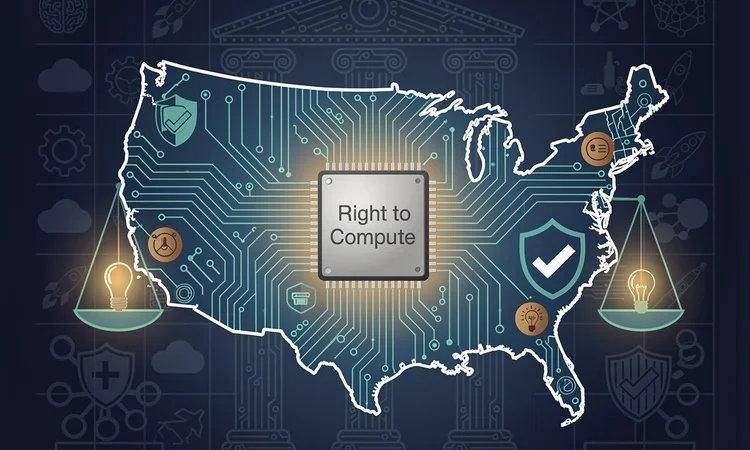
A new frontier in technology regulation is emerging across the United States, one that could fundamentally alter how Americans access and use computational resources. Right to Compute laws, a nascent legislative movement gaining traction in state legislatures, aim to establish computational access as a protected right—a concept that sits at the intersection of digital liberty, artificial intelligence governance, and economic opportunity. As these proposals advance from theoretical frameworks to actual legislation, they’re sparking intense debate among technologists, policymakers, and civil liberties advocates about the proper balance between innovation and regulation in an increasingly AI-driven economy.
The concept of a “right to compute” emerged from concerns that restrictive AI regulations could inadvertently create a two-tiered system where only large corporations and well-funded institutions maintain access to advanced computational resources. According to analysis from VKTR , these laws would establish legal protections ensuring individuals and organizations can access, operate, and develop computational technologies without arbitrary government restrictions. The framework draws philosophical parallels to First Amendment protections, positioning computational access as essential to modern free expression and economic participation.
Legislative Momentum Builds Across State Capitols
The movement gained concrete form when Arizona became one of the first states to seriously consider right to compute legislation. The proposed bills aim to prevent state-level restrictions on running AI models, training algorithms, or accessing computational infrastructure, provided such activities don’t violate existing criminal laws. Proponents argue this preemptive approach is necessary to prevent a patchwork of conflicting state regulations that could stifle innovation and create compliance nightmares for businesses operating across multiple jurisdictions.
Texas has emerged as another focal point for this legislative trend, with lawmakers introducing measures that would enshrine computational rights in state law. The Texas proposals go beyond mere access, attempting to establish that individuals have a fundamental right to purchase, own, and operate computing hardware and software of their choosing. This expansive interpretation reflects the state’s broader political philosophy favoring minimal government intervention in technological development and personal choice.
The Corporate Divide: Tech Giants Take Sides
The debate has exposed significant divisions within the technology industry itself. Major AI laboratories and established technology companies have expressed concerns that unfettered access to computational resources could enable malicious actors to develop harmful AI systems, from sophisticated deepfakes to autonomous cyber weapons. These firms advocate for measured oversight that balances innovation with safety considerations, arguing that some level of regulatory framework is necessary to prevent catastrophic misuse.
Conversely, open-source advocates, startup founders, and civil liberties organizations have rallied behind right to compute legislation. They contend that restrictive AI regulations primarily benefit incumbent players by raising barriers to entry that smaller competitors cannot overcome. VKTR’s analysis notes that these advocates view computational access as essential for maintaining competitive markets and preventing the concentration of AI capabilities in the hands of a few dominant corporations.
International Implications and Competitive Concerns
The right to compute movement exists within a broader context of international AI competition, particularly between the United States and China. Supporters argue that overly restrictive domestic regulations could handicap American innovation while authoritarian competitors face no such constraints. This national security dimension adds urgency to the debate, with some policymakers viewing computational freedom as essential to maintaining America’s technological leadership.
European regulatory approaches, particularly the EU’s AI Act, serve as a cautionary tale for right to compute advocates. They point to the compliance burdens and innovation-dampening effects of comprehensive AI regulation as evidence that America should chart a different course. The contrast between Europe’s precautionary principle and America’s traditionally permissive approach to technology regulation frames much of the current policy discussion.
Constitutional Questions and Legal Precedents
Legal scholars are grappling with whether computational access merits constitutional protection. Some argue that running code constitutes a form of speech protected under the First Amendment, a position with roots in earlier debates over encryption software and digital rights management. This framing would elevate right to compute beyond mere policy preference to a fundamental constitutional question, potentially limiting government regulatory authority even in the face of legitimate safety concerns.
The legal architecture of these proposals draws from diverse precedents, including telecommunications common carrier regulations, Second Amendment jurisprudence around arms access, and First Amendment cases involving encryption and software distribution. This eclectic legal foundation reflects the novel nature of the challenge: existing constitutional frameworks weren’t designed with artificial intelligence and advanced computation in mind, forcing creative legal reasoning to address 21st-century technological realities.
Economic Implications for Innovation Ecosystems
The economic stakes extend far beyond abstract principles. Cloud computing providers, chip manufacturers, and AI startups all have direct financial interests in how these regulations develop. Restrictions on computational access could reshape market dynamics, potentially determining which companies thrive and which struggle to compete. The semiconductor industry, already navigating complex export controls and supply chain challenges, watches nervously as new regulatory frameworks could further complicate their business environment.
Small businesses and independent researchers argue they would be disproportionately harmed by restrictive AI regulations. Unlike large corporations with dedicated compliance departments and legal teams, smaller entities lack resources to navigate complex regulatory requirements. Right to compute laws could level the playing field, ensuring that innovation isn’t the exclusive domain of well-capitalized incumbents. This democratization argument resonates particularly strongly in entrepreneurial communities and among venture capital investors seeking to fund the next generation of AI companies.
Safety Concerns and Risk Management
Critics of right to compute legislation raise legitimate concerns about potential misuse of unfettered computational access. The development of increasingly powerful AI systems carries genuine risks, from automated disinformation campaigns to potential biosecurity threats. Some researchers argue that certain capabilities, particularly around autonomous weapons or biological design, may require oversight mechanisms that right to compute laws would prohibit or complicate.
The challenge lies in designing regulatory frameworks that address genuine risks without creating unnecessary barriers to beneficial innovation. Proponents of right to compute laws argue that existing criminal statutes already prohibit harmful activities, making additional AI-specific restrictions redundant. They contend that the focus should be on prosecuting actual harms rather than preemptively restricting access to tools that have overwhelmingly beneficial applications.
The Path Forward: Balancing Liberty and Security
As right to compute legislation advances through state legislatures, the debate increasingly centers on implementation details rather than abstract principles. Questions about scope, exceptions, and enforcement mechanisms will determine whether these laws achieve their intended goals or create unintended consequences. The interaction between state-level right to compute protections and potential federal AI regulations remains uncertain, with possible conflicts requiring eventual judicial resolution.
The coming months will prove critical as early-adopter states move from proposal to implementation. Their experiences will inform other jurisdictions considering similar measures, creating natural experiments in different regulatory approaches. Whether right to compute becomes a widely adopted framework or remains a niche concern of libertarian-leaning states will depend largely on how well these initial implementations balance the competing values of innovation, safety, and economic opportunity in an age of transformative artificial intelligence.


Leave a Reply
Your email address will not be published.