
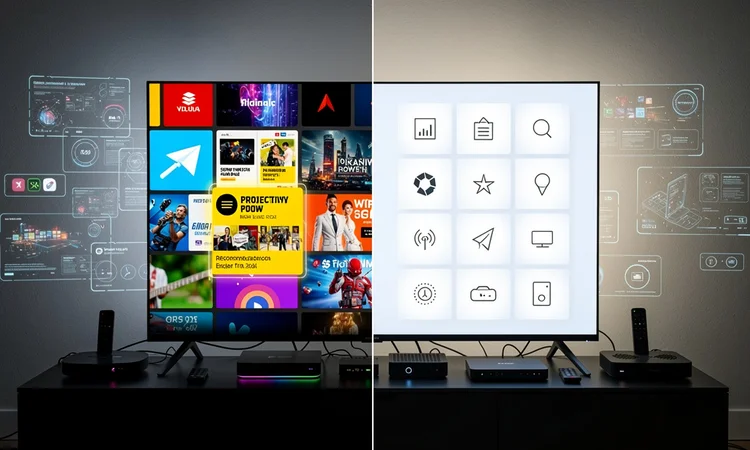
NEW YORK—In the fiercely competitive battle for the modern living room, the main screen of a smart television has become prime real estate, not just for content, but for advertising. Giants like Google, Amazon, and Samsung have meticulously crafted user interfaces that guide viewers toward sponsored content and revenue-generating services. Yet, a growing undercurrent of user dissent is fueling a quiet insurgency, waged not by a corporate rival, but by independent software developers offering an escape from the digital clutter. At the forefront of this movement is Projectivy Launcher, a tool that is rapidly gaining a cult following among tech-savvy consumers for doing one thing exceptionally well: giving control back to the user.
The default home screens on most Android TV and Google TV devices, such as the Chromecast or Nvidia Shield, have evolved into complex, algorithm-driven billboards. Rows of “recommendations” often feel more like advertisements, pushing content from services to which a user may not subscribe. Performance can lag as the system struggles to load a dizzying array of high-resolution promotional images. For many, the experience has strayed far from the simple promise of a smart TV—easy access to the apps and content they actually want to watch. This mounting frustration has created a fertile ground for third-party launchers, a concept long familiar to Android smartphone power users, to make the leap to the big screen.
A Grassroots Answer to Digital Clutter
Enter Projectivy Launcher. Developed by spdstudio, it is not merely a cosmetic overlay but a fundamental reimagining of the television interface, prioritizing speed, customization, and a user-centric philosophy. Unlike the default Google TV experience, Projectivy presents a clean, minimalist grid of user-selected applications, free from the visual noise of sponsored content. Its appeal lies in its direct refutation of the prevailing industry model, which treats the user’s attention as a commodity to be sold. An in-depth review from MakeUseOf praises the launcher for its ability to create a “more personal and efficient user experience,” effectively decluttering the most valuable screen in the home ( MakeUseOf ).
The installation process itself speaks to the launcher’s grassroots nature. While available on the Google Play Store, unlocking its full potential requires a few extra steps that place it firmly in the enthusiast category—for now. Users must enable developer options on their device and use a tool called ADB (Android Debug Bridge) to issue a command that allows Projectivy to override the default launcher and respond to the remote control’s “Home” button. While this may seem daunting to the average consumer, detailed guides and a passionate community on forums like XDA Developers have made the process accessible to a wider audience, signaling a clear demand for such alternatives ( XDA Developers ).
Reclaiming the Home Screen, One Feature at a Time
The feature set of Projectivy directly addresses the primary grievances users have with stock interfaces. The ability to hide unwanted pre-installed apps—often referred to as bloatware—is a major draw. Users can also create custom categories, grouping streaming services, games, and utility apps for more intuitive navigation. This level of organization stands in stark contrast to the one-size-fits-all approach of native launchers, which frequently mix a user’s apps with a deluge of external content suggestions. Furthermore, Projectivy offers advanced parental controls, allowing for the hiding of specific apps and preventing changes to the settings, a feature often lacking or less robust in default systems.
Beyond simple organization, the launcher delves deeper into system control. It allows users to fine-tune display settings, including brightness and color profiles, and even provides an option to circumvent stock screensavers with a more customizable alternative. Perhaps most critically, it offers multi-user profile support, a feature that allows different family members to have their own curated home screen experience. As noted on its official listing, this collection of advanced functionalities is designed for users who want to “tweak and customize their device to their liking” ( Google Play Store ). This philosophy is the antithesis of the locked-down, simplified experience that major manufacturers are pushing in their quest for mass-market adoption and advertising revenue.
Challenging the Platform’s Profitable Default
The existence and growing popularity of applications like Projectivy represent a direct threat to the business models of platform owners like Google and Amazon. The smart TV operating system is no longer just a gateway to content; it is a significant revenue driver. Advertising on connected TV (CTV) is a booming market, with platforms taking a cut of ad revenue and charging for premium placement on the home screen. By creating an ad-free environment, Projectivy effectively cuts off this revenue stream at the source for every user who installs it. If such launchers were to achieve mainstream adoption, the financial impact on platform holders could be substantial.
This dynamic creates a classic cat-and-mouse game. While Google’s Android is ostensibly an open platform, the company has historically taken steps to protect its core services and revenue models. It is conceivable that future updates to the Android TV operating system could make it more difficult, or even impossible, for third-party launchers to override the default home screen. This would mirror actions taken in the smartphone space, where manufacturers have increasingly locked down certain system-level functions. For now, however, the platform remains open enough for Projectivy to thrive, but its long-term viability may depend on Google’s tolerance for a tool that so effectively undermines its monetization strategy, a strategy that has drawn criticism for its aggressive commercialization of the user interface ( The Verge ).
The Inevitable Push for a More Open Living Room
The rise of Projectivy Launcher is more than just a story about a clever piece of software; it is a barometer of consumer sentiment in the streaming era. It suggests that a segment of the market is reaching a saturation point with ad-supported, recommendation-heavy interfaces and is willing to invest a small amount of technical effort to achieve a cleaner, more efficient experience. This movement is not about rejecting content, but about changing the terms of its discovery—shifting from a model where the platform pushes content to one where the user pulls it on their own terms. The enthusiasm is palpable in online communities, where users share custom setups and celebrate the newfound speed and simplicity of their devices.
Ultimately, the long-term impact of Projectivy and its contemporaries will depend on how the industry responds. Will major manufacturers see this as a niche complaint from a vocal minority, or will they recognize it as valuable feedback on the state of the user experience? The most forward-thinking players may choose to incorporate the best ideas from these third-party launchers—more customization, less clutter, faster performance—into their own software. By doing so, they could neutralize the threat by addressing the core problems that drove users to seek alternatives in the first place. Until then, Projectivy Launcher will remain a powerful symbol of user agency in an increasingly controlled digital environment, proving that for many, the best smart TV experience is the one they build for themselves.


Leave a Reply
Your email address will not be published.