
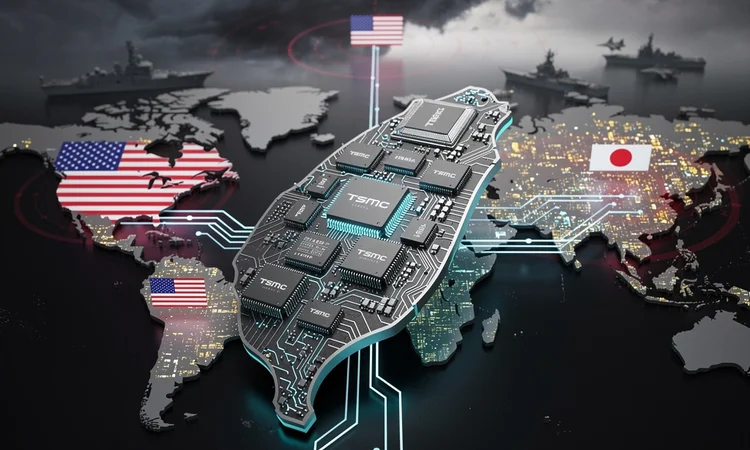
The Trillion-Dollar Chip: Inside the Global Scramble to Avert a TSMC Catastrophe
HSINCHU, Taiwan – In the quiet, meticulously clean fabrication plants, or “fabs,” operated by Taiwan Semiconductor Manufacturing Company, robots glide along ceiling tracks, ferrying silicon wafers through hundreds of complex chemical and photolithographic steps. The result is the most advanced microchips on Earth—the brains inside every new iPhone, Nvidia AI server, and F-35 fighter jet. For decades, this mastery made TSMC an unparalleled success story and a quiet giant of the global economy.
Today, that quiet dominance has become the world’s most significant single point of failure. With over 90% of the world’s most advanced logic chips originating from this one company on an island Beijing claims as its own, a new and urgent calculus has gripped boardrooms and war rooms from Washington to Tokyo. The central question is no longer about TSMC’s technological prowess, but whether the global economy can survive a disruption to it, prompting a frantic, multi-trillion-dollar effort to de-risk a supply chain balanced on a geopolitical knife-edge.
The Shadow of the Strait
For years, the concept of a “Silicon Shield” held sway in policy circles: the idea that Taiwan’s critical role in the semiconductor supply chain made it too important to the global economy for China to risk an invasion. As detailed in an analysis by the Center for Strategic and International Studies, this interdependence was seen as a powerful deterrent. But that logic is now being dangerously inverted. Increasingly, strategists fear that China’s own dependence on Taiwanese chips, and the desire to control the world’s most vital technological resource, could make seizing TSMC a primary objective rather than a deterrent.
The potential economic fallout is staggering. A recent analysis by Bloomberg Economics projected that a war over Taiwan could cost the global economy around $10 trillion, equivalent to roughly 10% of global GDP. This figure dwarfs the impact of the COVID-19 pandemic and the 2008 financial crisis, illustrating how deeply intertwined the world’s digital infrastructure is with the continued, uninterrupted operation of TSMC’s fabs. The company’s own success, which saw it beat first-quarter profit estimates on the back of soaring AI chip demand as reported by Reuters , only serves to heighten the stakes.
An Irreplaceable Ecosystem
The response from Western governments has been to try and replicate TSMC’s magic on their own shores. Yet the notion that these highly complex facilities can simply be moved or taken over in a conflict misunderstands their nature. TSMC Chairman Mark Liu, in a rare interview with CNN , stated that in the event of an invasion, the company’s fabs would be rendered “not operable.”
This is not a threat of sabotage, but a statement of fact about the intricate ecosystem required to run a leading-edge fab. It relies on a constant, real-time connection to a global network of suppliers for specialty chemicals, software, and equipment from companies like Europe’s ASML. More importantly, it depends on a deep well of institutional knowledge held by thousands of highly specialized engineers and technicians in Taiwan—a human element that cannot be easily packed up and shipped overseas.
Washington’s Billion-Dollar Bet
Faced with this reality, the United States has embarked on its most significant piece of industrial policy in decades. The CHIPS and Science Act, as outlined by the White House , allocates over $52 billion in subsidies to incentivize companies like TSMC to build advanced fabs on American soil. TSMC answered the call, committing to a $40 billion investment in two facilities in Arizona, with plans to produce some of the world’s most sophisticated chips stateside by 2026.
However, the project has become a case study in the immense difficulty of reshoring advanced manufacturing. As The Wall Street Journal has reported , the Arizona campus has been plagued by construction delays, soaring costs, and a significant culture clash between Taiwanese managers and American labor. The challenges in finding a sufficient number of workers with the highly specific skills needed to equip and run the fabs have pushed the production timeline back, underscoring that building the factory is only half the battle.
A Worldwide Race for Redundancy
The United States is not alone in its pursuit of semiconductor sovereignty. Japan, moving with remarkable speed and efficiency, has successfully courted TSMC to build a fab in Kumamoto. The plant, which opened ahead of schedule, is a major victory for Tokyo’s ambitions to revive its chip industry, as detailed by Nikkei Asia . The European Union has followed suit with its own European Chips Act, aiming to double its share of the global chip market by 2030.
This global scramble is creating a new competitive dynamic. Governments are offering massive subsidy packages to lure investment, all driven by the same underlying fear: being cut off from Taiwan. While this diversification will eventually build some resilience into the supply chain, it is a slow and extraordinarily expensive process. Furthermore, these new fabs will take years to reach the scale and efficiency of TSMC’s operations in its home base.
The Rivals at the Gates
The geopolitical uncertainty has created a crucial opening for TSMC’s primary competitors, Samsung of South Korea and Intel of the United States. Both are aggressively pitching their foundry services to major chip designers like Nvidia and Apple, arguing that geographic diversification is now a strategic necessity. Intel, under CEO Pat Gelsinger’s IDM 2.0 strategy, is investing heavily in new fabs in Ohio and Arizona, positioning itself as a secure, American-based alternative.
For customers, the calculus is shifting from a singular focus on performance and cost to a more complex equation that includes supply chain security. While TSMC still holds a clear technological lead in many areas, the risk associated with its location is forcing its biggest clients to at least explore and validate production with other foundries, a trend that could slowly erode TSMC’s market share if the geopolitical tensions persist or worsen.
Taiwan’s Strategic Calculus
For its part, TSMC is navigating this new era with a careful strategy. It is cooperating with the global diversification push, building plants in the U.S. and Japan, and planning another in Germany. This placates its powerful customers and their governments. Yet, the company is deliberately keeping its most advanced research and development and its next-generation, 2-nanometer-and-beyond production firmly at home in Taiwan. This “N-1” strategy ensures that while its partners get access to advanced manufacturing, the absolute cutting edge remains on the island.
The effort to build a global, resilient semiconductor supply chain is well underway, but the road ahead is long and costly. The talent gap, particularly for skilled technicians and engineers, remains a critical bottleneck, a challenge the Financial Times notes could undermine Western ambitions. For the foreseeable future, the world’s technological progress and economic stability will remain inextricably linked to the continued peaceful operation of the fabs in Hsinchu, leaving the trillion-dollar question of TSMC’s security unanswered.


Leave a Reply
Your email address will not be published.