
Trump’s 100% Tariff Ultimatum: Carney’s China Pact Ignites North American Trade War

Ivy Bailey
Ivy Bailey

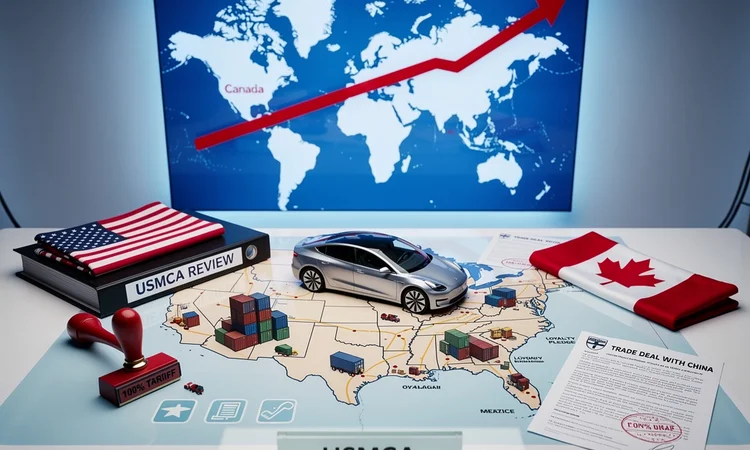
President Trump threatens 100% tariffs on Canada over its China trade deal, prompting PM Carney to deny free trade pursuits and affirm USMCA loyalty. The feud, fueled by EV tariff cuts and Davos barbs, risks upending North American commerce amid USMCA review.

Trump’s 100% Tariff Ultimatum: Carney’s China Pact Ignites North American Trade War

Canadian Prime Minister Mark Carney pushed back forcefully against U.S. President Donald Trump’s threat to impose 100% tariffs on all Canadian goods, insisting Ottawa has no plans for a free trade deal with China. The exchange, unfolding over social media and public statements, underscores deepening frictions in North American trade relations amid Trump’s aggressive tariff strategy. Carney, speaking in Quebec City on January 25, 2026, clarified that a recent agreement with Beijing merely addressed specific tariff disputes, capping Chinese electric vehicle imports at 49,000 units annually at a 6.1% rate, rising to 70,000 over five years.

Trump’s salvo came via Truth Social on January 24, where he warned, “If Governor Carney thinks he is going to make Canada a ‘Drop Off Port’ for China to send goods and products into the United States, he is sorely mistaken.” He followed up, claiming “China is successfully and completely taking over the once Great Country of Canada. So sad to see it happen. I only hope they leave Ice Hockey alone! President DJT.” The U.S. leader also shared a video from the Canadian Vehicle Manufacturers’ Association CEO, who warned that without U.S. market access, Canada’s auto sector would collapse, as its domestic market is too small for large-scale production.

U.S. Treasury Secretary Scott Bessent amplified the concerns on ABC News, stating, “We can’t let Canada become an opening that the Chinese pour their cheap goods into the U.S.” This rhetoric reflects fears that Canada could serve as a backdoor for Chinese exports evading U.S. duties, a worry heightened by Carney’s January 16 visit to Beijing, where he secured lower Chinese tariffs on Canadian canola oil, pork, and seafood in exchange for EV concessions.

Roots of the Tariff Tit-for-Tat

The dispute traces back to 2024, when Canada mirrored U.S. tariffs by slapping 100% duties on Chinese EVs and 25% on steel and aluminum. China retaliated with 100% tariffs on Canadian canola and 25% on pork and seafood. The recent pact rectified these, with China dropping canola tariffs from 85% to 15% by March and exempting certain agriproducts until 2026 end, per AP News . Carney emphasized USMCA obligations: “under the free trade agreement with the U.S. and Mexico there are commitments not to pursue free trade agreements with nonmarket economies without prior notification. We have no intention of doing that with China or any other nonmarket economy.”

Trump initially praised the deal on January 16, telling reporters at the White House, “That’s what he should be doing. It’s a good thing for him to sign a trade deal. If you can get a deal with China, you should do that,” as reported by CNBC . But tensions escalated after Carney’s Davos speech on January 20, where he decried great powers using “tariffs as leverage, financial infrastructure as coercion,” widely seen as a jab at Trump, according to The New York Times .

Canada-U.S. trade minister Dominic LeBlanc reinforced Carney’s stance, stating, “There is no pursuit of a free trade deal with China. What was achieved was resolution on several important tariff issues,” per CBC News . Trump responded by rescinding Carney’s invitation to his “Board of Peace” and mocking Canada as dependent: “Canada lives because of the United States.”

USMCA Renegotiation Looms Large

The USMCA, shielding most Canadian exports from tariffs, faces mandatory review this summer. Article 32.10 requires three months’ notice for talks with non-market economies like China. Canada notified the U.S. before the EV deal, but Trump’s threat bypasses this framework, raising questions about enforcement. In August 2025, Trump hiked tariffs on select Canadian goods like steel to 35% from 25%, per CNBC .

Canadian industry leaders warn of catastrophe. The Canadian Chamber of Commerce noted the China pact benefits domestic consumers, not U.S. circumvention, as per Reuters. Provincial leaders rallied: Manitoba’s Wab Kinew declared Canada won’t be taken over “Not by China. Not by Trump,” while B.C.’s David Eby backed Carney on X, echoing sentiments from CBC .

Trump’s pattern includes past threats, like a 10% hike over an Ontario ad, which fizzled. Yet executives like Conference Board of Canada’s Pedro Antunes highlight recessionary consumer confidence, with U.S. uncertainty stifling investment, as in Toronto Star .

Broader Geopolitical Maneuvers

Carney positions Canada among middle powers resisting coercion, stating at Davos, “Middle powers must act together because if you are not at the table, you are on the menu,” via AP News. Trump has toyed with Canada as the 51st state, shared altered maps, and pursued Greenland aggressively, walking back EU tariffs after NATO talks.

On X, users like @MarcNixon24 warned a 100% tariff risks 75% of Canadian exports, while @govt_corrupt clipped Carney vowing forceful counter-tariffs. Carney appointed Mark Wiseman as Washington ambassador to navigate ties, per AP News .

Formal USMCA talks launch mid-January, with auto rules-of-origin central. Canadian Vehicle Manufacturers stress U.S. access viability, amplified by Trump. As Carney eyes diversification—Europe tops his list per Politico—Trump’s threats test North American resilience amid global realignments.

Stakeholder Reactions and Economic Stakes

Saskatchewan Premier Scott Moe decried tariff erosion of fair trade, per CBC. U.S. firms eye shifts; Trump posted businesses fleeing Canada for America. China moves fast, importing Canadian canola post-deal, Toronto Star noted. Carney urges buying Canadian, signaling domestic fortification.

Analysts see Carney’s pragmatism risking China ties but shielding from U.S. volatility. With 75% exports U.S.-bound in a C$1.3 trillion flow, a full tariff war could devastate autos, metals, machinery. Yet Carney’s Davos defiance and Beijing outreach mark a pivot from U.S. reliance, forcing industry insiders to recalibrate supply chains.

About the Author

Ivy Bailey
Ivy Bailey

Ivy Bailey specializes in product management and reports on the systems behind modern business. They work through trend monitoring with careful context and caveats to make complex topics approachable. They look for overlooked details that differentiate sustainable success from short‑term wins. Their perspective is shaped by interviews across engineering, operations, and leadership roles. Readers appreciate their ability to connect strategic goals with everyday workflows. They also highlight cultural factors that determine whether change sticks. They frequently translate research into action for engineering managers, prioritizing clarity over buzzwords. They are known for dissecting tools and strategies that improve execution without adding complexity. A recurring theme in their writing is how teams build repeatable systems and measure impact over time. They frequently compare approaches across industries to surface patterns that travel well. They avoid buzzwords, focusing instead on outcomes, incentives, and the human side of technology. They tend to favor small experiments over sweeping predictions. Readers return for the clarity, the caution, and the actionable takeaways.

Comments

Join the discussion and share your thoughts.

No comments yet. Be the first to comment.

Leave a Reply

Your email address will not be published.

Related Posts

US Lawmakers Strip Right-to-Repair from 2026 NDAA, Boosting Defense Contractors

US Lawmakers Strip Right-to-Repair from 2026 NDAA, Boosting Defense Contractors

U.S. lawmakers removed right-to-repair provisions from the 2026 NDAA, preventing military personnel from independently fixing equipment and preserving defense contractors' lucrative service contracts. Critics decry industry influence, citing potential cost savings and improved readiness. This setback fuels ongoing advocacy for repair reforms in military and civilian sectors.

Posted on: by Jack Chen
Amazon Prime Air Struggles: Drone Incidents, Regulations, and Rivals

Amazon Prime Air Struggles: Drone Incidents, Regulations, and Rivals

Amazon's Prime Air drone delivery program, launched in 2013, faces setbacks including a 2025 Texas incident where a drone clipped a cable, triggering FAA scrutiny, regulatory hurdles, and technical glitches. Trailing rivals like Walmart and Zipline, Amazon is pivoting strategies amid fierce competition. Recovery hinges on innovations and safer operations.

Posted on: by Grace Wright
DOJ’s Appeal in Google Antitrust Case Signals Protracted Legal Battle Over Search Monopoly Remedies

DOJ’s Appeal in Google Antitrust Case Signals Protracted Legal Battle Over Search Monopoly Remedies

The DOJ and state attorneys general have appealed Judge Mehta's Google antitrust remedies ruling, challenging the decision to reject structural breakups including Chrome divestiture. The appeal argues behavioral restrictions are insufficient to dismantle Google's search monopoly, setting up a multi-year legal battle.

Retail Ecommerce
Google Launches Doppl: AI Virtual Try-Ons Transform Online Shopping

Google Launches Doppl: AI Virtual Try-Ons Transform Online Shopping

Google has launched Doppl, an AI-powered app enabling virtual clothing try-ons with personalized, dynamic models to reduce online shopping uncertainties and returns. Amid expanding AI shopping tools like agentic checkout, it faces regulatory scrutiny over data practices, yet promises to revolutionize e-commerce personalization and consumer behavior.

Retail Ecommerce
Microsoft 365 Prices to Rise Up to 33% in 2026 Amid AI and Security Upgrades

Microsoft 365 Prices to Rise Up to 33% in 2026 Amid AI and Security Upgrades

Microsoft is raising Microsoft 365 prices by up to 33% starting July 1, 2026, for commercial, frontline, and government users, driven by AI enhancements like Copilot and improved security features. This first major hike since 2022 aims to fund innovations amid cyber threats, though it sparks mixed reactions on affordability.

Retail Ecommerce
EU Court Upholds Intel Antitrust Ruling, Slashes Fine to €237M

EU Court Upholds Intel Antitrust Ruling, Slashes Fine to €237M

Europe's General Court upheld Intel's antitrust violation for using rebates and payments to exclude rivals like AMD in the chip market, but slashed the fine from €376 million to €237 million. This ruling, part of a decades-long saga, highlights evolving EU antitrust standards amid Intel's competitive challenges.

Retail Ecommerce
MasterClass 2025 Holiday Deal: 40% Off Annual Subscriptions

MasterClass 2025 Holiday Deal: 40% Off Annual Subscriptions

MasterClass's 2025 holiday promotion offers 40% off annual subscriptions, reducing Standard to $72, Plus to $108, and Premium to $144, including gifts. This strategy enhances accessibility to celebrity-led courses amid market competition. It boosts subscriber growth and democratizes elite education during economic uncertainties.

Retail Ecommerce
NYC’s 2025 Congestion Pricing Slashes Traffic 11%, Pollution 22% in Manhattan

NYC’s 2025 Congestion Pricing Slashes Traffic 11%, Pollution 22% in Manhattan

New York City's 2025 congestion pricing in Manhattan charges drivers to enter south of 60th Street, reducing traffic by 11% and PM2.5 pollution by 22%. This has improved air quality citywide, cut noise and accidents, funded transit upgrades, and serves as a model for urban sustainability.

Retail Ecommerce
2025 RAM Prices Skyrocket Amid AI-Driven Shortages

2025 RAM Prices Skyrocket Amid AI-Driven Shortages

In 2025, RAM prices have skyrocketed due to explosive AI demand for high-bandwidth memory in data centers, causing shortages and doubling or tripling costs for consumer DDR5 and DDR4 modules. This crisis disrupts PC building, smartphones, and industries, with experts forecasting prolonged volatility through 2027-2028 as production lags behind.

Retail Ecommerce
Nvidia Pilots AI Chip Tracking Software to Curb Smuggling to China

Nvidia Pilots AI Chip Tracking Software to Curb Smuggling to China

Nvidia is piloting software that uses telemetry data to track the locations of its AI chips, like the Blackwell series, to combat smuggling into restricted markets such as China amid US export bans. This initiative addresses geopolitical tensions and black-market operations, enhancing compliance without hardware changes.

Retail Ecommerce