
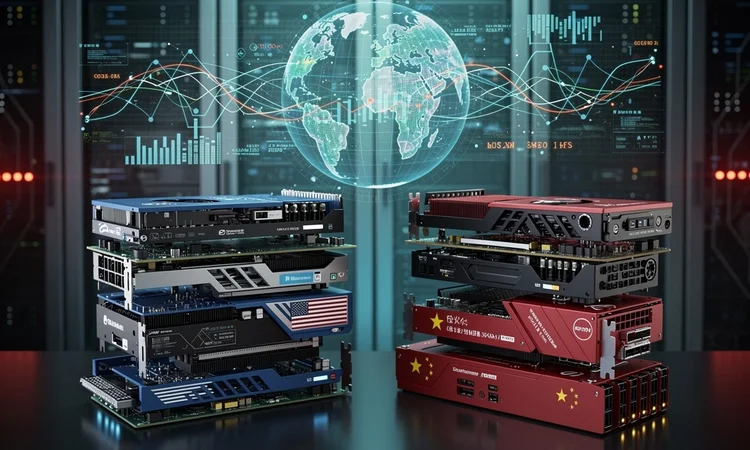
In the high-stakes arena of global technology and national security, President Donald Trump’s recent maneuvers involving advanced AI chips have thrust the administration into a maelstrom of controversy. What began as a bold deal to allow U.S. chipmakers like Nvidia and AMD to sell cutting-edge semiconductors to China—in exchange for a share of the revenue—has evolved into a multifaceted saga of oversight battles, security alarms, and political backlash. This arrangement, announced in mid-2025, promised to bolster American coffers while navigating tense U.S.-China relations, but it quickly drew scrutiny from lawmakers, experts, and industry watchers who question its implications for technological dominance and defense.
The deal’s core involved granting permissions for exporting AI chips that could supercharge China’s computing capabilities, with the U.S. government taking a 15% to 25% cut of the revenues. Trump touted this as a win-win, arguing it would fund domestic innovation while keeping a leash on foreign advancements. However, critics argue it risks handing adversaries tools for military AI applications, echoing long-standing fears about technology transfers. Recent developments, including Trump’s abrupt blocking of a smaller chip-related acquisition, have only amplified the debate, highlighting inconsistencies in the administration’s approach.
As of early 2026, the controversy has spilled into public discourse, with social media platforms like X buzzing with opinions from politicians and analysts. Posts on X reflect a divide: some hail Trump’s tough stance on China, while others decry perceived hypocrisy in approving massive exports only to nix minor deals. This tension underscores broader anxieties in the tech sector about regulatory unpredictability under the current leadership.
Escalating National Security Alarms
Digging deeper, the origins of the furor trace back to August 2025, when Trump announced the agreement with Nvidia and AMD. According to reporting from PBS News , the deal allowed sales of advanced AI chips to China, contingent on revenue sharing. Scott Kennedy of the Center for Strategic and International Studies highlighted potential legal pitfalls, noting that such arrangements could skirt export control laws designed to protect U.S. interests.
By November 2025, Trump shifted gears, declaring that top-tier chips like Nvidia’s Blackwell should remain exclusive to U.S. customers, as detailed in a Reuters article. This pronouncement came amid growing pressure from national security hawks who warned of China’s potential to leverage these chips for weapons development. Yet, just weeks later, reports emerged of Trump greenlighting sales of Nvidia’s H200 chips to China for a 25% U.S. cut, per CNBC .
The inconsistency peaked in early January 2026, when Trump issued an executive order blocking a $2.9 million deal involving HieFo Corp., a Chinese-controlled firm acquiring assets from Emcore. Reuters reported that the order cited unspecified security concerns, without naming individuals. This move, while small in scale, signaled a selective enforcement that has puzzled industry insiders.
Industry Ripples and Lobbyist Fears
Tech lobbyists are increasingly vocal about the administration’s erratic policies. David Sacks, appointed as Trump’s AI czar, was expected to champion the sector’s interests, but as Politico noted in December 2025, his actions have instead sown doubt, with fears that overzealous regulations could stifle innovation nationwide.
On X, sentiment mirrors this unease. Users, including former officials and tech enthusiasts, have posted threads questioning the logic behind approving billions in AI chip exports while blocking a modest $3 million transaction, as covered in a Times of India piece. One prominent post from a national security expert likened the strategy to “guarding the back door while leaving the front wide open,” capturing widespread frustration.
The broader implications for the semiconductor industry are profound. Companies like Nvidia, the world’s most valuable by market cap, rely on global markets, yet U.S. restrictions could erode their edge. An opinion piece in The New York Times by former White House advisers argued that Trump’s policies might inadvertently aid China’s quest for AI supremacy, potentially undermining years of bipartisan efforts to curb technology leaks.
Political Backlash and Oversight Demands
Congressional oversight has intensified, with Democrats and some Republicans calling for investigations into the deal’s legality. Senator Elissa Slotkin, in an X post from August 2025, criticized the arrangement for potentially empowering China’s military AI capabilities. This echoes concerns raised in an ABC News explainer, which outlined how the pact paves the way for advanced chip sales amid escalating trade tensions.
Recent news searches reveal a flurry of articles dissecting the HieFo-Emcore blockage. CNBC detailed how the White House ordered the divestment, emphasizing risks to U.S. national security from Chinese control over specialized photonics technology. Similarly, Security Affairs reported on the $2.9 million deal’s unraveling, noting its roots in a 2024 acquisition under the previous administration.
Industry analysts point out that while the blocked deal involves niche components like indium phosphide used in aerospace, its symbolic weight is heavy. Posts on X from tech bloggers, such as one highlighting CFIUS’s role as an “AI supply chain throttle,” underscore how such interventions could broaden to affect larger players, potentially disrupting global supply chains.
Strategic Calculations and Global Repercussions
Trump’s team defends the approach as pragmatic realpolitik. By extracting revenue shares, the administration aims to finance domestic AI initiatives, as Trump himself has stated in interviews. However, experts like those quoted in the PBS News segment warn that short-term gains could yield long-term vulnerabilities, especially if China reverse-engineers the technology.
The controversy has also spotlighted figures like Peter Navarro, whose past involvement in similar deals draws parallels to current events. An older X post from journalist Heidi Przybyla referenced Navarro’s role in a 2020 deal, calling for clawbacks amid oversight concerns—a sentiment that resonates today.
Internationally, allies are watching closely. European and Asian partners, reliant on U.S. tech leadership, express unease over policies that might accelerate China’s rise. A Boston Herald article from January 2026 described the Emcore deal’s undoing as a microcosm of broader U.S.-China tech frictions, with Trump prioritizing security over commerce in select cases.
Voices from the Tech Trenches
Insiders in Silicon Valley whisper about the chilling effect on investments. Venture capitalists fear that unpredictable export controls could deter funding for AI startups, pushing innovation offshore. This aligns with Politico’s reporting on Sacks, where lobbyists worry about nationwide derailment of tech agendas.
X posts from users like NoelCaslerComedy lambast the administration for perceived double standards, contrasting the AI chip approvals with crypto investments from the UAE. Such public discourse amplifies calls for transparency, with some demanding congressional hearings to unpack the revenue-sharing mechanics.
Moreover, the MSN article that sparked much of this discussion, titled “Trump’s AI Chip Deal Sparks Oversight Fury” and available here , delves into how bipartisan fury has mounted over potential conflicts of interest and lax oversight, urging probes into whether personal or political gains influenced decisions.
Future Trajectories in Tech Policy
As the dust settles on these events, the administration faces mounting pressure to clarify its strategy. Will more deals be blocked, or will revenue-sharing become the norm? Industry groups are lobbying for consistent guidelines, arguing that ambiguity hampers competitiveness.
Recent web searches confirm ongoing coverage, with Yahoo Finance noting the HieFo order’s focus on a Chinese citizen’s control, raising questions about foreign influence in U.S. firms.
Ultimately, this saga reflects the delicate balance between economic incentives and security imperatives in an era where AI chips are as strategic as oil once was. Stakeholders await the next move, hoping for policies that safeguard innovation without sparking unnecessary conflicts.
Echoes of Broader Geopolitical Shifts
Looking ahead, the controversy could reshape U.S. export controls. Experts predict tighter scrutiny on all China-linked deals, potentially extending to allies. This shift, as discussed in The New York Times opinion, might force companies to diversify away from Chinese markets, altering global trade patterns.
On X, users debate the long-term wisdom, with some praising Trump’s decisiveness in the Emcore case as a necessary check. Others, however, see it as reactive rather than strategic, pointing to earlier approvals as evidence of inconsistency.
In conversations with industry executives, there’s a consensus that while the deals aim to monetize U.S. tech superiority, they risk eroding it. As one anonymous source put it, “We’re playing poker with our best cards face up.” The coming months will test whether Trump’s gambit pays off or folds under scrutiny.


Leave a Reply
Your email address will not be published.