
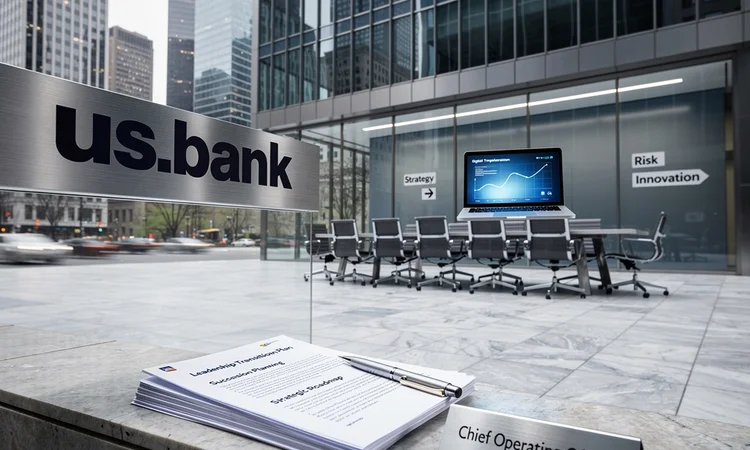
U.S. Bank, the nation’s fifth-largest commercial bank by assets, is preparing for a significant leadership transition as Chief Operating Officer Shailesh Kotwal announced his retirement effective this spring. The departure marks the end of a transformative tenure for an executive who has been instrumental in modernizing the Minneapolis-based institution’s operations and technology infrastructure during a period of unprecedented industry upheaval.
According to Banking Dive , Kotwal’s decision to step down comes at a pivotal moment for the $675 billion asset institution as it navigates evolving regulatory requirements, technological disruption, and shifting customer expectations. The retirement announcement, while not entirely unexpected given Kotwal’s extensive career in banking, raises questions about succession planning and strategic direction at one of America’s most prominent regional banking powerhouses.
Kotwal joined U.S. Bank in 2016 and was promoted to COO in 2020, a role in which he oversaw the bank’s technology, operations, and various support functions. His tenure coincided with a period of intense digital transformation across the banking sector, accelerated dramatically by the COVID-19 pandemic. Under his operational leadership, U.S. Bank invested heavily in cloud computing, artificial intelligence, and digital banking capabilities to compete with both traditional rivals and emerging fintech challengers.
Operational Excellence and Digital Transformation Legacy
During Kotwal’s time as COO, U.S. Bank distinguished itself through operational efficiency metrics that outpaced many competitors. The institution maintained a reputation for technological innovation while balancing the need for robust risk management and regulatory compliance—a particularly challenging feat in an era of heightened supervisory scrutiny following the regional banking crisis of 2023.
The bank’s efficiency ratio, a key metric measuring operating expenses as a percentage of revenue, remained competitive throughout Kotwal’s tenure. Industry analysts have credited the COO’s focus on process automation and strategic technology investments with helping U.S. Bank maintain profitability margins even as interest rate volatility and economic uncertainty pressured the broader banking sector.
Kotwal’s operational philosophy emphasized the importance of scalable systems and standardized processes across U.S. Bank’s extensive branch network and digital channels. This approach proved particularly valuable as the institution absorbed and integrated various acquisitions, including its 2021 purchase of MUFG Union Bank’s core regional banking franchise, which added approximately $133 billion in assets and expanded U.S. Bank’s West Coast presence significantly.
Succession Planning and Leadership Continuity Questions
The announcement of Kotwal’s retirement has naturally sparked speculation about succession planning within U.S. Bank’s executive ranks. The COO position is often viewed as a critical role that requires deep operational knowledge, technological acumen, and the ability to manage complex organizational change—qualities that take years to develop and are not easily replaced.
U.S. Bank has not yet announced Kotwal’s successor, though industry observers suggest the institution likely has been preparing for this transition. The bank’s leadership bench includes several executives with extensive operational experience who could potentially step into the role. The selection will be closely watched by investors, analysts, and employees alike, as it will signal the institution’s strategic priorities and operational focus for the coming years.
Chief Executive Officer Andy Cecere, who has led U.S. Bank since 2017, faces the challenge of ensuring leadership continuity while potentially reshaping the executive team to address emerging challenges. The banking industry is confronting multiple simultaneous pressures, including the need to modernize legacy technology systems, defend against increasingly sophisticated cyber threats, meet evolving regulatory expectations, and compete with technology companies entering financial services.
Industry Context and Competitive Positioning
Kotwal’s retirement occurs against a backdrop of significant change in the American banking sector. The regional banking turmoil of March 2023, which saw the failures of Silicon Valley Bank, Signature Bank, and First Republic Bank, has fundamentally altered the competitive dynamics and regulatory environment for institutions of U.S. Bank’s size and complexity.
Regulators have signaled their intention to apply more stringent capital and liquidity requirements to banks with assets between $100 billion and $250 billion, a category that includes U.S. Bank. These enhanced standards, while not as strict as those applied to the largest global systemically important banks, will nonetheless require significant operational adjustments and compliance investments—work that will fall substantially to whoever succeeds Kotwal as COO.
The competitive environment has also intensified as technology companies and fintech startups continue to unbundle traditional banking services. Payment processing, lending, and wealth management functions that once were the exclusive domain of banks now face competition from specialized providers with lower cost structures and more agile technology platforms. U.S. Bank’s operational strategy under Kotwal recognized these threats and invested accordingly in digital capabilities and partnerships.
Technology Infrastructure and Innovation Initiatives
One of Kotwal’s most significant contributions was overseeing U.S. Bank’s technology modernization efforts. The institution invested billions of dollars in upgrading core banking systems, migrating applications to cloud platforms, and developing advanced data analytics capabilities. These investments positioned U.S. Bank to offer more personalized customer experiences and operate more efficiently than institutions still reliant on legacy mainframe systems.
The bank’s mobile and online banking platforms consistently rank among the industry’s most highly rated by customers, reflecting the operational focus on user experience and reliability. U.S. Bank also developed proprietary artificial intelligence and machine learning tools to improve fraud detection, credit underwriting, and customer service functions—initiatives that required close coordination between technology teams and business units under the COO’s purview.
Cybersecurity became an increasingly critical operational priority during Kotwal’s tenure, as banks faced a rising tide of sophisticated attacks from both criminal organizations and nation-state actors. U.S. Bank invested heavily in security infrastructure and personnel, recognizing that operational resilience depends fundamentally on protecting customer data and maintaining system availability. The next COO will inherit both the benefits of these investments and the ongoing responsibility for defending against evolving threats.
Regulatory Compliance and Risk Management Evolution
The operational function at major banks has become inextricably linked with regulatory compliance and risk management, and Kotwal’s tenure reflected this reality. U.S. Bank, like all institutions of its size, operates under continuous examination by federal and state regulators who scrutinize everything from capital adequacy to consumer protection practices.
The bank has generally maintained a strong regulatory relationship, avoiding the enforcement actions and consent orders that have plagued some competitors. This record reflects operational discipline and effective compliance programs—areas where the COO plays a crucial coordinating role across business lines and support functions. The next COO will need to maintain this regulatory standing while implementing new requirements emerging from the post-2023 banking crisis regulatory reforms.
Risk management practices evolved significantly during Kotwal’s time as COO, particularly in areas like interest rate risk, liquidity management, and operational resilience. The Federal Reserve and other regulators have raised expectations for how banks monitor and manage these risks, requiring more sophisticated modeling, stress testing, and scenario analysis—all of which depend on operational capabilities and data infrastructure.
Strategic Implications for U.S. Bank’s Future Direction
Kotwal’s retirement provides an opportunity for U.S. Bank to reassess its operational priorities and potentially adjust its strategic direction. The selection of his successor will send important signals about whether the institution intends to continue on its current path or shift emphasis to different priorities such as geographic expansion, product innovation, or efficiency initiatives.
The banking industry is entering a period where operational excellence may become an even more critical competitive differentiator. As interest rate margins normalize and loan growth moderates, banks will need to rely more heavily on operational efficiency and fee-based revenue to sustain profitability. The COO role will be central to achieving these objectives through process improvement, technology leverage, and strategic resource allocation.
U.S. Bank’s board and senior leadership will need to consider whether to promote from within, which would provide continuity and institutional knowledge, or recruit external talent, which might bring fresh perspectives and different experiences. Each approach carries distinct advantages and risks, and the decision will reflect the board’s assessment of the institution’s current capabilities and future needs.
Employee and Cultural Considerations
Beyond the strategic and operational implications, Kotwal’s departure will have cultural significance within U.S. Bank. As COO, he was responsible for tens of thousands of employees across operations, technology, and support functions. His leadership style and priorities shaped the daily work experience for a substantial portion of the bank’s workforce.
The transition period will require careful management to maintain employee morale and productivity while ensuring that critical operational initiatives continue without disruption. U.S. Bank’s human resources and communications teams will need to work closely with senior leadership to manage the transition effectively and minimize uncertainty among staff members who report up through the COO organization.
The next COO will also need to address ongoing workforce challenges facing the banking industry, including competition for technology talent, the shift to hybrid work arrangements, and the need to develop skills for an increasingly automated operational environment. These human capital issues have significant operational implications and will require sustained attention from whoever assumes the role.
Market Reaction and Investor Perspectives
Financial markets typically view executive transitions at major banks through the lens of continuity and capability. Investors want assurance that leadership changes will not disrupt strategic execution or create operational risks. U.S. Bank’s stock performance and analyst commentary in the wake of Kotwal’s retirement announcement will provide insights into how the market assesses the transition.
Bank analysts generally focus on metrics like efficiency ratios, return on assets, and asset quality when evaluating operational performance. To the extent that Kotwal’s departure raises questions about U.S. Bank’s ability to maintain its operational track record, it could influence investor sentiment and the institution’s valuation relative to peers. Conversely, if the succession process is managed smoothly and the new COO brings complementary skills, it could be viewed as a positive development.
The retirement also comes at a time when investors are increasingly focused on how regional banks are adapting to the post-2023 crisis environment. Operational resilience, liquidity management, and technology capabilities have all become more prominent in investor evaluations of bank quality and risk. The next COO’s background and priorities will be scrutinized for signals about how U.S. Bank intends to address these investor concerns.





Leave a Reply
Your email address will not be published.