
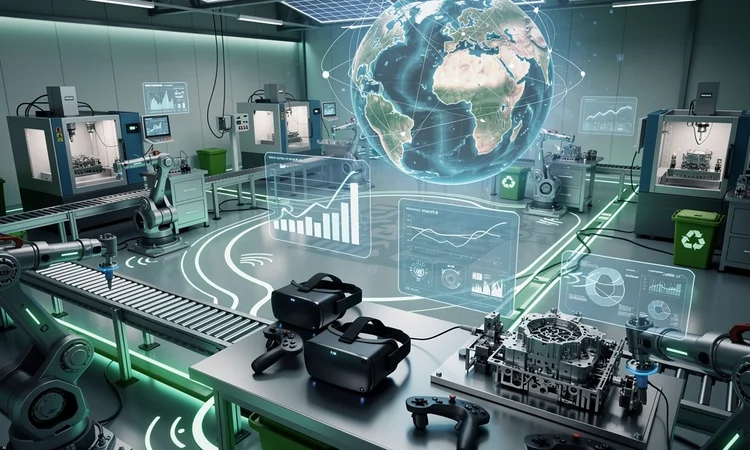
In the heart of modern factories, where precision meets innovation, virtual reality (VR) is no longer a futuristic gimmick but a core tool reshaping operations. As we step into 2025, manufacturers are leveraging VR to simulate complex processes, train workers safely, and streamline design workflows. This shift is driven by rapid advancements in hardware and software, making immersive technologies more accessible and effective than ever. According to a report from Fortune Business Insights , the global VR in manufacturing market is projected to surge from $5.69 billion in 2024 to $38.93 billion by 2032, boasting a compound annual growth rate of 27.2%. This explosive growth underscores how VR is becoming indispensable for boosting efficiency and reducing costs.
Beyond market figures, real-world applications are painting a vivid picture of VR’s impact. Companies like Boeing and Ford have integrated VR into their assembly lines, allowing engineers to visualize prototypes in three-dimensional spaces before physical production begins. This not only cuts down on material waste but also accelerates iteration cycles. In training scenarios, VR environments replicate hazardous factory settings without the risks, enabling workers to practice machinery operation or emergency responses in a controlled virtual space. Recent posts on X highlight this trend, with users discussing how VR headsets are enabling remote maintenance and predictive troubleshooting, aligning with broader automation pushes in the sector.
The integration of VR with other technologies, such as artificial intelligence and the Internet of Things, is amplifying its potential. For instance, AI-driven simulations can predict equipment failures within VR models, allowing preemptive fixes. This convergence is particularly evident in Europe, where countries like Germany and the U.K. are leading the charge in adopting VR for workforce enhancement, as noted in a press release from Fortune Business Insights . Here, cloud-based VR systems paired with private 5G networks are facilitating low-latency remote assistance, transforming how teams collaborate across global supply chains.
Training Transformations and Safety Enhancements
Education in manufacturing is undergoing a profound evolution thanks to VR. Traditional methods often involve costly physical mockups or on-the-job learning, which can be inefficient and dangerous. VR flips this script by offering immersive simulations that mimic real-world scenarios with stunning accuracy. A study published in ScienceDirect explores how VR is revolutionizing manufacturing education, emphasizing its role in additive manufacturing and design processes. Students and professionals can experiment with virtual prototypes, honing skills without the expense of real materials.
Moreover, VR’s safety benefits are a game-changer. In high-risk environments like chemical plants or heavy machinery operations, virtual training reduces accident rates significantly. Workers can navigate simulated emergencies, such as equipment malfunctions or chemical spills, building muscle memory in a risk-free setting. Insights from HQ Software Lab detail how VR aids in quality control by allowing inspectors to examine virtual models for defects before production, minimizing errors that could lead to recalls.
The emotional and experiential aspects of VR training are also noteworthy. A recent mixed-methods study in the International Journal of Human–Computer Interaction found that VR not only improves performance but also enhances user engagement and reduces stress during learning. Participants reported higher retention rates and a more positive emotional response compared to traditional methods, suggesting VR could address workforce shortages by making training more appealing to younger generations entering the field.
Design and Prototyping Revolutions
At the design stage, VR is dismantling barriers to innovation. Engineers can walk through virtual factories, tweaking layouts and workflows in real time. This capability is crucial for complex products like automobiles or aerospace components, where even minor design flaws can be catastrophic. The Business.com article highlights how next-generation VR is making these tools readily available, enabling smaller manufacturers to compete with industry giants.
Prototyping, once a time-consuming and expensive endeavor, is now accelerated through VR. Digital twins—virtual replicas of physical assets—allow for testing under various conditions without building multiple physical models. According to Grand View Research , the combined augmented reality (AR) and VR market in manufacturing was valued at $8.01 billion in 2022 and is expected to reach $62.71 billion by 2030, growing at 29.3%. This growth is fueled by applications in product design, where VR handles intricate 3D models requiring powerful computing.
Integration with cloud technology is further enhancing prototyping. As per insights from recent X posts, advancements in 5G and IoT are enabling seamless data sharing, allowing teams to collaborate on virtual prototypes from anywhere. This is particularly transformative for global operations, where time zones and distances once hindered progress. A post from CTIA on X emphasizes how 5G-enabled VR headsets are empowering frontline workers to perform remote tasks, underscoring the technology’s role in preventive maintenance and inspection.
Market Dynamics and Regional Leadership
The market for VR in manufacturing is characterized by robust regional variations. North America leads with immersive technologies redefining entertainment, healthcare, and enterprise applications, as detailed in a forecast from The Swamp . Here, companies are investing heavily in VR for simulation and training, driven by a tech-savvy workforce and supportive infrastructure.
Europe, meanwhile, is focusing on automation and productivity. Germany’s manufacturing sector, renowned for precision engineering, is adopting VR to enhance efficiency, with cloud-integrated systems dominating deployments. The U.K. follows suit, leveraging VR for complex tasks like product development. A report from Gray discusses how AR and VR are emerging for training and quality control, pointing to a future where these tools are standard.
Asia-Pacific is emerging as a hotspot for VR adoption, with rapid industrialization and tech investments. Countries like China and Japan are integrating VR into smart factories, combining it with robotics for unprecedented automation levels. Recent news from OpenPR highlights trends in AR and VR, forecasting growth driven by innovations from players like Microsoft, PTC, and Siemens.
Innovations on the Horizon
Looking ahead, 2025 promises breakthroughs that could redefine manufacturing norms. Advancements in haptic feedback and mixed reality are making VR experiences more tactile and intuitive. For example, engineers can “feel” virtual components, improving design accuracy. A piece from Firstpost notes that while AI dominates, VR innovations are key in industrial applications, with developments in laser cutting and 3D printing enhanced by virtual simulations.
Hybrid approaches, blending VR with physical prototyping, are gaining traction. Posts on X from users like Greg Koenig discuss high-speed CNC machining enabled by VR planning, allowing for precise component manufacturing from raw materials. This ties into broader trends like space-based manufacturing, where VR simulates microgravity environments for orbital production, as mentioned in SA News Channel’s X update.
Challenges remain, such as high initial costs and the need for skilled operators, but decreasing hardware prices are mitigating these. A critical X post from Rui Ma envisions mirror worlds through digital twins, predicting cost reductions in 3D content creation via AI, which could democratize VR access for smaller firms.
Overcoming Barriers and Future Prospects
Adoption barriers are being addressed through scalable solutions. Cloud-based platforms are lowering entry points, enabling even mid-sized manufacturers to deploy VR without massive upfront investments. Insights from Critical Hit debate whether 2025 will mark a breakthrough or stagnation for VR, but current trajectories suggest the former, with mainstream AR/VR glasses pulling users into immersive realms.
Sustainability is another angle where VR shines. By reducing physical prototypes, it cuts waste and energy consumption, aligning with global green initiatives. X discussions, such as those from Ivory Tang, point to AI’s role in robotics, where VR bridges the gap between digital planning and physical execution, potentially automating labor-intensive setups.
As manufacturing evolves, VR stands as a pillar of this transformation, fostering innovation, safety, and efficiency. With projections indicating continued growth, the sector is poised for an era where virtual simulations drive real-world success, ensuring competitiveness in an increasingly digital world. Recent analyses, including one from Glass Almanac , surprise with developments in AR that complement VR, redefining how industries operate. This immersive overhaul is not just changing manufacturing—it’s redefining its future possibilities.


Leave a Reply
Your email address will not be published.