
2026’s State HR Patchwork: 48 Compliance Shifts Employers Can’t Ignore

Samuel Johnson
Samuel Johnson

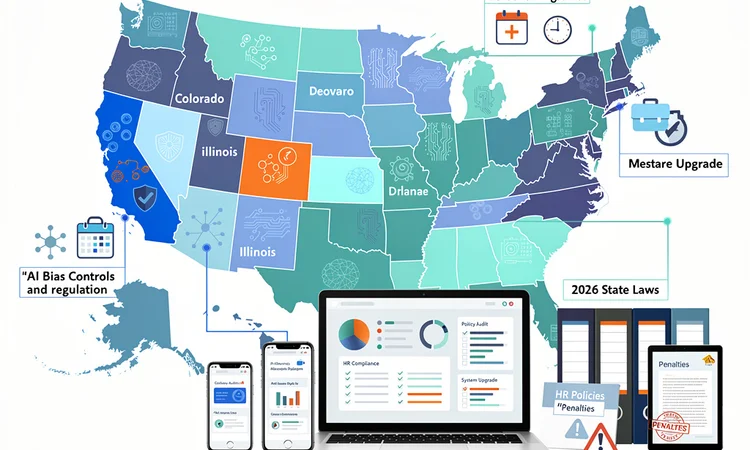
Employers navigate 48 state-specific HR shifts in 2026, from AI bias curbs in Colorado and Illinois to paid-leave launches in Delaware and Maine. Multistate compliance demands policy audits and tech upgrades to avert penalties.

2026’s State HR Patchwork: 48 Compliance Shifts Employers Can’t Ignore

As the calendar flips to 2026, U.S. employers confront a dizzying array of state-specific regulations reshaping human-resources practices. From expansions in paid leave to novel restrictions on artificial intelligence in hiring, the divergences across jurisdictions demand vigilant adaptation, particularly for multistate operators. ADP’s SPARK blog details 48 targeted changes , underscoring the imperative for proactive policy overhauls.

California leads with multifaceted updates effective January 1, including amendments to sick leave allowing use for judicial proceedings tied to crime victimization and mandates separating pay data from personnel files. Employers must also revise “pay scale” definitions for disclosures and clarify vehicle reimbursement duties under business-expense rules. Ogletree Deakins highlights these as part of a broader wave impacting wage-hour compliance and leave administration in a January 1 watchlist .

Personnel-record access expands to education and training documents, while WARN notices gain new requirements for mass layoffs. By February 1, a standalone annual notice on employee rights becomes mandatory, per HR Dive’s coverage of 10 Golden State shifts . Hospitality recall rights for Covid-era layoffs persist through year-end.

West Coast AI and Leave Expansions

Colorado’s June 30 AI law targets high-risk systems to curb discrimination, imposing duties on developers and deployers, as noted in ADP’s roundup. Paid family leave extends for parents of NICU infants, with reduced premiums. Illinois joins the fray January 1, clarifying paid nursing breaks and prohibiting AI-driven bias in decisions, per HR Executive .

The Prairie State’s updates amend VESSA to bar retaliation for using company devices to document violence and expand organ-donation leave to part-timers. Human Rights Act tweaks ban ZIP-code proxies for protected classes and require AI-use notifications. By June 1, NICU leave mandates hit smaller employers at 10 days unpaid, scaling to 20 for larger ones.

Connecticut’s sick leave overhaul covers firms with 11-plus employees, broadening uses and accrual methods. Delaware and Maine launch 12-week paid family-medical programs January 1 and May 1, respectively, for qualifying employers, aligning with trends tracked by Paychex in HR Executive.

Midwest and Northeast Mandate Surge

Minnesota rolls out paid family-medical leave January 1, with tweaks to contributions and intermittent use, alongside mandated breaks: 15 minutes every four hours or longer for restroom access, plus 30-minute meals after six hours. New Hampshire introduces unpaid childbirth leave up to 25 hours for 20-plus-employee firms and military-spouse leave for 50-plus-employee operations.

New York City targets app-based grocery deliverers with minimum pay January 26, then expands earned safe-sick time February 22, adding unpaid leave, prenatal paid time, and easing schedule-change rules. Nevada requires air-quality monitoring for 10-plus-employee outdoor-exposed workers when indices hit 150-plus.

Oregon clarifies overpayment collections, adds blood donation to paid sick leave for 10-plus-employee firms (unpaid below), mandates hire-time pay explanations, and demands health-care violence prevention upgrades, as detailed in Seyfarth Shaw’s Horizon Report .

Pay, Safety, and Posting Pressures

Pennsylvania mandates veteran-benefits posters for 50-plus-employee employers January 1; Pittsburgh widens sick-leave accrual. Philadelphia tightens background checks January 6, bans hair discrimination January 24, and refines risk assessments for criminal records. Rhode Island requires hotel and rental human-trafficking training, new-hire notices, donor protections, and TCI sibling coverage.

Texas curbs discriminatory AI intent January 1. Washington’s hate-crime victim leave, paid family expansions, isolated-worker safety (panic buttons), hospital break waivers, and sick leave for immigration proceedings hit January 1; Fair Chance Act and child-labor penalties strengthen July 1, per ADP.

These shifts compound minimum-wage hikes in nearly 20 states, per HR Executive, and salary-threshold rises—like California’s $70,304 overtime exemption. Multistate firms must recalibrate payroll, per BambooHR’s guide .

Broader Implications for Operations

AI scrutiny intensifies: Colorado, Illinois, Texas, and others mandate bias checks, notices. “When evaluating any AI tool, consider whether it was developed using secure, high-quality data,” advises ADP’s Helena Almeida in SPARK’s trends piece . Paid-leave programs proliferate, adding to 13 active states.

Posters, notices, and training multiply: Pennsylvania veterans, Oregon earnings, California rights. Fisher Phillips flags 50-plus January 1 laws, urging handbook audits. Enforcement risks rise; violations invite penalties, suits.

Experts like Ogletree’s Lucas J. Asper urge webinars for playbooks. Proactive monitoring via tools like ADP alerts or Seyfarth reports positions firms ahead.

Strategic Pathways Forward

For industry insiders, 2026 tests HR-tech integration: Update HCM for geo-fencing compliance, audit AI vendors, model leave costs. Multistate operators face “added complexity,” per Paychex, with divergent accruals, notices.

Federal overlays—like OBBBA tax tweaks—intersect, but states dominate. Hughes Recruiting notes Midwest divergences demand tailored policies. Noncompliance erodes margins; foresight builds resilience.

Employers succeeding invest in compliance platforms, legal counsel, training. As ADP’s Eye on Compliance Team asserts, early alignment mitigates risk, bolsters workforce trust.

About the Author

Samuel Johnson
Samuel Johnson

Samuel Johnson is a journalist who focuses on consumer behavior. They work through clear frameworks, case studies, and practical checklists to make complex topics approachable. They frequently translate research into action for product leaders, prioritizing clarity over buzzwords. Their coverage includes guidance for teams under resource or time constraints. Their reporting blends qualitative insight with data, highlighting what actually changes decision‑making. They often cover how organizations respond to change, from process redesign to technology adoption. They believe good analysis should be specific, testable, and useful to practitioners. They look for overlooked details that differentiate sustainable success from short‑term wins. Readers appreciate their ability to connect strategic goals with everyday workflows. They write about both the promise and the cost of transformation, including risks that are easy to overlook. They emphasize responsible innovation and the constraints teams face when scaling products or services. They emphasize decision‑making under uncertainty and imperfect data. They value transparency, practical advice, and honest uncertainty.

Comments

Join the discussion and share your thoughts.

No comments yet. Be the first to comment.

Leave a Reply

Your email address will not be published.

Related Posts

Atlantic’s $1.2 Billion Staffing Power Play: F1 Tech Talent Fuels Transatlantic Surge

Atlantic’s $1.2 Billion Staffing Power Play: F1 Tech Talent Fuels Transatlantic Surge

Atlantic International Corp. acquires Circle8 Group in an all-stock deal, creating a $1.2 billion global staffing platform blending U.S. industrial and European IT talent. Circle8's Aston Martin F1 partnership highlights its elite capabilities amid cross-selling potential.

Posted on: by Liam Price
Bots at Work: Service Robotics’ $500 Billion Surge Reshapes Labor Markets

Bots at Work: Service Robotics’ $500 Billion Surge Reshapes Labor Markets

Service robotics rockets toward $498 billion by 2033 at 37% CAGR, automating logistics, healthcare, and hospitality amid AI advances and labor crunches. Deals like Serve's Diligent buy propel indoor expansions.

Posted on: by Layla Reed
Aspire-Deel Tie-Up Reshapes Global Hiring for Fintech Startups

Aspire-Deel Tie-Up Reshapes Global Hiring for Fintech Startups

Aspire integrates Deel's EOR services for seamless global hiring and finance management, targeting startups scaling internationally. The partnership addresses compliance hurdles, offering unified insights into workforce costs and cash flow.

Business
Deel’s Record-Breaking Hiring Spectacle: AI-Powered Push Reshapes Global Talent Wars

Deel’s Record-Breaking Hiring Spectacle: AI-Powered Push Reshapes Global Talent Wars

Deel shattered records with 6,848 attendees at its largest online hiring event, blending AI tools and global reach to fill 300+ sales roles. Amid growth to $17.3 billion valuation, the feat highlights innovations in HR and payroll but sparks debate on stunt versus substance.

Business
Deel’s $17 Billion Sprint: From Y Combinator to Global Payroll Powerhouse

Deel’s $17 Billion Sprint: From Y Combinator to Global Payroll Powerhouse

Deel rocketed to a $17.3 billion valuation in seven years by pioneering owned global payroll infrastructure, processing $22 billion annually for 37,000 firms. Amid IPO prep and DOJ scrutiny, COO Dan Westgarth reveals elite ops driving $1 billion revenue.

Business
HR’s AI Superagent Revolution: Reinventing the Workforce Engine

HR’s AI Superagent Revolution: Reinventing the Workforce Engine

Enterprise AI Superagents ignite HR's biggest transformation in decades, automating 30-40% of jobs while birthing full-stack roles and skills-first strategies. Josh Bersin leads the charge amid bias risks and tech trends reshaping hiring, experience, and leadership.

Business
AI’s HR Reckoning: 10 Pivotal Shifts Reshaping Workforce Strategies in 2026

AI’s HR Reckoning: 10 Pivotal Shifts Reshaping Workforce Strategies in 2026

As AI propels organizations into hybrid human-machine teams, HR must master fluency screening, skills-based shifts and agentic governance to thrive amid 2026's disruptions, blending tech efficiency with human resilience.

Business
The Upselling Paradox: How Retailers Walk the Tightrope Between Revenue Growth and Consumer Trust

The Upselling Paradox: How Retailers Walk the Tightrope Between Revenue Growth and Consumer Trust

New research reveals upselling's hidden risks as retailers balance revenue growth with customer trust. While upselling can boost transaction values by 10-30%, approximately 23% of consumers experience post-purchase regret, potentially damaging long-term profitability and brand reputation in an increasingly skeptical marketplace.

Business
Chrome Extensions’ Silent Siege on Enterprise HR Crown Jewels

Chrome Extensions’ Silent Siege on Enterprise HR Crown Jewels

Five malicious Chrome extensions hijacked sessions on Workday, NetSuite, and SAP SuccessFactors, stealing cookies, blocking admin pages, and enabling takeovers. Socket's discovery prompted Google takedowns after 2,300 installs, exposing enterprise browser risks.

Business
AI Proficiency Divide: HR’s Mounting Crisis

AI Proficiency Divide: HR’s Mounting Crisis

Corporate AI adoption surges, but superficial employee use creates a proficiency chasm now demanding HR intervention through targeted training, outcome metrics, and equity for overlooked workers.

Business