AI Agents Resurrect the Database Imperative

Ivy Bailey
Ivy Bailey

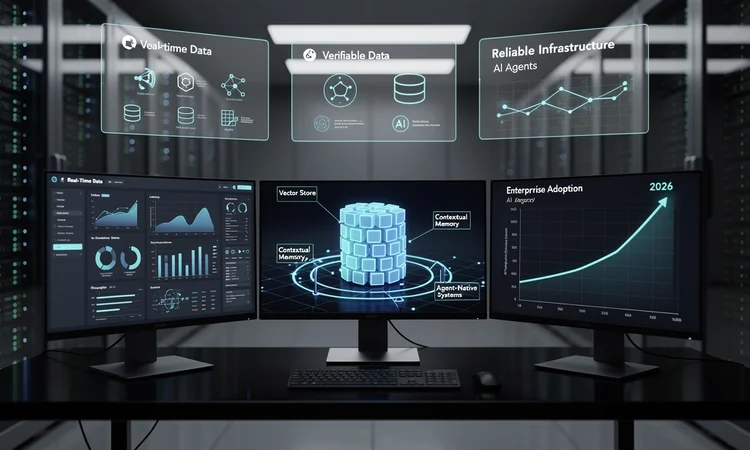
AI agents are forcing a database renaissance, prioritizing reliable infrastructure for real-time, verifiable data. Vector stores, contextual memory, and agent-native systems address scaling challenges, with forecasts signaling massive enterprise adoption by 2026.

AI Agents Resurrect the Database Imperative

In the rush toward autonomous AI agents, a long-dormant truth has resurfaced: databases are the unyielding foundation of reliable intelligence. As enterprises deploy agentic systems at scale, the fragility of data infrastructure has emerged as the primary bottleneck, demanding robust, real-time storage solutions that traditional cloud abstractions once obscured.

“You can’t have reliable AI agents without reliable data infrastructure,” argues Matt Asay in InfoWorld . This resurgence echoes the early days of computing, when data persistence defined system viability, but now amplified by agents that query, update, and orchestrate across petabytes in milliseconds.

Recent forecasts underscore the shift. Gartner predicts 40% of enterprise applications will integrate task-specific AI agents by 2026, up from less than 5% today, per an AWS report . Financial giants like Itaú Unibanco have migrated mainframe workloads to AWS, achieving 99.99% uptime for 70 million customers, proving mission-critical data layers are non-negotiable.

Agentic Demands Redefine Storage

Agentic AI—autonomous systems that plan, reason, and act—exposes database shortcomings. Traditional OLTP systems, optimized for human-paced transactions, falter under agents’ relentless read-write barrages. “2026 is the year databases stop being passive storage and become active substrates for autonomous software creation,” states a PingCAP analysis .

Unlike humans, agents spawn ephemeral workloads without throttling. They branch schemas, merge experiments, and discard resources at machine speed, necessitating scale-to-zero economics and dynamic cost surfaces. Instaclustr’s managed services for Apache Cassandra and Kafka provide the scalable backbone, enabling real-time data fusion for adaptive decisions.

VentureBeat warns that RAG, once hailed for grounding LLMs, yields to contextual memory in agentic workflows. Systems like Hindsight and Memobase maintain state, learn from feedback, and adapt, rendering static retrieval obsolete for operational deployments.

Vector Stores Evolve Amid Reliability Scrutiny

Vector databases, purpose-built for embeddings, powered the generative AI surge but now face reliability probes. “Data + AI teams are beginning to realize those vector databases they’ve been relying on might not be as reliable as they thought,” notes Towards Data Science . Lacking built-in monitoring for embeddings and search, they risk degrading agent accuracy.

Pinecone, a managed vector service, excels in uptime and scalability for RAG, while open-source FAISS offers raw power for custom integration. Yet, as Towards Data Science observes, observability tools are rising to track vector drift, ensuring sub-50ms retrievals for interactive agents.

Hybrid approaches dominate: Postgres with pgvector extensions now rivals dedicated stores, blending operational data with semantic search. Knack highlights Postgres’s 2025 native vector support, enhancing AI-driven semantic capabilities without rip-and-replace overhauls.

Enterprise Shifts Toward Intelligent Foundations

Databricks reports over 80% of new databases created by AI agents, signaling a pivot to agent-native infrastructure. Box CEO Aaron Levie emphasizes systems of record as guardrails: “When we have 100X more agents than humans, we’ll care a lot about the workflows and data those agents are tied to.”

The New Stack identifies four infrastructure pivots for 2026: intelligent processing, multi-modal integration, and real-time architectures. SearchCans stresses real-time data as table stakes, warning that outdated info spells competitive defeat.

Google Cloud, a Gartner Leader in Cloud Database Management Systems for 2025, positions AlloyDB for agentic eras, fusing analytical petabytes with transactional speed. Agents demand this duality to act on historical context in real time.

Memory and Provenance as Competitive Moats

Persistent memory distinguishes production agents. LangChain’s State of Agent Engineering reveals 57% of organizations rely on base models with RAG, forgoing fine-tuning’s overhead. Yet, agentic memory—long-context retention across sessions—becomes mandatory.

SiliconANGLE predicts scaling via contextual intelligence, with semantic layers supplanting unification narratives. Medium’s 2026 Data Engineering Roadmap urges architects to curate meaning for AI consumers, providing provenance on reliability and relations.

X discussions amplify urgency. Astasia Myers notes Databricks’ stat, while Levie warns of fragility in data pulls: “The fragility point often has nothing to do with the model and everything to do with whether the agent pulled the right value.”

Protocols and Acquisitions Signal Consolidation

Interoperability protocols like Anthropic’s MCP and Google’s A2A standardize agent-tool connections, per MachineLearningMastery. TechTarget reports A2A’s merger with IBM’s framework, backed by AWS, Microsoft, and Snowflake.

M&A accelerates: Meta’s $14.3 billion in Scale AI, IBM’s $11 billion Confluent bid. Solutions Review forecasts a $7 trillion enterprise AI data market by 2030, with Dell enhancing platforms for reliable outcomes.

Graph databases surge for AI reasoning, per ZDNet, comprising the fastest-growing category in the $137 billion market. Their connected patterns fuel inferences relational stores can’t match.

Production Realities Demand Governance

Securiti’s 2026 trends highlight data provenance and ungoverned agents as risks. PerleLabs anchors AI data via blockchain-stored human judgments, restoring legitimacy in high-stakes domains.

AWS Developer Advocate Elizabeth Fuentes stresses long-term memory: “AI agents forgetting users is a problem.” Contextual AI’s Agent Composer transforms enterprise RAG into production agents, per VentureBeat.

As agents proliferate, databases evolve from commodities to strategic assets, ensuring verifiable truth powers the next computing paradigm.
About the Author

Ivy Bailey
Ivy Bailey

Ivy Bailey specializes in product management and reports on the systems behind modern business. They work through trend monitoring with careful context and caveats to make complex topics approachable. They look for overlooked details that differentiate sustainable success from short‑term wins. Their perspective is shaped by interviews across engineering, operations, and leadership roles. Readers appreciate their ability to connect strategic goals with everyday workflows. They also highlight cultural factors that determine whether change sticks. They frequently translate research into action for engineering managers, prioritizing clarity over buzzwords. They are known for dissecting tools and strategies that improve execution without adding complexity. A recurring theme in their writing is how teams build repeatable systems and measure impact over time. They frequently compare approaches across industries to surface patterns that travel well. They avoid buzzwords, focusing instead on outcomes, incentives, and the human side of technology. They tend to favor small experiments over sweeping predictions. Readers return for the clarity, the caution, and the actionable takeaways.

Comments

Join the discussion and share your thoughts.

No comments yet. Be the first to comment.

Leave a Reply

Your email address will not be published.

Related Posts

Formae’s Multi-Cloud Leap: Platform Engineering Labs Arms Builders Against IaC Gridlock

Formae’s Multi-Cloud Leap: Platform Engineering Labs Arms Builders Against IaC Gridlock

Platform Engineering Labs' formae surges to multi-cloud with GCP, Azure, OCI, and OVH beta support plus a Plugin SDK, empowering infrastructure builders to extend IaC without vendor delays. This upgrade redefines extensibility in a fragmented cloud era.

Posted on: by Ivy Bailey
Sky47’s Sovereign Surge: Pakistan’s Massive AI Cloud Bet

Sky47’s Sovereign Surge: Pakistan’s Massive AI Cloud Bet

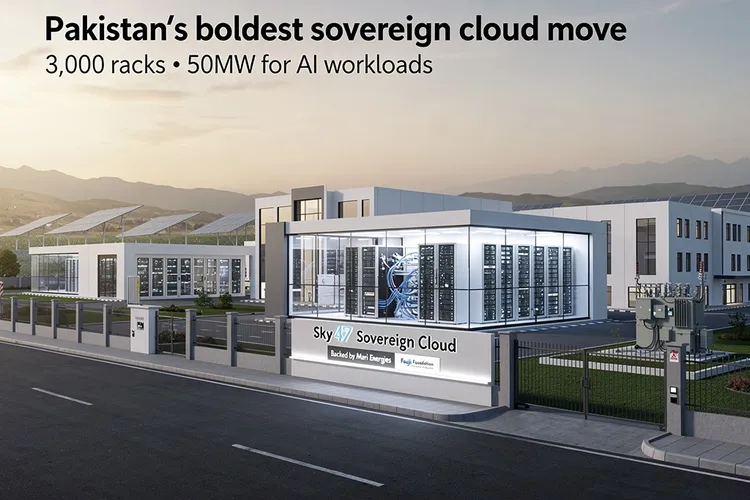
Sky47's January 2026 launch marks Pakistan's boldest sovereign cloud move, with 3,000 racks and 50MW for AI workloads. Backed by Mari Energies and Fauji Foundation, it eyes hyperscalers amid rising data sovereignty demands.

Posted on: by Zoe Patel
Cloud’s Complexity Trap: How Tool Overload and AI-Wielding Attackers Are Fracturing Security Defenses

Cloud’s Complexity Trap: How Tool Overload and AI-Wielding Attackers Are Fracturing Security Defenses

Fortinet's 2026 Cloud Security Report exposes a widening complexity gap in hybrid clouds, where tool sprawl, AI-driven attacks, and skills shortages overwhelm teams despite rising budgets. Nearly 70% cite fragmentation as the top barrier, urging platform shifts and MSSP aid.

IT Management
NordVPN’s Sixth Consecutive Audit Validates Zero-Logs Promise as Privacy Scrutiny Intensifies

NordVPN’s Sixth Consecutive Audit Validates Zero-Logs Promise as Privacy Scrutiny Intensifies

NordVPN completes its sixth consecutive independent audit by Deloitte, confirming its zero-logs policy amid intensifying privacy scrutiny. The verification highlights industry trends toward verifiable transparency as regulatory pressure mounts and consumer skepticism grows regarding VPN privacy claims.

IT Management
Upwind’s Runtime Revolution: $250M Fuels $1.5B Cloud Security Unicorn

Upwind’s Runtime Revolution: $250M Fuels $1.5B Cloud Security Unicorn

Upwind's $250 million Series B catapults it to $1.5 billion valuation, powering runtime-first cloud security amid 900% revenue surge. Backed by Bessemer and all-stars, the ex-Spot.io team targets AI-era threats for giants like Siemens and Roku.

IT Management
Mesh Security’s $12M Bet: Unifying Cyber Chaos into Enterprise Powerhouse

Mesh Security’s $12M Bet: Unifying Cyber Chaos into Enterprise Powerhouse

Mesh Security's $12M Series A funds its CSMA platform to unify enterprise cyber tools across clouds and SaaS, eliminating silos agentlessly. Backed by Lobby Capital and SentinelOne's CVC, it gains traction with Paychex and Nutanix amid tool sprawl crisis.

IT Management
Abstract Security and Netskope Forge Real-Time Threat Pipeline, Slicing Through Data Delays

Abstract Security and Netskope Forge Real-Time Threat Pipeline, Slicing Through Data Delays

Abstract Security and Netskope's new partnership embeds real-time detection into security data streams, eliminating indexing delays and slashing costs for joint customers. By processing Netskope telemetry in motion, it boosts threat response while preserving data control.

IT Management
Nationwide’s AI Fortress: AWS Bolsters Fraud Defenses for 17 Million Clients

Nationwide’s AI Fortress: AWS Bolsters Fraud Defenses for 17 Million Clients

Nationwide Building Society expands its AWS partnership to deploy AI-driven cloud security and fraud prevention, powering tools like Call Checker against impersonation scams affecting 17% of incidents. Workforce training boosts cloud literacy for enhanced service to 17 million customers.

IT Management
CISOs’ Hidden Roadblocks: Why 58% See Their Firms Unready for Cyber Onslaught

CISOs’ Hidden Roadblocks: Why 58% See Their Firms Unready for Cyber Onslaught

Despite rising budgets, 58% of CISOs deem their organizations unready for cyberattacks, hindered by team overload, AI gaps, talent shortages, and tool sprawl. Experts urge prioritization training, governance, and resilience focus.

IT Management
Security Chiefs Gear Up for AI Agents and Poly-Threats in 2026

Security Chiefs Gear Up for AI Agents and Poly-Threats in 2026

Security leaders brace for 2026's AI agents, poly-threats, and quantum risks, shifting from reactive defenses to governance, identity controls, and resilient architectures amid record attacks and regulatory mandates.

IT Management