AI Answers Demand New Rules: Why Google SEO Fails ChatGPT Citations

Chloe Ortiz
Chloe Ortiz

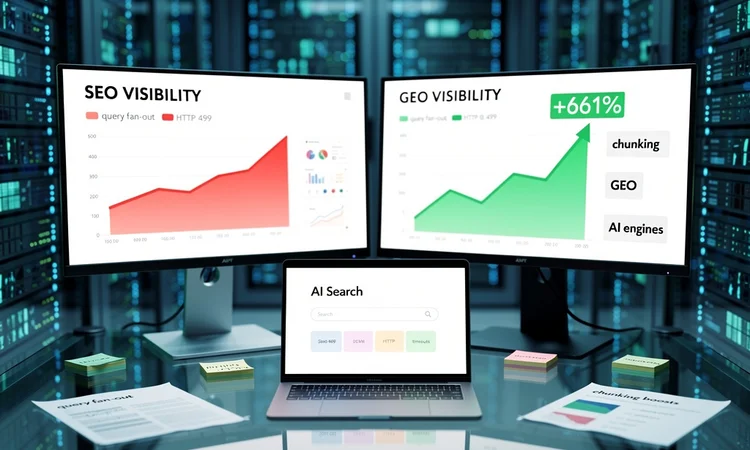
Mike King reveals why Google SEO tactics fail AI engines like ChatGPT, from query fan-out to HTTP 499 timeouts and chunking boosts. Case studies show 661% visibility gains via GEO.

AI Answers Demand New Rules: Why Google SEO Fails ChatGPT Citations

Mike King, founder and CEO of iPullRank and twice-named Search Marketer of the Year by Search Engine Land , delivered a stark message during a January 2026 SparkToro Office Hours session: Optimizing content for large language models like ChatGPT, Gemini and Claude requires tactics distinct from traditional Google search engine optimization. “Standard SEO ranking factors explain only 4-7% of the citations in AI results,” King stated, citing research from Josh Blyskal at Profound, which analyzed 250 million AI responses and found just a 39% overlap between ChatGPT sources and Google rankings.

The core divergence stems from query fan-out, where AI engines decompose a single user prompt into multiple synthetic subqueries. For a query like “training program for New York Marathon,” models generate related questions such as “how to train for 26.2 miles” or “marathon training checklist.” AI Overviews use 5-10 such queries for speed, while ChatGPT deploys 3-7 and AI Mode up to 100, per King’s analysis. A Semrush study revealed 28.3% of these queries have zero search volume, invisible to tools like Ahrefs or SEMrush, creating massive data gaps for marketers.

King’s tool Qoria, leveraging the Gemini API, simulates this process by prompting the model to generate fan-out queries and even execute Google searches via function calls. “We were the first to give you QFO data,” he noted, promising to open-source the underlying code soon. Profound extracts actual fan-out from ChatGPT’s API JSON, boosting overlap estimates from 19% to 39% when accounted for, as detailed in their 250 million response analysis .

Technical Pitfalls Blocking AI Visibility

Unlike Google and Bing, which rely on indexes, platforms like ChatGPT fetch pages in real time, introducing unique failure modes. King highlighted HTTP 499 errors—client timeouts from slow-loading pages—as a silent killer. “ChatGPT gives up if your page takes too long,” he explained, sharing a client case where spiking 499s in logs correlated with plummeting visibility. Traditional SEO overlooks this Nginx-originated code, absent from most HTTP response guides.

Metadata emerges as a direct ranking signal for AI. “Your meta description is the advertisement to the LLM,” King said. While Google rewrites 80% of descriptions, ChatGPT uses them verbatim to decide fetches. Profound data shows semantically rich URL slugs yield 11.4% more citations, with query-specific slugs adding 5%. Schema and accessibility matter too, as non-JavaScript rendering aids parsing, and LLMs ingest structured data beyond Google’s rich results.

Strategic shifts follow: Brands hiding pricing pages for lead gen lose narrative control, as AI scrapes Clutch or DesignRush. “It’s reputation management across the content ecosystem,” King advised, noting consensus bias in ChatGPT versus site-primary pulls in AI Overviews.

Chunking’s Measurable Edge Over Walls of Text

Dismissing claims that “chunking is a scam,” King demonstrated splitting a paragraph on “machine learning and data privacy” boosted cosine similarity scores from 0.6481/0.6948 to 0.7477/0.7634—a 15.4% and 9.78% lift. This aligns content with vector space models powering retrieval, where proximity determines relevance. “Structure for humans first, but measure semantically,” he urged.

Emerging research reinforces: Berkeley’s Ring Attention chunks long sequences for unified meaning; Meta’s MuWalker builds hierarchical memory trees; MIT’s Recursive Language Model and Google’s Mixture of Recursions favor atomic units. Even infinite context compresses cleaner from structured chunks, countering Google spokesman Danny Sullivan’s warnings. Rand Fishkin interjected: “Doesn’t align with how people read.” King agreed, likening machines to an accessibility persona.

Style needn’t suffer: “You can blend voice with extractable data points,” King said, citing rap’s technical flair as analogy. iPullRank’s 20-chapter AI Search Manual expands on GEO content production, emphasizing atomic units amid content collapse.

Proven Gains from GEO Overhauls

Case studies validate: A vehicle sales client saw 661% ChatGPT visibility growth and 330% in AI Overviews via semantic gap-filling and technical fixes. Telecom jumped 253% in Overviews; financial services gained 121% signups, 52.6% organic traffic, and 24% AI Overviews after relevance engineering. “AI search is a raffle—rank for more synthetic queries to buy more tickets,” King framed it.

Measurement remains probabilistic, akin to Google Search Console averages. Profound scrapes interfaces multiple times daily for precision; clickstream data could refine. Recency relies on explicit dates, as AI lacks Google’s Wayback-style indexing—update timestamps on evergreen posts. Reddit dominates citations (despite recency bias overridden by comprehensive older threads), followed by YouTube as “cheat code.”

Q&A touched priorities: Treat AI as branding, not performance (low referral ROI). PR and UGC build consensus; avoid URL rewrites (catastrophic for SEO) but craft descriptive slugs forward. Acronyms work if defined via NLP entity resolution.

Tools and Roadmaps for Practitioners

SEO software lags, King lamented, lacking fan-out simulation or passage scoring. Start manually: Split overbroad paragraphs, add clear headings, inject data for authority, test readability. His forthcoming open-source tools will bridge gaps. Profound’s citation intelligence tracks share of voice; Semrush evolves attribution.

As AI Mode queries lengthen to 10-11 words per iPullRank data , and ChatGPT hits 400 million weekly users with 60-70% web retrieval per Profound , GEO demands discipline akin to social channels—nuanced strategies despite shared tactics. Decision-makers’ focus offers SEO a reputation reboot.

About the Author

Chloe Ortiz
Chloe Ortiz

Chloe Ortiz specializes in marketing performance and reports on the systems behind modern business. They work through scenario planning and on‑the‑ground reporting to make complex topics approachable. Readers appreciate their ability to connect strategic goals with everyday workflows. They write about both the promise and the cost of transformation, including risks that are easy to overlook. Their perspective is shaped by interviews across engineering, operations, and leadership roles. They also highlight cultural factors that determine whether change sticks. They value transparent sourcing and prefer primary data when it is available. They often cover how organizations respond to change, from process redesign to technology adoption. They avoid buzzwords, focusing instead on outcomes, incentives, and the human side of technology. Their coverage includes guidance for teams under resource or time constraints. They look for overlooked details that differentiate sustainable success from short‑term wins. They are interested in the economics of scale and operational resilience. They value transparency, practical advice, and honest uncertainty.

Comments

Join the discussion and share your thoughts.

No comments yet. Be the first to comment.

Leave a Reply

Your email address will not be published.

Related Posts

AI Search Erodes Organic Traffic by 30-40% in 2026, Publishers Adapt

AI Search Erodes Organic Traffic by 30-40% in 2026, Publishers Adapt

In 2026, AI-driven search features like Google's AI Overviews are eroding organic web traffic, with declines of 30-40% in referrals from Google and social media, severely impacting publishers and e-commerce. Causes include zero-click searches and algorithm shifts. Adaptation strategies emphasize diversification and content optimization for sustainability.

Posted on: by Aria Brooks
Meta Launches Ads on Threads Globally Next Week for Revenue Boost

Meta Launches Ads on Threads Globally Next Week for Revenue Boost

Meta Platforms is launching ads on Threads globally next week, following successful tests in select markets, to monetize its 400 million+ user base amid competition with X. This integrates Threads into Meta's advertising ecosystem, promising revenue growth while prioritizing seamless user experience and retention.

Posted on: by Claire Bell
YouTube TV Launches Custom Multiview for Personalized Viewing

YouTube TV Launches Custom Multiview for Personalized Viewing

YouTube TV is enhancing its multiview feature, enabling subscribers to customize up to four live channels from sports, news, and more, moving beyond preselected bundles. This upgrade, paired with upcoming genre-specific plans in 2026, boosts personalization and viewer engagement in a competitive streaming market.

Advertising Marketing
Vimeo’s Post-Acquisition Purge: Bending Spoons Axes Jobs in Israel and Beyond

Vimeo’s Post-Acquisition Purge: Bending Spoons Axes Jobs in Israel and Beyond

Vimeo faces global layoffs months after Bending Spoons' $1.38 billion acquisition, dismantling its Israeli development center and cutting staff worldwide. The moves follow a prior 10% reduction and signal aggressive cost-cutting by the new owner.

Advertising Marketing
YouTube CEO Unveils 2026 AI Roadmap for Creators and Ethical Tools

YouTube CEO Unveils 2026 AI Roadmap for Creators and Ethical Tools

YouTube CEO Neal Mohan outlines a 2026 AI roadmap to empower creators with tools like AI avatars for Shorts, autodubbing, and monetization analytics, while combating "AI slop" through detection and safeguards. This vision enhances user experiences, global reach, and ethical AI use, positioning YouTube as an innovative entertainment hub.

Advertising Marketing
Will.i.am’s AI Reckoning: From Music Slop to Personal Agents

Will.i.am’s AI Reckoning: From Music Slop to Personal Agents

Will.i.am warns of AI music's evolution from slop to originals, urging personal agents and likeness ownership amid fragmentation. Live performances regain value as regulations loom.

Advertising Marketing
X’s Starterpacks: Copying Bluesky to Fix Onboarding Woes

X’s Starterpacks: Copying Bluesky to Fix Onboarding Woes

X launches Starterpacks, Bluesky-inspired curated account lists to boost onboarding and retention. Curated for niches like crypto, the feature rolls out soon, drawing on proven discovery tactics amid fierce social media competition.

Advertising Marketing
Paramount’s High-Stakes Wager: Will EU Block Netflix’s Warner Bros. Grab?

Paramount’s High-Stakes Wager: Will EU Block Netflix’s Warner Bros. Grab?

Paramount gambles on EU regulators torpedoing Netflix's $83 billion Warner Bros. Discovery bid, amid simultaneous reviews and U.S. pushback. WBD favors Netflix's all-cash offer, but antitrust hurdles could hand victory to David Ellison's hostile play.

Advertising Marketing
Spotify’s AI Playlists Hand Listeners the Reins

Spotify’s AI Playlists Hand Listeners the Reins

Spotify launched AI-driven prompted playlists for U.S. and Canada premium users, enabling custom mixes via natural language prompts tied to vibes and memories. The feature empowers listeners to direct algorithms, boosting engagement amid streaming competition.

Advertising Marketing
Grammy Stars Collaborate with AI on ‘The Eleven Album

Grammy Stars Collaborate with AI on ‘The Eleven Album

Grammy-winning artists like Liza Minnelli and Art Garfunkel collaborate with ElevenLabs' AI on "The Eleven Album," blending human creativity with generated tracks. This project showcases AI's role in efficient music production across genres, while sparking debates on authorship, ethics, and industry innovation. It positions AI as a tool amplifying artistry.

Advertising Marketing