
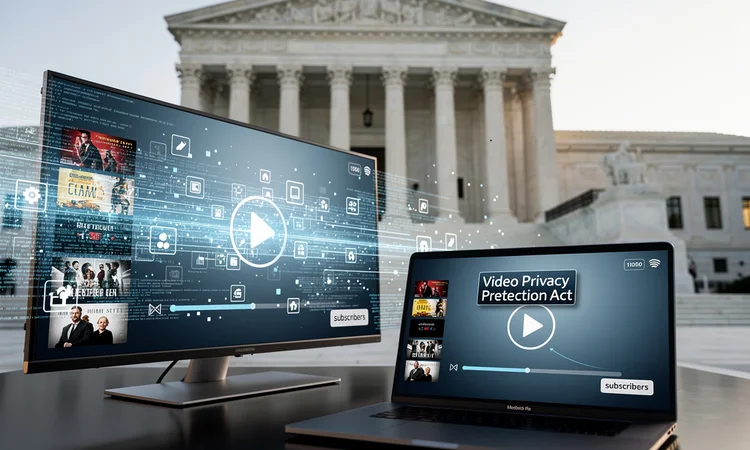
In the autumn of 1987, a Washington D.C. alternative weekly newspaper published the video rental history of Supreme Court nominee Robert Bork. The list was mundane—featuring titles like The Man Who Knew Too Much and various Hitchcock classics—but the political fallout was immediate. Congress, alarmed by the ease with which personal viewing habits could be exposed, swiftly passed the Video Privacy Protection Act (VPPA) of 1988. Nearly four decades later, that statute, written for a world of magnetic tape and brick-and-mortar storefronts, has become the central weapon in a high-stakes battle over digital data rights. The Supreme Court has now granted certiorari to determine whether this analog relic applies to the complex data flows of the modern streaming internet.
The catalyst for this judicial review is a fracture in the federal courts regarding who qualifies as a "consumer" under the Act. While the law was originally designed to prevent video rental clerks from selling customer lists to tabloids, plaintiffs’ attorneys have successfully argued in recent years that it should also prohibit streaming giants from sharing watch histories with data brokers and social media platforms. As reported by Slashdot , the Court’s decision to hear the case marks a critical turning point for the digital media industry, which has faced a barrage of class-action lawsuits alleging that the use of tracking pixels constitutes a violation of federal privacy law.
The Ghost of Blockbuster Past Haunts Silicon Valley
At the heart of the current dispute is Warner Bros. Discovery, Inc. v. Bjelkholm , a case that typifies the modern application of the VPPA. The plaintiffs allege that by downloading a free app or browsing a website, they established a relationship with the video provider that mandates privacy protection. The core legal debate hinges on the statutory definition of a "consumer," which the 1988 Congress defined as a "renter, purchaser, or subscriber of goods or services." In the era of Blockbuster, this was clear-cut; money exchanged hands for a physical object. In the era of ad-supported streaming and freemium models, the lines are significantly blurred.
The Second Circuit Court of Appeals previously ruled that a loose connection—such as merely downloading an app and streaming free content—was insufficient to categorize a user as a "subscriber" under the VPPA. However, other circuits, including the Eleventh, have taken a broader view, creating a circuit split that has left media companies in a state of compliance limbo. According to an analysis of the petition by SCOTUSblog , Warner Bros. Discovery argues that expanding the definition of "subscriber" to include anyone who views free content online would expose virtually every website with video capabilities to crushing liability, fundamentally altering the economics of the ad-supported internet.
The Pixel Problem and Third-Party Data Sharing
The mechanism driving these lawsuits is not a rogue employee leaking lists, but rather the automated operation of the Meta Pixel (formerly the Facebook Pixel) and similar tracking technologies. These snippets of code, embedded on countless media sites to track conversion and ad performance, automatically transmit user activity back to advertising giants. When a user watches a video on a news site or a streaming platform, the Pixel often reports that title back to Meta, linking it to the user’s Facebook ID. Privacy advocates argue this is the digital equivalent of a rental clerk shouting a customer’s choices across a crowded room to a marketing agent.
For the advertising industry, the implications of a broad VPPA interpretation are catastrophic. If the Supreme Court rules that casual site visitors are "consumers," media companies would be required to obtain standalone, distinct consent forms every time a user watches a video if that data is shared for analytics. As noted in technical breakdowns by The Markup , the ubiquity of these trackers means that thousands of companies—from major news organizations to niche lifestyle blogs—could be technically violating federal law millions of times per day. The statutory damages for VPPA violations are set at $2,500 per incident, creating a theoretical liability exposure that runs into the trillions of dollars.
Judicial Textualism Meets Digital Reality
Legal scholars anticipate that the Supreme Court’s conservative majority, which tends to favor textualist interpretations, will focus intensely on the plain meaning of the word "subscriber" as it was understood in 1988. The defense will likely argue that Congress intended to protect individuals who entered into a formal, likely financial, relationship with a video provider. They will posit that equating a free app download to a video rental contract stretches the statute beyond its breaking point. This argument aligns with recent trends in the judiciary to limit the expansion of old statutes to new technologies without explicit Congressional authorization.
Conversely, the plaintiffs will argue that the spirit of the law—privacy in one’s intellectual and entertainment choices—is rendered meaningless if it does not adapt to the medium where most video consumption now occurs. They contend that paying with one’s data and attention is the modern equivalent of paying a rental fee. As highlighted by the Electronic Privacy Information Center (EPIC) , the VPPA remains one of the few federal privacy laws with a private right of action, making it a vital tool for consumers in the absence of a comprehensive federal data privacy framework. Stripping it of its power in the digital realm would leave American video consumption largely unprotected from surveillance.
The Economic Friction of Privacy Compliance
The industry reaction to the granting of certiorari has been a mix of anxiety and relief—relief that a final standard is coming, but anxiety over the potential outcome. If the Court sides with the plaintiffs, the friction introduced to the user experience could be significant. Media companies might be forced to erect "consent walls" specifically for video content, separate from general cookie banners, to comply with the VPPA’s strict requirement that consent must be "distinct and separate" from other legal agreements. This could depress video engagement rates, a key metric for ad revenue.
Furthermore, a ruling against the media companies could accelerate the shift toward subscription-only models. If monetizing free users through targeted advertising becomes legally perilous due to VPPA liability, publishers may abandon free tiers entirely. This potential contraction of the open web is a central talking point for industry lobbyists, who argue that the VPPA was never meant to regulate the complex ecosystem of real-time bidding and programmatic advertising. Coverage from Reuters Legal has frequently documented how these privacy suits have targeted not just streaming services like Hulu and Netflix, but also news outlets like CNN and BuzzFeed, illustrating the widespread vulnerability of the sector.
A Congressional Abdication of Duty?
Ultimately, the fact that the Supreme Court must decide how a law signed by Ronald Reagan applies to TikTok and tracking pixels highlights a persistent failure of the legislative branch. The technology sector has evolved at light speed, while federal privacy legislation has remained stagnant. The VPPA is being stretched to cover scenarios its drafters could never have conceived, simply because it is the only statute available to plaintiffs seeking redress for digital surveillance. The Court is essentially being asked to patch a hole in the digital privacy framework with an analog cloth.
The outcome of Warner Bros. Discovery v. Bjelkholm will likely hinge on whether the Justices believe the judiciary’s role is to preserve the specific mechanisms of the 1988 act or to uphold its underlying privacy purpose in a changed world. A narrow ruling will close the floodgates on class-action lawsuits but may leave digital viewing habits exposed. A broad ruling will empower privacy advocates but could force a fundamental re-architecture of how video is delivered and monetized on the internet. As oral arguments approach, the entire digital media sector is holding its breath, waiting to see if the rules of the video store will dictate the future of the stream.


Leave a Reply
Your email address will not be published.