
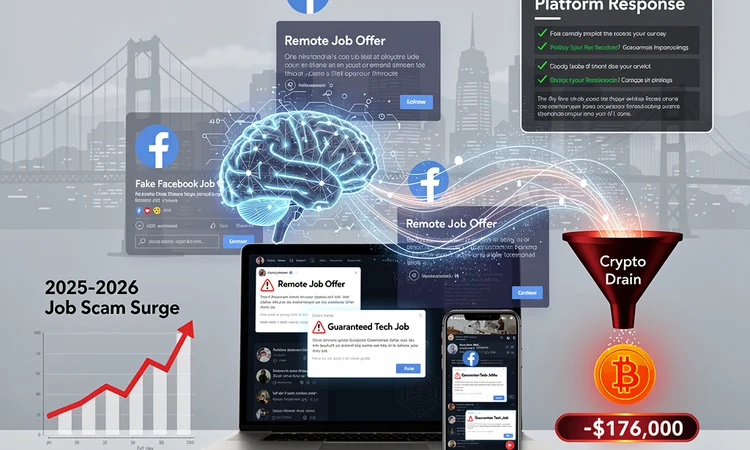
In the competitive world of tech employment, Dawn Furseth, a 60-year-old software sales representative from Brentwood, California, thought she had landed the perfect remote gig. Fresh off a contract with a Bay Area software firm, she received an enticing email in October promising part-time work with just a few hours a day. Instead, it unraveled into a sophisticated scam that drained her life savings of $176,000 in a mere six weeks. The operation masqueraded as a legitimate Facebook role, leveraging AI advancements to place ads and train algorithms, but it was a trap designed to extract funds through escalating fees.
Furseth recounted the initial allure: “You know, you get these emails that say, ‘Hey, we’ve got a part time job for you, remote situation, and you only have to work (a) couple hours a day.’ In the situation I was in, it sounded like, OK… let me try it.” A contact named “Lily” directed her to what appeared to be Facebook’s ad management center, complete with familiar login interfaces. “It looked totally like it… I checked the URL, made sure everything looked fine… logged in with the same credentials as my normal personal Facebook. It was all the same,” she told reporter ABC7 San Francisco .
The scammers shifted platforms seamlessly to WhatsApp, a common tactic to evade detection, where Furseth began “working” by posting ads and receiving payments that seemed to flow into her account. Early payouts built trust, but soon came the reversal: claims of account freezes requiring her to front money via cryptocurrency wallets to “unfreeze” funds.
The Escalation to Ruin
As demands intensified, Furseth wired increasing sums, convinced she was resolving a legitimate glitch. Six weeks in, her “mentor” suggested selling her car and pawning belongings for a 20% penalty fee—a breaking point. “When her so-called mentor suggested she sell her car and all her physical belongings at a pawn shop to try and ‘unfreeze’ her account, Dawn Furseth realized she had been scammed,” detailed ABC7 San Francisco . Reflecting on the ordeal, she said, “$176,000, yeah… but learned a lesson for sure and that’s why I wanted to share it… because these scams are getting so sophisticated so quickly for people.”
7 On Your Side reporter Stephanie Sierra collaborated with Meta, parent of Facebook and WhatsApp, uncovering the fraud’s multi-platform nature. Meta noted scammers often cycle victims across apps, complicating tracking. In response, the company suspended over 6.8 million WhatsApp accounts tied to global scam operations and introduced tools like warnings for chats with unknown contacts.
This case highlights a surge in AI-augmented frauds targeting job seekers. Furseth’s technical background made her a prime mark, as scammers exploited her familiarity with platforms to mimic authenticity.
Job Fraud’s Mounting Toll
Job scams have proliferated amid economic pressures, with U.S. employers laying off over 1.17 million workers in 2025—the most since 2020—fueling vulnerability, according to AARP . The Federal Trade Commission logged $300 million in “ghost job” losses in early 2025 alone, per reports cited in Yahoo News . Globally, victims lost $442 billion to scams in 2025, reports the Global Anti-Scam Alliance via MyDataRemoval .
Meta-specific impersonations are rampant. Researchers at Qualys documented fake remote job ads on Facebook leading to data theft, with victims receiving forged contracts from brands like Qualys itself, as outlined in Dark Reading . McAfee reported job-related scams exploding over 1,000% from May to July 2025, often promising easy remote work via texts or social media.
These schemes frequently demand upfront payments for “training” or “equipment,” transitioning to crypto transfers. In Furseth’s instance, the AI pretext—ad placement for machine learning—added a layer of plausibility in tech hubs like the Bay Area.
Mechanics of Deception
Scammers initiate contact via email or Facebook messages, posing as recruiters like “Lily.” Victims log into spoofed portals mirroring official sites, then move to WhatsApp for “onboarding.” Initial tasks yield small crypto payouts, fostering confidence. The pivot: fabricated errors requiring victim-funded resolutions, escalating to unrecoverable blockchain transactions.
Yahoo News described Furseth’s scam as “the most elaborate employment fraud scheme yet—one that used AI-enhanced social engineering and her own Facebook messages,” with impersonation scams up over 1,000% yearly ( Yahoo News ). Meta’s suspensions underscore organized crime links, often overseas centers.
Recovery remains elusive; Furseth’s funds vanished into crypto, with little law enforcement recourse reported. Local police in Brentwood were involved peripherally, but international trails stymie pursuits.
Meta’s Counteroffensive
Meta’s actions include proactive warnings and account bans, but challenges persist. “Scammers are using advancements in AI to lure people into remote work as a way to make fast cash,” warned Sierra in the ABC7 report. New features flag suspicious group adds and provide scam-reporting shortcuts.
Broader industry stats from McAfee predict worsening trends into 2026, with AI deepfakes and personalized pitches. Employment fraud topped complaints, blending with investment scams like crypto “pig butchering” prevalent in the Bay Area.
Victims like Furseth, now sharing her story, urge verification: contact companies directly via official channels, never pay upfront, and report anomalies immediately.
Defensive Strategies for Insiders
For tech professionals, red flags include unsolicited offers, non-official communication apps, and crypto demands. The Better Business Bureau advises searching job/company + “scam” and sticking to verified boards. FTC guidelines echo: legitimate employers don’t request funds pre-hire.
In the Bay Area, prior incidents like a Brentwood man’s $1 million crypto loss via “wrong number” texts ( ABC7 San Francisco ) signal regional hotspots. As 2026 unfolds, insiders must prioritize multi-factor authentication, platform privacy settings, and skepticism toward high-yield remote pitches.
Furseth’s wake-up call resonates: “It’s terrifying… because I had a good job for most of my career.” Her public account, amplified by 7 On Your Side, aims to shield others from similar devastation.


Leave a Reply
Your email address will not be published.