
Alibaba’s $2 Billion Robovan Gambit: Cainiao-Zelos Merger Reshapes Delivery Automation

Samuel Johnson
Samuel Johnson

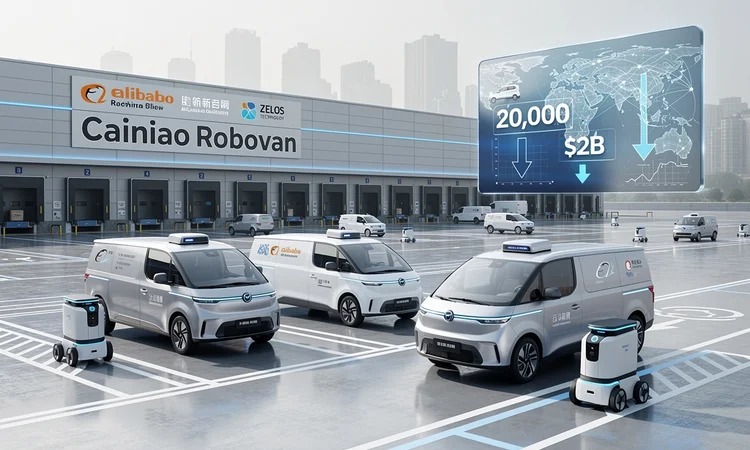
Alibaba's Cainiao merges its autonomous unit with Zelos Technology, forming a $2 billion Cainiao Robovan entity with over 20,000 vehicles. The deal combines production scale and logistics networks to cut delivery costs amid China's e-commerce boom.

Alibaba’s $2 Billion Robovan Gambit: Cainiao-Zelos Merger Reshapes Delivery Automation

Alibaba Group Holding Ltd.’s logistics powerhouse Cainiao is merging its autonomous-driving unit with Zelos Technology, forging a combined entity valued at roughly $2 billion, according to people familiar with the matter. The deal positions Zelos to operate the new venture, dubbed Cainiao Robovan, which will command a fleet exceeding 20,000 robovans tailored for last-mile delivery. This move accelerates China’s push into driverless logistics amid soaring e-commerce demands and labor shortages.

Deal Mechanics and Valuation Surge

Under the agreement, Cainiao will contribute its unmanned-vehicle operations—complete with self-driving delivery vans—into Zelos, securing an equity stake in return. Zelos, founded in 2021 by Kong Qi, a veteran of Baidu and JD.com autonomous units, will helm the merged business. A senior Cainiao executive is slated to join Zelos’s board, while select managers and technical staff from Cainiao transfer over, as detailed in reports from the Wall Street Journal and Reuters .

The $2 billion valuation reflects Zelos’s dominance in Level-4 autonomous logistics vehicles, where it claims over 70% market share in China for major express clients. Post-merger, the fleet combines Zelos’s production prowess—six factories with 45,000 annual capacity—and Cainiao’s deployment scale across postal, retail, and e-commerce sectors, per insights from Startup News FYI .

Zelos’s Rapid Ascent in Robovan Tech

Zelos pioneered mid-to-large urban autonomous trucks, launching the RoboVan series in 2023 with over 10,000 units deployed globally. The firm recently expanded internationally, initiating full-scale RoboVan operations in Abu Dhabi on January 20, 2026, partnering for postal and urban delivery, and announcing a deal in Kuala Lumpur with Pos Malaysia Berhad, as reported by Gasgoo . China Post’s record order of 7,000 driverless vans underscores Zelos’s lead, outpacing rivals like Neolix and Rino.ai.

Cainiao brings complementary strengths, having developed low-cost L4 vehicles like the GT-Lite at $2,385—ushering in sub-$10,000 robovans—with approvals in over 200 Chinese cities, according to Pandaily . Earlier, Alibaba’s DAMO Academy autonomous lab merged into Cainiao in 2023, powering ‘Little Donkey’ robovans for last-mile needs, per TechCrunch .

Cainiao’s Logistics Evolution

Launched in 2013 as Alibaba’s smart logistics network, Cainiao fully integrated under group control in 2024 after Alibaba bought out minority shares. Its global footprint spans pilots with Saudi Post in Riyadh and expansions in Brazil, Mexico, and Chile. The merger aligns with cost pressures in China’s e-commerce delivery, where robovans slash per-order expenses by 35%-45% on repeatable routes, dropping unit costs from ¥0.32 to ¥0.126 per parcel, as analyzed in Tech Buzz China .

Competitors like Meituan, JD Logistics, SF Express, Baidu Apollo, and Haomo are piloting similar driverless fleets, with international trials in the Middle East and Southeast Asia proving L4 model transferability. Zelos and Cainiao’s tie-up could dominate urban freight, leveraging shared data for end-to-end autonomy from last-mile to distribution networks.

Strategic Imperatives Amid Regulation

The partnership grants Zelos access to Cainiao’s vast network and road data, accelerating unmanned capacity amid rising labor costs and thin margins. Regulatory approvals remain pending in China, where authorities scrutinize autonomous safety and data governance. Neither company has confirmed terms, with Reuters noting no immediate response to comment requests.

Alibaba shares rose in pre-market trading on the news, signaling investor optimism. This deal marks a pivot from R&D to alliances, prioritizing commercial ROI in delivery over passenger mobility pursuits by Baidu or Pony.ai, as highlighted in TipRanks .

Global Ripples and Competitive Pressures

Zelos’s overseas push positions the merged entity for exports, challenging Western incumbents. Cainiao’s prior collaborations, like with Neolix, evolve into deeper integration, potentially reshaping supply chains worldwide. Rivals ramp production—Neolix, SF-backed Rino.ai—fueled by government procurement and falling hardware costs, per Jiemian Global .

For industry insiders, the merger signals consolidation in autonomous freight, blending Zelos’s 76% deployment share with Cainiao’s orchestration. Expect accelerated rollouts, with economics favoring high-frequency urban routes and hints of broader adoption in 2026.

About the Author

Samuel Johnson
Samuel Johnson

Samuel Johnson is a journalist who focuses on consumer behavior. They work through clear frameworks, case studies, and practical checklists to make complex topics approachable. They frequently translate research into action for product leaders, prioritizing clarity over buzzwords. Their coverage includes guidance for teams under resource or time constraints. Their reporting blends qualitative insight with data, highlighting what actually changes decision‑making. They often cover how organizations respond to change, from process redesign to technology adoption. They believe good analysis should be specific, testable, and useful to practitioners. They look for overlooked details that differentiate sustainable success from short‑term wins. Readers appreciate their ability to connect strategic goals with everyday workflows. They write about both the promise and the cost of transformation, including risks that are easy to overlook. They emphasize responsible innovation and the constraints teams face when scaling products or services. They emphasize decision‑making under uncertainty and imperfect data. They value transparency, practical advice, and honest uncertainty.

Comments

Join the discussion and share your thoughts.

No comments yet. Be the first to comment.

Leave a Reply

Your email address will not be published.

Related Posts

US Lawmakers Strip Right-to-Repair from 2026 NDAA, Boosting Defense Contractors

US Lawmakers Strip Right-to-Repair from 2026 NDAA, Boosting Defense Contractors

U.S. lawmakers removed right-to-repair provisions from the 2026 NDAA, preventing military personnel from independently fixing equipment and preserving defense contractors' lucrative service contracts. Critics decry industry influence, citing potential cost savings and improved readiness. This setback fuels ongoing advocacy for repair reforms in military and civilian sectors.

Posted on: by Jack Chen
Amazon Prime Air Struggles: Drone Incidents, Regulations, and Rivals

Amazon Prime Air Struggles: Drone Incidents, Regulations, and Rivals

Amazon's Prime Air drone delivery program, launched in 2013, faces setbacks including a 2025 Texas incident where a drone clipped a cable, triggering FAA scrutiny, regulatory hurdles, and technical glitches. Trailing rivals like Walmart and Zipline, Amazon is pivoting strategies amid fierce competition. Recovery hinges on innovations and safer operations.

Posted on: by Grace Wright
DOJ’s Appeal in Google Antitrust Case Signals Protracted Legal Battle Over Search Monopoly Remedies

DOJ’s Appeal in Google Antitrust Case Signals Protracted Legal Battle Over Search Monopoly Remedies

The DOJ and state attorneys general have appealed Judge Mehta's Google antitrust remedies ruling, challenging the decision to reject structural breakups including Chrome divestiture. The appeal argues behavioral restrictions are insufficient to dismantle Google's search monopoly, setting up a multi-year legal battle.

Retail Ecommerce
Google Launches Doppl: AI Virtual Try-Ons Transform Online Shopping

Google Launches Doppl: AI Virtual Try-Ons Transform Online Shopping

Google has launched Doppl, an AI-powered app enabling virtual clothing try-ons with personalized, dynamic models to reduce online shopping uncertainties and returns. Amid expanding AI shopping tools like agentic checkout, it faces regulatory scrutiny over data practices, yet promises to revolutionize e-commerce personalization and consumer behavior.

Retail Ecommerce
Microsoft 365 Prices to Rise Up to 33% in 2026 Amid AI and Security Upgrades

Microsoft 365 Prices to Rise Up to 33% in 2026 Amid AI and Security Upgrades

Microsoft is raising Microsoft 365 prices by up to 33% starting July 1, 2026, for commercial, frontline, and government users, driven by AI enhancements like Copilot and improved security features. This first major hike since 2022 aims to fund innovations amid cyber threats, though it sparks mixed reactions on affordability.

Retail Ecommerce
EU Court Upholds Intel Antitrust Ruling, Slashes Fine to €237M

EU Court Upholds Intel Antitrust Ruling, Slashes Fine to €237M

Europe's General Court upheld Intel's antitrust violation for using rebates and payments to exclude rivals like AMD in the chip market, but slashed the fine from €376 million to €237 million. This ruling, part of a decades-long saga, highlights evolving EU antitrust standards amid Intel's competitive challenges.

Retail Ecommerce
MasterClass 2025 Holiday Deal: 40% Off Annual Subscriptions

MasterClass 2025 Holiday Deal: 40% Off Annual Subscriptions

MasterClass's 2025 holiday promotion offers 40% off annual subscriptions, reducing Standard to $72, Plus to $108, and Premium to $144, including gifts. This strategy enhances accessibility to celebrity-led courses amid market competition. It boosts subscriber growth and democratizes elite education during economic uncertainties.

Retail Ecommerce
NYC’s 2025 Congestion Pricing Slashes Traffic 11%, Pollution 22% in Manhattan

NYC’s 2025 Congestion Pricing Slashes Traffic 11%, Pollution 22% in Manhattan

New York City's 2025 congestion pricing in Manhattan charges drivers to enter south of 60th Street, reducing traffic by 11% and PM2.5 pollution by 22%. This has improved air quality citywide, cut noise and accidents, funded transit upgrades, and serves as a model for urban sustainability.

Retail Ecommerce
2025 RAM Prices Skyrocket Amid AI-Driven Shortages

2025 RAM Prices Skyrocket Amid AI-Driven Shortages

In 2025, RAM prices have skyrocketed due to explosive AI demand for high-bandwidth memory in data centers, causing shortages and doubling or tripling costs for consumer DDR5 and DDR4 modules. This crisis disrupts PC building, smartphones, and industries, with experts forecasting prolonged volatility through 2027-2028 as production lags behind.

Retail Ecommerce
Nvidia Pilots AI Chip Tracking Software to Curb Smuggling to China

Nvidia Pilots AI Chip Tracking Software to Curb Smuggling to China

Nvidia is piloting software that uses telemetry data to track the locations of its AI chips, like the Blackwell series, to combat smuggling into restricted markets such as China amid US export bans. This initiative addresses geopolitical tensions and black-market operations, enhancing compliance without hardware changes.

Retail Ecommerce