
Amazon’s $475 Million Saks Bet Turns to Dust in Bankruptcy Clash

Vivian Stewart
Vivian Stewart

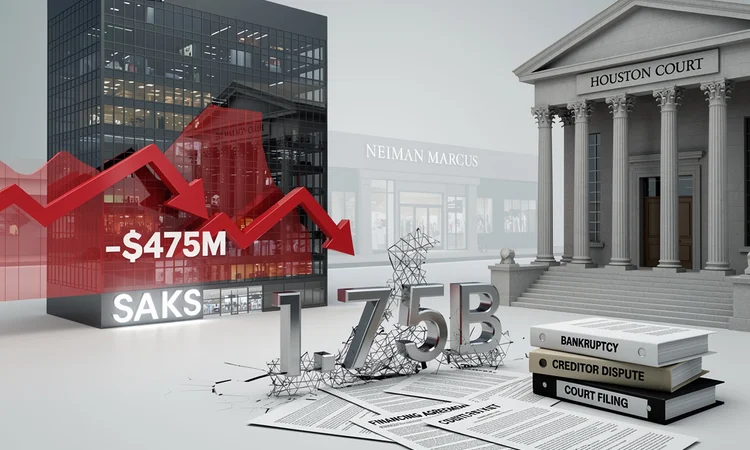
Amazon blasts Saks' bankruptcy plan as wiping out its $475M stake, threatening drastic action in court. After a failed Neiman Marcus merger, Saks fights for $1.75B financing amid creditor clashes in Houston.

Amazon’s $475 Million Saks Bet Turns to Dust in Bankruptcy Clash

In a stark reminder of the perils facing luxury retail amid shifting consumer habits and mounting debt, Amazon.com Inc. has escalated its battle against Saks Global Enterprises LLC’s Chapter 11 filing, labeling its $475 million investment ‘presumptively worthless’ and threatening ‘drastic remedies’ if its concerns go unaddressed. The e-commerce titan filed objections in U.S. Bankruptcy Court in Houston, accusing Saks of burning through cash at an alarming rate after the $2.7 billion acquisition of Neiman Marcus Group in December 2024.

The investment was meant to secure Saks products on Amazon’s platform via a ‘Saks at Amazon’ storefront, complete with guaranteed referral fees totaling at least $900 million over eight years, alongside Amazon’s technology and logistics support. Yet, mere months later, Saks’ rapid cash depletion and unpaid invoices have left Amazon’s stake in jeopardy, pushing the company lower in the creditor hierarchy under the proposed $1.75 billion debtor-in-possession financing plan.

During a marathon hearing on January 15, 2026, before Judge Alfredo Perez, Saks secured interim approval to access about $400 million of that financing, staving off immediate liquidation. Amazon’s legal team argued the plan saddles previously unencumbered Saks entities with new debt, harming creditors like itself. Judge Perez has yet to rule on the full financing or Amazon’s broader objections. CNBC first detailed the filing’s explosive language.

Saks’ Swift Descent Post-Merger

Saks Global, encompassing Saks Fifth Avenue, Neiman Marcus, and Bergdorf Goodman, filed for bankruptcy on January 14, 2026, after missing a $100 million debt payment that triggered cross-defaults across its obligations. The filing reveals a company saddled with over $1 billion in secured debt and hundreds of millions in trade claims, despite the high-profile merger aimed at creating a luxury retail powerhouse.

Amazon’s court papers paint a picture of mismanagement: ‘Saks continuously failed to meet its budgets, burned through hundreds of millions of dollars in less than a year, and ran up additional hundreds of millions of dollars in unpaid invoices owed to its retail partners.’ This echoes broader struggles in department store retail, where Saks’ assets include prime real estate like its Fifth Avenue flagship, but liabilities dwarf them amid declining foot traffic and e-commerce competition.

The merger brought in tech heavyweights like Amazon and Salesforce, which took a smaller minority stake. While Salesforce’s position remains unclear, Amazon’s aggressive stance signals potential friction among investors. Yahoo Finance reported on Amazon’s initial loss in blocking interim funding after a 7.5-hour court skirmish.

Strategic Partnership Gone Awry

The Amazon-Saks pact was part of Amazon’s push into luxury e-commerce, featuring curated fashion and beauty items on its site with Saks paying referral fees. Amazon has pursued similar deals, such as its expanding stake in Grubhub from 2% in 2022 to up to 18% in 2024, tying investments to Prime perks. For Saks, Amazon’s involvement promised logistics prowess to compete with pure-play online rivals.

Yet, bankruptcy documents show Saks projected $900 million in annual sales from Amazon collaborations that never materialized at scale, contributing to liquidity woes. Amazon now warns that the financing plan’s structure—prioritizing new lenders—dilutes recovery for equity holders like itself, prompting threats of seeking an examiner or trustee to oversee proceedings.

Posts on X from industry observers highlight sentiment around Amazon’s uncharacteristic retail misstep, with users noting the irony of the tech giant’s physical retail ambitions—from scrapped bookstore experiments to Whole Foods integration—now clashing with Saks’ woes. No official statements from Amazon or Saks beyond filings, per reports.

Courtroom Drama Unfolds

Judge Perez’s interim ruling allows Saks to draw $400 million immediately, with final approval pending in coming weeks. Amazon and other objecting creditors can renew challenges. Bloomberg noted the judge overruled Amazon’s bid despite claims of breached agreements, buying Saks time amid vendor lawsuits over unpaid bills. Bloomberg .

Saks’ filing lists assets of $1.5 billion to $10 billion against similar liabilities, with key creditors including Apollo Global Management and a steering committee of lenders. The plan envisions shedding $1.5 billion in debt through restructuring, but Amazon argues it favors senior lenders unfairly. Reuters detailed the creditor roster and financing terms. Reuters .

For Amazon, the stakes extend beyond $475 million; failure here could deter future retail investments as it eyes fashion dominance. Business of Fashion reported Saks’ relief at securing rescue funds despite objections. Business of Fashion .

Implications for Luxury Retail and Tech Investors

This saga underscores luxury retail’s fragility: post-merger synergies faltered as Saks faced $500 million-plus in annual cash burn, per filings. Fox Business highlighted the bankruptcy trigger from the missed payment. Fox Business . Neiman Marcus itself had restructured in 2020, yet the combined entity couldn’t weather e-commerce pressures and economic headwinds.

Amazon’s threat of ‘drastic action’—potentially converting debt, litigating breaches, or pushing for liquidation—could prolong proceedings, benefiting no one. TheStreet covered vendor suits preceding the filing. TheStreet . Business Insider quoted Amazon’s stark warning of pursuing remedies if unresolved. Business Insider .

As hearings continue, eyes are on whether Amazon leverages its influence to reshape the plan or exits the luxury fray wiser. FashionUnited noted the court’s approval despite pushback. FashionUnited . The outcome will test bankruptcy norms when tech meets troubled retail.

About the Author

Vivian Stewart
Vivian Stewart

As a writer, Vivian Stewart covers retail operations with an eye for detail. They work through comparative reviews and hands‑on testing to make complex topics approachable. They believe good analysis should be specific, testable, and useful to practitioners. They frequently translate research into action for marketing teams, prioritizing clarity over buzzwords. Their coverage includes guidance for teams under resource or time constraints. They explore how policies, markets, and infrastructure intersect to create second‑order effects. They write about both the promise and the cost of transformation, including risks that are easy to overlook. They frequently compare approaches across industries to surface patterns that travel well. Readers appreciate their ability to connect strategic goals with everyday workflows. Their reporting blends qualitative insight with data, highlighting what actually changes decision‑making. They maintain a balanced tone, separating speculation from evidence. They are known for dissecting tools and strategies that improve execution without adding complexity. They emphasize decision‑making under uncertainty and imperfect data. Their work aims to be useful first, timely second.

Comments

Join the discussion and share your thoughts.

No comments yet. Be the first to comment.

Leave a Reply

Your email address will not be published.

Related Posts

US Lawmakers Strip Right-to-Repair from 2026 NDAA, Boosting Defense Contractors

US Lawmakers Strip Right-to-Repair from 2026 NDAA, Boosting Defense Contractors

U.S. lawmakers removed right-to-repair provisions from the 2026 NDAA, preventing military personnel from independently fixing equipment and preserving defense contractors' lucrative service contracts. Critics decry industry influence, citing potential cost savings and improved readiness. This setback fuels ongoing advocacy for repair reforms in military and civilian sectors.

Posted on: by Jack Chen
Amazon Prime Air Struggles: Drone Incidents, Regulations, and Rivals

Amazon Prime Air Struggles: Drone Incidents, Regulations, and Rivals

Amazon's Prime Air drone delivery program, launched in 2013, faces setbacks including a 2025 Texas incident where a drone clipped a cable, triggering FAA scrutiny, regulatory hurdles, and technical glitches. Trailing rivals like Walmart and Zipline, Amazon is pivoting strategies amid fierce competition. Recovery hinges on innovations and safer operations.

Posted on: by Grace Wright
DOJ’s Appeal in Google Antitrust Case Signals Protracted Legal Battle Over Search Monopoly Remedies

DOJ’s Appeal in Google Antitrust Case Signals Protracted Legal Battle Over Search Monopoly Remedies

The DOJ and state attorneys general have appealed Judge Mehta's Google antitrust remedies ruling, challenging the decision to reject structural breakups including Chrome divestiture. The appeal argues behavioral restrictions are insufficient to dismantle Google's search monopoly, setting up a multi-year legal battle.

Retail Ecommerce
Google Launches Doppl: AI Virtual Try-Ons Transform Online Shopping

Google Launches Doppl: AI Virtual Try-Ons Transform Online Shopping

Google has launched Doppl, an AI-powered app enabling virtual clothing try-ons with personalized, dynamic models to reduce online shopping uncertainties and returns. Amid expanding AI shopping tools like agentic checkout, it faces regulatory scrutiny over data practices, yet promises to revolutionize e-commerce personalization and consumer behavior.

Retail Ecommerce
Microsoft 365 Prices to Rise Up to 33% in 2026 Amid AI and Security Upgrades

Microsoft 365 Prices to Rise Up to 33% in 2026 Amid AI and Security Upgrades

Microsoft is raising Microsoft 365 prices by up to 33% starting July 1, 2026, for commercial, frontline, and government users, driven by AI enhancements like Copilot and improved security features. This first major hike since 2022 aims to fund innovations amid cyber threats, though it sparks mixed reactions on affordability.

Retail Ecommerce
EU Court Upholds Intel Antitrust Ruling, Slashes Fine to €237M

EU Court Upholds Intel Antitrust Ruling, Slashes Fine to €237M

Europe's General Court upheld Intel's antitrust violation for using rebates and payments to exclude rivals like AMD in the chip market, but slashed the fine from €376 million to €237 million. This ruling, part of a decades-long saga, highlights evolving EU antitrust standards amid Intel's competitive challenges.

Retail Ecommerce
MasterClass 2025 Holiday Deal: 40% Off Annual Subscriptions

MasterClass 2025 Holiday Deal: 40% Off Annual Subscriptions

MasterClass's 2025 holiday promotion offers 40% off annual subscriptions, reducing Standard to $72, Plus to $108, and Premium to $144, including gifts. This strategy enhances accessibility to celebrity-led courses amid market competition. It boosts subscriber growth and democratizes elite education during economic uncertainties.

Retail Ecommerce
NYC’s 2025 Congestion Pricing Slashes Traffic 11%, Pollution 22% in Manhattan

NYC’s 2025 Congestion Pricing Slashes Traffic 11%, Pollution 22% in Manhattan

New York City's 2025 congestion pricing in Manhattan charges drivers to enter south of 60th Street, reducing traffic by 11% and PM2.5 pollution by 22%. This has improved air quality citywide, cut noise and accidents, funded transit upgrades, and serves as a model for urban sustainability.

Retail Ecommerce
2025 RAM Prices Skyrocket Amid AI-Driven Shortages

2025 RAM Prices Skyrocket Amid AI-Driven Shortages

In 2025, RAM prices have skyrocketed due to explosive AI demand for high-bandwidth memory in data centers, causing shortages and doubling or tripling costs for consumer DDR5 and DDR4 modules. This crisis disrupts PC building, smartphones, and industries, with experts forecasting prolonged volatility through 2027-2028 as production lags behind.

Retail Ecommerce
Nvidia Pilots AI Chip Tracking Software to Curb Smuggling to China

Nvidia Pilots AI Chip Tracking Software to Curb Smuggling to China

Nvidia is piloting software that uses telemetry data to track the locations of its AI chips, like the Blackwell series, to combat smuggling into restricted markets such as China amid US export bans. This initiative addresses geopolitical tensions and black-market operations, enhancing compliance without hardware changes.

Retail Ecommerce