
Saks-Neiman Merger’s Swift Collapse: Debt, Demand Slump Fuel Bankruptcy

Isabella Reed
Isabella Reed

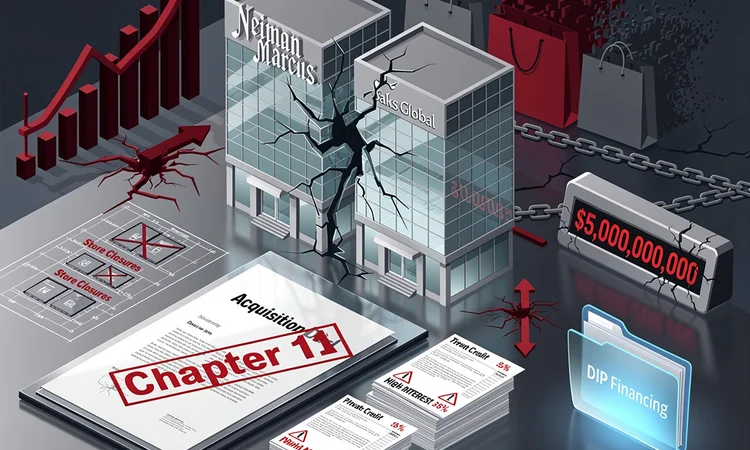
Saks Global's Neiman Marcus acquisition ended in Chapter 11 bankruptcy after $5 billion debt overwhelmed slumping sales and failed synergies. Private credit fueled high interest, while consumer shifts battered luxury demand. Restructuring eyes store closures and DIP financing.

Saks-Neiman Merger’s Swift Collapse: Debt, Demand Slump Fuel Bankruptcy

Saks Global’s bold acquisition of Neiman Marcus, completed in May 2024, was pitched as a lifeline for luxury retail amid e-commerce pressures. Instead, the $2.65 billion deal propelled the combined company into Chapter 11 bankruptcy just 20 months later, with filings in Houston federal court listing $5 billion in debt against assets and liabilities each between $1 billion and $10 billion. Secured creditors, led by private credit funds, hold $4.2 billion in claims backed by inventory, real estate, and credit card portfolios.

The filing follows a missed $100 million interest payment, triggering default on financing from firms like HPS Investment Partners and Owl Rock, now Blue Owl Capital. Payment-in-kind interest rates toggling to 13.75% ballooned costs as sales faltered. Operations continue under debtor-in-possession financing, but store closures and vendor disputes loom large. CNBC reports the merger created overlapping footprints and redundant overhead without promised synergies.

Private Equity’s Heavy Debt Legacy

Neiman Marcus entered the deal saddled with $5.5 billion in debt from prior private equity ownership by Apollo Global Management and One Equity Partners. Saks Global, backed partially by Marc Benioff’s investment vehicle, assumed this burden while issuing $2.2 billion in junk bonds. Experts call it a ‘recipe for disaster.’ Howard Shelanski, senior counsel at Davis Polk & Wardwell, told CNBC: ‘This is a value-destructive transaction from day one.’

Saks launched a $1.4 billion rights offering post-deal to refinance, but Q3 2025 comparable sales plunged 5.8%, with Neiman Marcus hit hardest. Luxury demand softened as aspirational buyers retreated amid economic uncertainty post-2024 election. Reuters notes the collapse as one of the largest retail failures since the pandemic.

Saks Global operates 40 Saks stores, 66 Neiman Marcus locations, and Bergdorf Goodman, but redundancies in markets like Dallas and New York eroded efficiencies. Vendor payments lagged, straining supplier relations.

Consumer Shift Hits High-End Hard

Luxury sales dropped 4% year-over-year in Q4 2025, per Wall Street Journal analysis, with Neiman Marcus underperforming further. Bain & Company data shows global luxury growth stalled at 2% in 2025, as middle-income shoppers pivoted to value brands. Gen Z and millennials fueled 85% of resale growth, per ThredUp’s 2025 report, favoring platforms over department stores.

Post-merger, Saks Global cut staff and announced closures, but digital sales at 25% of revenue trailed rivals like Farfetch. Saksoff5th.com grew 20% year-over-year, highlighting off-price strength amid core brand weakness. Wall Street Journal attributes declines to inventory overhang and trading down.

On X, analysts reacted swiftly. Retail Dive posted: ‘Saks-Neiman deal doomed by debt, no real synergies,’ capturing industry sentiment.

Courtroom Battles and Restructuring Path

Judge Christopher Lopez, who oversaw Neiman Marcus’s 2020 bankruptcy, presides again in Texas court. Saks seeks $500 million in DIP financing from Apollo and others to fund operations. An ad-hoc lender group negotiates terms, while unsecured creditors including vendors face steep haircuts.

Landlords like Simon Property Group and Brookfield Properties brace for lease rejections. The plan targets underperforming Neiman Marcus stores for closure, aiming for an optimized footprint in 6-12 months. Bloomberg details creditor claims exceeding $10 billion in some estimates.

Saks Global’s 10 million loyalty members and off-price banner offer reorganization anchors, but private equity’s dividend recapitalizations drew scrutiny. Apollo’s history with Neiman since 2013 amplified risks.

Broader Retail Reckoning Unfolds

This filing echoes Sears, Brooks Brothers, and Forever 21 bankruptcies, per CNBC archives, underscoring department stores’ struggles against Amazon, Shein, and Temu. Coresight Research forecasts 20% of U.S. malls closing by 2030. McKinsey notes 40% of luxury buyers now shop online exclusively.

Saks Global’s plight questions consolidation viability in luxury. New York Times explores customer impacts, confirming stores remain open. Fox Business highlights the $2.7 billion deal’s debt trigger.

Industry insiders on X, including CNBC posts, emphasize high-cost debt’s role. As proceedings advance, luxury retail’s debt-dependent model faces transformation pressures.

About the Author

Isabella Reed
Isabella Reed

Isabella Reed is a journalist who focuses on sustainability in business. Their approach combines long‑form narratives grounded in real‑world metrics. Their perspective is shaped by interviews across engineering, operations, and leadership roles. They believe good analysis should be specific, testable, and useful to practitioners. They frequently translate research into action for policy readers, prioritizing clarity over buzzwords. They examine how customer expectations evolve and how organizations adapt to meet them. They often cover how organizations respond to change, from process redesign to technology adoption. Readers appreciate their ability to connect strategic goals with everyday workflows. They write about both the promise and the cost of transformation, including risks that are easy to overlook. They are known for dissecting tools and strategies that improve execution without adding complexity. Their reporting blends qualitative insight with data, highlighting what actually changes decision‑making. They watch the policy landscape closely when it affects product strategy. They value transparency, practical advice, and honest uncertainty.

Comments

Join the discussion and share your thoughts.

No comments yet. Be the first to comment.

Leave a Reply

Your email address will not be published.

Related Posts

US Lawmakers Strip Right-to-Repair from 2026 NDAA, Boosting Defense Contractors

US Lawmakers Strip Right-to-Repair from 2026 NDAA, Boosting Defense Contractors

U.S. lawmakers removed right-to-repair provisions from the 2026 NDAA, preventing military personnel from independently fixing equipment and preserving defense contractors' lucrative service contracts. Critics decry industry influence, citing potential cost savings and improved readiness. This setback fuels ongoing advocacy for repair reforms in military and civilian sectors.

Posted on: by Jack Chen
Amazon Prime Air Struggles: Drone Incidents, Regulations, and Rivals

Amazon Prime Air Struggles: Drone Incidents, Regulations, and Rivals

Amazon's Prime Air drone delivery program, launched in 2013, faces setbacks including a 2025 Texas incident where a drone clipped a cable, triggering FAA scrutiny, regulatory hurdles, and technical glitches. Trailing rivals like Walmart and Zipline, Amazon is pivoting strategies amid fierce competition. Recovery hinges on innovations and safer operations.

Posted on: by Grace Wright
DOJ’s Appeal in Google Antitrust Case Signals Protracted Legal Battle Over Search Monopoly Remedies

DOJ’s Appeal in Google Antitrust Case Signals Protracted Legal Battle Over Search Monopoly Remedies

The DOJ and state attorneys general have appealed Judge Mehta's Google antitrust remedies ruling, challenging the decision to reject structural breakups including Chrome divestiture. The appeal argues behavioral restrictions are insufficient to dismantle Google's search monopoly, setting up a multi-year legal battle.

Retail Ecommerce
Google Launches Doppl: AI Virtual Try-Ons Transform Online Shopping

Google Launches Doppl: AI Virtual Try-Ons Transform Online Shopping

Google has launched Doppl, an AI-powered app enabling virtual clothing try-ons with personalized, dynamic models to reduce online shopping uncertainties and returns. Amid expanding AI shopping tools like agentic checkout, it faces regulatory scrutiny over data practices, yet promises to revolutionize e-commerce personalization and consumer behavior.

Retail Ecommerce
Microsoft 365 Prices to Rise Up to 33% in 2026 Amid AI and Security Upgrades

Microsoft 365 Prices to Rise Up to 33% in 2026 Amid AI and Security Upgrades

Microsoft is raising Microsoft 365 prices by up to 33% starting July 1, 2026, for commercial, frontline, and government users, driven by AI enhancements like Copilot and improved security features. This first major hike since 2022 aims to fund innovations amid cyber threats, though it sparks mixed reactions on affordability.

Retail Ecommerce
EU Court Upholds Intel Antitrust Ruling, Slashes Fine to €237M

EU Court Upholds Intel Antitrust Ruling, Slashes Fine to €237M

Europe's General Court upheld Intel's antitrust violation for using rebates and payments to exclude rivals like AMD in the chip market, but slashed the fine from €376 million to €237 million. This ruling, part of a decades-long saga, highlights evolving EU antitrust standards amid Intel's competitive challenges.

Retail Ecommerce
MasterClass 2025 Holiday Deal: 40% Off Annual Subscriptions

MasterClass 2025 Holiday Deal: 40% Off Annual Subscriptions

MasterClass's 2025 holiday promotion offers 40% off annual subscriptions, reducing Standard to $72, Plus to $108, and Premium to $144, including gifts. This strategy enhances accessibility to celebrity-led courses amid market competition. It boosts subscriber growth and democratizes elite education during economic uncertainties.

Retail Ecommerce
NYC’s 2025 Congestion Pricing Slashes Traffic 11%, Pollution 22% in Manhattan

NYC’s 2025 Congestion Pricing Slashes Traffic 11%, Pollution 22% in Manhattan

New York City's 2025 congestion pricing in Manhattan charges drivers to enter south of 60th Street, reducing traffic by 11% and PM2.5 pollution by 22%. This has improved air quality citywide, cut noise and accidents, funded transit upgrades, and serves as a model for urban sustainability.

Retail Ecommerce
2025 RAM Prices Skyrocket Amid AI-Driven Shortages

2025 RAM Prices Skyrocket Amid AI-Driven Shortages

In 2025, RAM prices have skyrocketed due to explosive AI demand for high-bandwidth memory in data centers, causing shortages and doubling or tripling costs for consumer DDR5 and DDR4 modules. This crisis disrupts PC building, smartphones, and industries, with experts forecasting prolonged volatility through 2027-2028 as production lags behind.

Retail Ecommerce
Nvidia Pilots AI Chip Tracking Software to Curb Smuggling to China

Nvidia Pilots AI Chip Tracking Software to Curb Smuggling to China

Nvidia is piloting software that uses telemetry data to track the locations of its AI chips, like the Blackwell series, to combat smuggling into restricted markets such as China amid US export bans. This initiative addresses geopolitical tensions and black-market operations, enhancing compliance without hardware changes.

Retail Ecommerce