
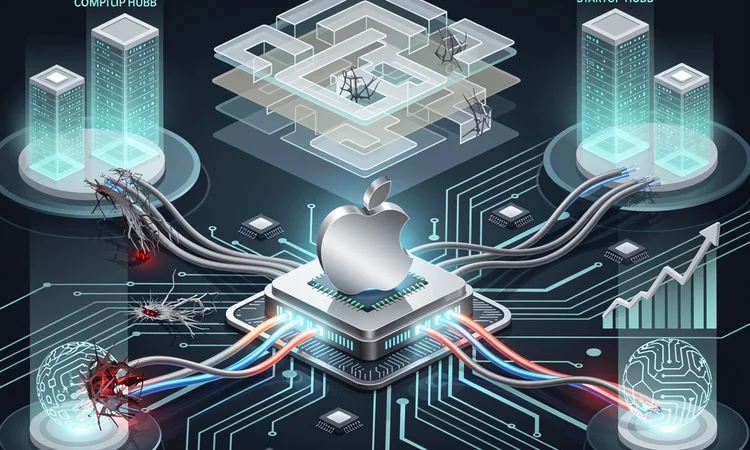
Apple’s artificial intelligence division is experiencing a significant exodus of top researchers and engineers, raising questions about the iPhone maker’s ability to compete in the rapidly evolving AI arms race. The departures come at a critical juncture as the company attempts to establish itself as a serious player in generative AI, following years of criticism for falling behind competitors like Google, Microsoft, and OpenAI.
According to MacRumors , several key members of Apple’s AI research team have recently left the company for opportunities at competing tech firms and well-funded startups. The talent migration represents more than just routine turnover; it signals deeper challenges within Apple’s AI strategy and organizational culture that have made it difficult to retain the specialized expertise needed to develop cutting-edge artificial intelligence systems.
The departures are particularly concerning given Apple’s public commitment to integrating AI capabilities across its product ecosystem. The company has invested billions in AI research and development, yet continues to struggle with keeping pace with rivals who have made AI their central focus. Industry analysts suggest that Apple’s traditionally secretive culture and slower product development cycles may be at odds with the fast-moving, collaborative nature of modern AI research.
Compensation Gaps and Cultural Friction Drive Researcher Exits
Financial incentives play a significant role in the talent drain. AI researchers and engineers command premium salaries in today’s market, with compensation packages at dedicated AI companies often exceeding what traditional tech giants like Apple offer. Startups backed by venture capital have been particularly aggressive in recruiting, offering not just higher base salaries but also equity stakes that could prove extraordinarily valuable if their AI technologies achieve commercial success.
Beyond compensation, cultural factors contribute to the exodus. Apple’s emphasis on product secrecy and its hierarchical organizational structure can frustrate researchers accustomed to the open collaboration and rapid publication cycles common in academic and AI-focused environments. Many AI researchers value the ability to publish their findings and contribute to the broader scientific community—activities that Apple’s tight control over intellectual property often restricts.
The company’s approach to AI development also differs fundamentally from competitors. While firms like Google and Microsoft have embraced large language models and cloud-based AI services, Apple has prioritized on-device processing and privacy-preserving techniques. This philosophical stance, while aligned with Apple’s brand values, may limit the scope and ambition of projects available to researchers, making positions at other companies more intellectually stimulating.
Strategic Implications for Apple Intelligence Rollout
The timing of these departures is particularly problematic for Apple’s AI ambitions. The company has been working to expand its Apple Intelligence features, which were introduced as part of iOS 18 and macOS Sequoia. These capabilities represent Apple’s most significant push into consumer-facing AI, including enhanced Siri functionality, writing assistance tools, and image generation features. Losing experienced researchers during this critical development phase could delay feature releases or compromise their quality.
Apple’s AI strategy relies heavily on integrating intelligence seamlessly into existing products rather than launching standalone AI services. This approach requires deep technical expertise across multiple domains—from natural language processing to computer vision to on-device optimization. Each researcher departure creates knowledge gaps that can take months or years to fill, particularly given the competitive hiring environment for AI talent.
The company faces additional pressure from investors and consumers who have grown accustomed to rapid AI innovation from competitors. Google’s Gemini, Microsoft’s Copilot integration across Office products, and OpenAI’s ChatGPT have set new expectations for what AI-powered features should deliver. Apple’s more measured approach, while potentially more privacy-conscious, risks being perceived as falling behind if the company cannot execute quickly and effectively.
Industry-Wide Competition for Limited AI Expertise
The challenge Apple faces reflects a broader industry crisis: there simply aren’t enough qualified AI researchers to meet demand. Universities produce a limited number of PhD graduates specializing in machine learning and AI each year, and those individuals are courted by dozens of companies before they even complete their degrees. This supply-demand imbalance has created a hyper-competitive hiring environment where even small advantages in compensation, culture, or project appeal can determine where talent lands.
Established tech companies like Apple must compete not only with each other but also with a new generation of AI-native startups. Companies like Anthropic, Cohere, and numerous stealth-mode ventures have attracted significant venture funding specifically to recruit top researchers. These startups often offer researchers the opportunity to work on foundational AI problems rather than applying existing techniques to consumer products—a distinction that appeals to many academics and research-oriented engineers.
The competition extends globally, with Chinese tech giants like ByteDance and Alibaba also aggressively recruiting AI talent, sometimes offering packages that exceed American compensation standards. European companies and research institutions have entered the fray as well, though they typically cannot match the financial resources of American and Chinese firms. This global dimension adds another layer of complexity to Apple’s retention challenges.
Apple’s Response Strategy and Organizational Adjustments
In response to the talent drain, Apple has reportedly begun adjusting its approach to AI research and development. The company has increased compensation for AI specialists and created more flexible publication policies that allow researchers to share certain findings with the broader scientific community. These changes represent significant departures from Apple’s traditional practices, indicating how seriously leadership views the retention crisis.
Apple has also expanded its AI research facilities beyond its Cupertino headquarters, establishing teams in Seattle, San Diego, and other tech hubs where AI talent concentrates. This geographic diversification helps the company tap into local talent pools and compete more effectively with regional employers. Additionally, Apple has increased its acquisition activity, purchasing smaller AI companies not just for their technology but for their teams—a strategy known as “acqui-hiring” that provides an alternative path to building internal capabilities.
The company has strengthened partnerships with academic institutions, funding research programs and creating pathways for graduate students to work on Apple projects while completing their degrees. These relationships help Apple maintain connections with emerging talent and potentially recruit them before competitors can make offers. However, such programs require years to bear fruit and do little to address immediate staffing challenges.
Broader Implications for Apple’s Competitive Position
The AI researcher exodus carries implications that extend beyond any single product or feature. As artificial intelligence becomes increasingly central to computing experiences, companies that cannot attract and retain top AI talent risk losing their competitive edge across their entire product portfolio. For Apple, this could mean falling behind in areas where it has traditionally excelled, from smartphone photography to voice assistants to augmented reality applications.
The situation also raises questions about Apple’s long-term strategic positioning. The company has built its modern success on vertical integration and controlling the entire technology stack from silicon to software. However, AI development increasingly relies on massive datasets, cloud infrastructure, and collaborative research—areas where Apple’s traditional strengths matter less than scale and openness. If Apple cannot adapt its organizational culture and development practices to the realities of AI competition, it may find itself relegated to licensing technology from competitors rather than developing proprietary capabilities.
Financial markets have begun to take notice of Apple’s AI challenges. While the company’s stock remains strong based on its existing business performance, some analysts have expressed concern about whether Apple can maintain its premium valuation if it falls significantly behind in AI capabilities. The technology sector has seen dramatic valuation shifts based on perceived AI leadership, with companies like Nvidia and Microsoft benefiting enormously from their AI positioning while others have struggled.
The Path Forward for Cupertino’s AI Ambitions
Despite these challenges, Apple retains significant advantages in the AI competition. The company’s massive installed base of devices provides a distribution channel that AI startups can only dream of reaching. Apple’s control over its hardware and operating systems enables optimizations that pure software companies cannot achieve. The company’s financial resources remain unmatched, giving it the ability to make strategic investments and acquisitions that smaller competitors cannot afford.
However, translating these advantages into AI leadership requires more than just resources—it demands organizational change and a willingness to adapt long-held practices to new competitive realities. Apple must find ways to balance its commitment to privacy and security with the data requirements of modern AI development. The company needs to create a research culture that can attract and retain top talent while maintaining the product discipline that has made it successful.
The coming months will reveal whether Apple’s adjustments prove sufficient to stem the talent exodus and accelerate its AI development. The company faces a critical test: can it transform itself into an AI powerhouse while preserving the unique characteristics that have defined its success? The answer will shape not just Apple’s future but the broader technology industry’s competitive dynamics for years to come. As AI continues to redefine computing, the companies that can attract, retain, and effectively deploy top research talent will determine the industry’s direction—and Apple’s position in that future remains uncertain.


Leave a Reply
Your email address will not be published.