
Cramer’s Verdict: Shrinking P/E Multiples Crush Software Giants Amid AI Fears

Stella Evans
Stella Evans

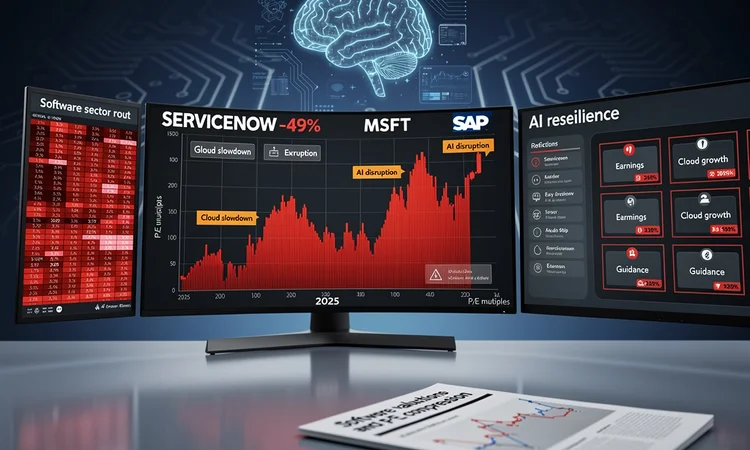
Jim Cramer blames collapsing P/E multiples for software stocks' rout amid AI disruption fears, spotlighting ServiceNow's 49% drop despite strong earnings. Microsoft and SAP followed suit on cloud slowdowns, signaling a sector bear market as investors demand proof of AI resilience.

Cramer’s Verdict: Shrinking P/E Multiples Crush Software Giants Amid AI Fears

Enterprise software stocks are in freefall, hammered by investor fears that artificial intelligence will upend their lucrative business models. On his CNBC show “Mad Money,” Jim Cramer pinpointed a single metric driving the carnage: the relentless compression of price-to-earnings multiples. “The market has turned against software stocks and this metric explains their downfall,” Cramer declared, as shares of high-quality names like ServiceNow plunged despite solid results.

Cramer described the P/E multiple as the “secret sauce” to understanding stock pricing, measuring how much investors will pay for each dollar of future profits. When growth confidence erodes, multiples shrink—a dynamic playing out brutally across the sector. ServiceNow, the poster child for this trend, dropped 9.9% Thursday after better-than-expected earnings and a massive buyback, with its forward P/E collapsing from the upper 60s in January 2025 to the 40s by April, and now under 28. Over the past year, ServiceNow shares have tumbled 49%, while the iShares Expanded Tech-Software Sector ETF fell 11%—lagging the S&P 500’s 15% gain by a wide margin, according to CNBC .

“Can the market be wrong? Of course, it’s wrong all the time,” Cramer said. But fighting the “freight train” of shrinking multiples is futile for now. He predicts these “great companies” could become buyable once multiples bottom out.

AI Disruption Sparks Valuation Reckoning

The root cause? Persistent worries that AI will disrupt traditional software workflows, from code generation to automation, eroding subscription revenue. ServiceNow CEO Bill McDermott appeared on “Mad Money” touting AI adaptation, yet the market voted him “off the island,” as Cramer put it. “The stock market has said, ‘Ain’t got nothin for you, Bill,’” he quipped. Earnings remain fine, but “what people will pay for those earnings” has cratered.

This sentiment rippled through the sector. Microsoft shares cratered nearly 10% Thursday after fiscal 2026 Q2 results topped estimates but revealed Azure cloud growth deceleration and surging AI capital expenditures. “This is largely Microsoft and software companies coming down because of Microsoft,” Cramer noted in a separate segment, per CNBC . Microsoft’s backlog reliance on OpenAI—45% of $625 billion—raised red flags, with operating margins forecast to dip to 45.1% amid infrastructure spends, as detailed by Forbes .

SAP’s shares plunged 15-16%—its worst day since 2020—after 2026 cloud revenue guidance of 23-25% growth and decelerating backlog missed expectations, dragging peers like Salesforce down 6.3%, Adobe 2.5%, and Datadog 5%, according to Reuters .

Sector-Wide Selloff Signals Bear Territory

The iShares Expanded Tech-Software Sector ETF (IGV) shed 5.4% in its largest one-day drop since April, with the S&P 500 Software and Services Index hitting a nine-month low after an 8.7% plunge. U.S. software stocks have posted double-digit annual declines as AI fears challenge SaaS models, per Reuters . On X, Cramer posted: “It’s the collapse of software and the ascent of hardware and it is staggering. Just staggering.”

Other names echoed the pain: Salesforce down 16% in recent sessions, Adobe and Workday struggling, as Cramer lamented uncertainty around AI rivals like Anthropic. Earlier, he advised steering clear of Datadog, saying enterprise software feels like “freefall,” via Yahoo Finance . X users highlighted the “Great SaaS Meltdown,” with Nasdaq 100 up 20% while the Morgan Stanley SaaS Index fell 20%, citing AI’s threat to per-seat pricing.

Jim Cramer on X reinforced the divide: software collapsing as hardware surges on AI infrastructure demand. Posts from analysts like @ThuanGlobal noted firms delaying long-term contracts amid AI automation, pushing the sector into bear market territory.

CapEx Surge and Cloud Slowdown Amplify Pressures

Microsoft’s woes stemmed from reversing prior guidance: after promising lower fiscal 2026 CapEx than 2025, it hiked spends, projecting Azure growth at 37-38% for Q3 but facing supply constraints, not demand weakness, as explained in Insider Monkey . Meta bucked the trend, rising 10% on AI-driven ad revenue acceleration, but Cramer warned against quarterly overreactions, citing Alphabet’s rebound on Gemini progress, per another CNBC piece.

Broader trends show investors rotating to semiconductors and memory plays like Micron, which tripled in 2025 on AI data center demand. Cramer cautioned against chasing those post-rally, favoring pullbacks, via CNBC . Software’s high-growth, low-profit model is “dead,” with profitability now paramount, as 24/7 Wall St. analyzed.

“I accept the market’s judgment at least for now, because I can’t fight it. It’s too powerful,” Cramer conceded on ServiceNow. Yet he remains bullish long-term: “Soon, when we see how low the multiple can go — and it will bottom — these may be worth buying.”

Investor Roadmap Through the Turmoil

For industry insiders, the P/E compression signals a valuation reset: software must prove AI integration boosts durable growth, not just offsets disruption. X chatter from @Bull1shPilot warns of the “seat crisis”—fewer users needed with AI efficiency. SAP’s backlog deceleration underscores execution risks, while Microsoft’s OpenAI dependency highlights partner vulnerabilities.

Cramer urges patience, avoiding fights with momentum. His Charitable Trust holds software exposure like CRM and MSFT, betting on rebounds. As hardware scarcity persists, software’s fate hinges on adapting to an AI-native world—where multiples reflect real profitability, not hype.

About the Author

Stella Evans
Stella Evans

Stella Evans is a journalist who focuses on AI deployment. They work through trend monitoring with careful context and caveats to make complex topics approachable. They believe good analysis should be specific, testable, and useful to practitioners. They examine how customer expectations evolve and how organizations adapt to meet them. Their reporting blends qualitative insight with data, highlighting what actually changes decision‑making. Readers appreciate their ability to connect strategic goals with everyday workflows. They write about both the promise and the cost of transformation, including risks that are easy to overlook. They also highlight cultural factors that determine whether change sticks. Their coverage includes guidance for teams under resource or time constraints. Their perspective is shaped by interviews across engineering, operations, and leadership roles. They often cover how organizations respond to change, from process redesign to technology adoption. They maintain a balanced tone, separating speculation from evidence. They are interested in the economics of scale and operational resilience. They prefer evidence over hype and explain trade‑offs plainly.

Comments

Join the discussion and share your thoughts.

No comments yet. Be the first to comment.

Leave a Reply

Your email address will not be published.

Related Posts

Atlantic’s $1.2 Billion Staffing Power Play: F1 Tech Talent Fuels Transatlantic Surge

Atlantic’s $1.2 Billion Staffing Power Play: F1 Tech Talent Fuels Transatlantic Surge

Atlantic International Corp. acquires Circle8 Group in an all-stock deal, creating a $1.2 billion global staffing platform blending U.S. industrial and European IT talent. Circle8's Aston Martin F1 partnership highlights its elite capabilities amid cross-selling potential.

Posted on: by Liam Price
Bots at Work: Service Robotics’ $500 Billion Surge Reshapes Labor Markets

Bots at Work: Service Robotics’ $500 Billion Surge Reshapes Labor Markets

Service robotics rockets toward $498 billion by 2033 at 37% CAGR, automating logistics, healthcare, and hospitality amid AI advances and labor crunches. Deals like Serve's Diligent buy propel indoor expansions.

Posted on: by Layla Reed
Aspire-Deel Tie-Up Reshapes Global Hiring for Fintech Startups

Aspire-Deel Tie-Up Reshapes Global Hiring for Fintech Startups

Aspire integrates Deel's EOR services for seamless global hiring and finance management, targeting startups scaling internationally. The partnership addresses compliance hurdles, offering unified insights into workforce costs and cash flow.

Business
Deel’s Record-Breaking Hiring Spectacle: AI-Powered Push Reshapes Global Talent Wars

Deel’s Record-Breaking Hiring Spectacle: AI-Powered Push Reshapes Global Talent Wars

Deel shattered records with 6,848 attendees at its largest online hiring event, blending AI tools and global reach to fill 300+ sales roles. Amid growth to $17.3 billion valuation, the feat highlights innovations in HR and payroll but sparks debate on stunt versus substance.

Business
Deel’s $17 Billion Sprint: From Y Combinator to Global Payroll Powerhouse

Deel’s $17 Billion Sprint: From Y Combinator to Global Payroll Powerhouse

Deel rocketed to a $17.3 billion valuation in seven years by pioneering owned global payroll infrastructure, processing $22 billion annually for 37,000 firms. Amid IPO prep and DOJ scrutiny, COO Dan Westgarth reveals elite ops driving $1 billion revenue.

Business
HR’s AI Superagent Revolution: Reinventing the Workforce Engine

HR’s AI Superagent Revolution: Reinventing the Workforce Engine

Enterprise AI Superagents ignite HR's biggest transformation in decades, automating 30-40% of jobs while birthing full-stack roles and skills-first strategies. Josh Bersin leads the charge amid bias risks and tech trends reshaping hiring, experience, and leadership.

Business
AI’s HR Reckoning: 10 Pivotal Shifts Reshaping Workforce Strategies in 2026

AI’s HR Reckoning: 10 Pivotal Shifts Reshaping Workforce Strategies in 2026

As AI propels organizations into hybrid human-machine teams, HR must master fluency screening, skills-based shifts and agentic governance to thrive amid 2026's disruptions, blending tech efficiency with human resilience.

Business
The Upselling Paradox: How Retailers Walk the Tightrope Between Revenue Growth and Consumer Trust

The Upselling Paradox: How Retailers Walk the Tightrope Between Revenue Growth and Consumer Trust

New research reveals upselling's hidden risks as retailers balance revenue growth with customer trust. While upselling can boost transaction values by 10-30%, approximately 23% of consumers experience post-purchase regret, potentially damaging long-term profitability and brand reputation in an increasingly skeptical marketplace.

Business
Chrome Extensions’ Silent Siege on Enterprise HR Crown Jewels

Chrome Extensions’ Silent Siege on Enterprise HR Crown Jewels

Five malicious Chrome extensions hijacked sessions on Workday, NetSuite, and SAP SuccessFactors, stealing cookies, blocking admin pages, and enabling takeovers. Socket's discovery prompted Google takedowns after 2,300 installs, exposing enterprise browser risks.

Business
AI Proficiency Divide: HR’s Mounting Crisis

AI Proficiency Divide: HR’s Mounting Crisis

Corporate AI adoption surges, but superficial employee use creates a proficiency chasm now demanding HR intervention through targeted training, outcome metrics, and equity for overlooked workers.

Business