DoorDash’s ChatGPT Grocery Gambit Ignites AI Delivery Duel With Instacart

Amelia Keller
Amelia Keller

DoorDash counters Instacart's ChatGPT grocery tool with its own AI shopping app, enabling recipe-to-delivery in one interface. This partnership escalates competition in on-demand services, leveraging OpenAI for seamless commerce.

DoorDash’s ChatGPT Grocery Gambit Ignites AI Delivery Duel With Instacart

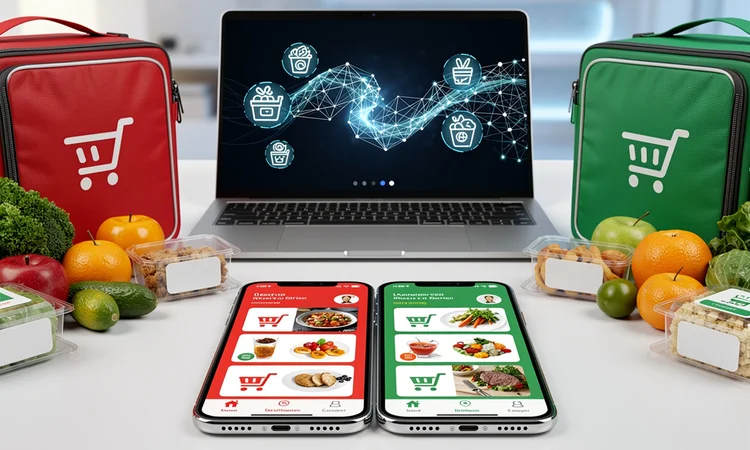
DoorDash Inc. has thrust itself into the vanguard of artificial intelligence-driven commerce, unveiling a grocery shopping app embedded within OpenAI’s ChatGPT just one week after rival Instacart’s similar debut. The move, announced on December 17, 2025, allows users to query ChatGPT for recipe ideas, generate shopping lists, and order ingredients from local stores for delivery in as little as an hour, all without leaving the chatbot interface. This partnership with OpenAI positions DoorDash to capture consumer attention at the precise moment of inspiration, escalating a fierce contest in on-demand grocery services.

The integration leverages ChatGPT’s conversational prowess to streamline the path from meal planning to doorstep delivery. Users can simply ask, “Suggest a quick dinner recipe and order the ingredients,” prompting the AI to curate options and redirect to DoorDash’s checkout for stores like Kroger and Safeway. Nick Turley, head of ChatGPT at OpenAI, hailed the development as “another step toward bringing our vision to life, where AI connects directly to real-world services, saving people time and effort in their everyday lives,” according to a Fox Business report.

Instacart’s entry into ChatGPT, launched the prior week, set the stage for this rapid counterpunch. Its app enables end-to-end grocery purchasing within the chat window, from recipe generation to payment and delivery. Instacart Chief Technology Officer Anirban Kundu described it as redefining “what’s possible in AI-powered shopping,” built on an “agentic commerce protocol” for real-time intelligence, as noted in the same Fox Business article.

Strategic Timing in a Crowded Arena

DoorDash’s swift response underscores the high stakes in grocery delivery, where grocery orders now comprise 17% of its total sales, up from negligible levels just years ago. The company’s blog post emphasized access to national chains and regional gems like Bi-Rite, signaling ambitions to diversify beyond restaurant meals into everyday essentials. This comes amid broader AI experiments, including DoorDash’s Zesty app for restaurant recommendations, per an AInvest analysis.

Instacart, long a grocery pure-play, views AI as a differentiator in a market squeezed by multibillion-dollar incumbents like DoorDash and Uber Eats. Its ChatGPT tool keeps transactions seamless within the chat, contrasting DoorDash’s approach of redirecting users to its app for checkout—a design choice that could influence user retention and conversion rates, according to Bloomberg .

Both companies are riding OpenAI’s wave of commerce integrations. Earlier pilots with Uber and others hinted at this expansion, as reported by Grocery Dive in October 2025, when multiple delivery apps joined ChatGPT’s ecosystem.

Technical Underpinnings and User Experience Edge

DoorDash’s implementation taps into ChatGPT’s agentic capabilities, where AI agents handle multi-step tasks like list compilation and store matching based on availability and speed. “You can now shop for groceries directly in ChatGPT and check out on DoorDash, turning recipe ideas into reality,” the company stated in its official announcement on DoorDash’s news site .

Instacart’s version, detailed in a TechCrunch piece, emphasizes zero-friction checkout: “Shoppers will be able to go from recipe planning to checkout within the ChatGPT window.” This in-chat completion could reduce drop-off rates, a critical metric as AI chatbots evolve into transactional hubs.

Early user reactions on X highlight excitement tempered by practical concerns. Posts from tech enthusiasts praised the seamlessness, while others flagged potential issues like pricing transparency and substitution handling—echoing perennial pain points in grocery delivery.

Business Model Shifts and Revenue Implications

For DoorDash, grocery penetration bolsters its marketplace moat, with AI lowering acquisition costs by meeting users in ChatGPT’s 300 million-plus weekly active users. Finance Yahoo reported the launch as a “major first step toward meeting customers where they look for inspiration,” citing DoorDash’s NASDAQ: DASH ticker amid rising shares post-announcement ( Yahoo Finance ).

Instacart, trading as MAPS, faces pressure to defend its 5% U.S. grocery delivery share against DoorDash’s encroachment. Its AI push aligns with prior investments in visual search and personalization, but DoorDash’s broader logistics network—spanning 7,000 cities—poses a scalability threat, as analyzed in Chain Store Age .

Monetization hinges on commissions, fees, and ads. OpenAI’s non-advertised product results, as seen in prior shopping experiments shared on X by @OpenAI, ensure organic discovery, potentially amplifying impulse buys.

Competitive Ripples and Broader AI Commerce Surge

The dueling launches signal a pivot to “agentic commerce,” where AI autonomously executes purchases. DoorDash’s Nick Turley and Instacart’s Anirban Kundu both invoked time-saving narratives, but execution details diverge: DoorDash prioritizes its app’s familiarity, while Instacart bets on chat containment.

Industry watchers anticipate knock-on effects. Supermarket News noted DoorDash embedding ChatGPT directly into its mobile app, compounding the web-based integration for hybrid experiences. Uber’s parallel efforts, though nascent, could triangulate the rivalry.

Regulatory scrutiny looms over data privacy and AI decision-making in commerce, especially with real-time pricing and substitutions. Yet, for now, the focus remains on user adoption amid holiday peaks.

Pathways to Market Dominance

DoorDash’s edge lies in its DashPass subscriber base—over 10 million strong—primed for grocery upsell. Integrating ChatGPT recipes with loyalty perks could drive retention, per GuruFocus insights on the launch ( GuruFocus ).

Instacart counters with deep retailer ties, including Costco and Aldi, enabling precise inventory matching. Its protocol for agentic flows positions it for enterprise expansions beyond consumers.

As 2026 dawns, expect iterative enhancements: voice ordering, AR previews, and multi-retailer comparisons. This AI arms race redefines grocery logistics, embedding delivery into the fabric of daily digital life.

About the Author

Amelia Keller
Amelia Keller

Amelia Keller writes about supply chain resilience, translating complex ideas into practical insight. Their approach combines scenario planning and on‑the‑ground reporting. Their coverage includes guidance for teams under resource or time constraints. They avoid buzzwords, focusing instead on outcomes, incentives, and the human side of technology. Their reporting blends qualitative insight with data, highlighting what actually changes decision‑making. They are known for dissecting tools and strategies that improve execution without adding complexity. They maintain a balanced tone, separating speculation from evidence. They also highlight cultural factors that determine whether change sticks. They write about both the promise and the cost of transformation, including risks that are easy to overlook. They explore how policies, markets, and infrastructure intersect to create second‑order effects. They frequently translate research into action for security leaders, prioritizing clarity over buzzwords. Readers appreciate their ability to connect strategic goals with everyday workflows. They focus on what changes decisions, not just what makes headlines.

Comments

Join the discussion and share your thoughts.

No comments yet. Be the first to comment.

Leave a Reply

Your email address will not be published.

Related Posts

US Lawmakers Strip Right-to-Repair from 2026 NDAA, Boosting Defense Contractors

US Lawmakers Strip Right-to-Repair from 2026 NDAA, Boosting Defense Contractors

U.S. lawmakers removed right-to-repair provisions from the 2026 NDAA, preventing military personnel from independently fixing equipment and preserving defense contractors' lucrative service contracts. Critics decry industry influence, citing potential cost savings and improved readiness. This setback fuels ongoing advocacy for repair reforms in military and civilian sectors.

Posted on: by Jack Chen
Amazon Prime Air Struggles: Drone Incidents, Regulations, and Rivals

Amazon Prime Air Struggles: Drone Incidents, Regulations, and Rivals

Amazon's Prime Air drone delivery program, launched in 2013, faces setbacks including a 2025 Texas incident where a drone clipped a cable, triggering FAA scrutiny, regulatory hurdles, and technical glitches. Trailing rivals like Walmart and Zipline, Amazon is pivoting strategies amid fierce competition. Recovery hinges on innovations and safer operations.

Posted on: by Grace Wright
DOJ’s Appeal in Google Antitrust Case Signals Protracted Legal Battle Over Search Monopoly Remedies

DOJ’s Appeal in Google Antitrust Case Signals Protracted Legal Battle Over Search Monopoly Remedies

The DOJ and state attorneys general have appealed Judge Mehta's Google antitrust remedies ruling, challenging the decision to reject structural breakups including Chrome divestiture. The appeal argues behavioral restrictions are insufficient to dismantle Google's search monopoly, setting up a multi-year legal battle.

Retail Ecommerce
Google Launches Doppl: AI Virtual Try-Ons Transform Online Shopping

Google Launches Doppl: AI Virtual Try-Ons Transform Online Shopping

Google has launched Doppl, an AI-powered app enabling virtual clothing try-ons with personalized, dynamic models to reduce online shopping uncertainties and returns. Amid expanding AI shopping tools like agentic checkout, it faces regulatory scrutiny over data practices, yet promises to revolutionize e-commerce personalization and consumer behavior.

Retail Ecommerce
Microsoft 365 Prices to Rise Up to 33% in 2026 Amid AI and Security Upgrades

Microsoft 365 Prices to Rise Up to 33% in 2026 Amid AI and Security Upgrades

Microsoft is raising Microsoft 365 prices by up to 33% starting July 1, 2026, for commercial, frontline, and government users, driven by AI enhancements like Copilot and improved security features. This first major hike since 2022 aims to fund innovations amid cyber threats, though it sparks mixed reactions on affordability.

Retail Ecommerce
EU Court Upholds Intel Antitrust Ruling, Slashes Fine to €237M

EU Court Upholds Intel Antitrust Ruling, Slashes Fine to €237M

Europe's General Court upheld Intel's antitrust violation for using rebates and payments to exclude rivals like AMD in the chip market, but slashed the fine from €376 million to €237 million. This ruling, part of a decades-long saga, highlights evolving EU antitrust standards amid Intel's competitive challenges.

Retail Ecommerce
MasterClass 2025 Holiday Deal: 40% Off Annual Subscriptions

MasterClass 2025 Holiday Deal: 40% Off Annual Subscriptions

MasterClass's 2025 holiday promotion offers 40% off annual subscriptions, reducing Standard to $72, Plus to $108, and Premium to $144, including gifts. This strategy enhances accessibility to celebrity-led courses amid market competition. It boosts subscriber growth and democratizes elite education during economic uncertainties.

Retail Ecommerce
NYC’s 2025 Congestion Pricing Slashes Traffic 11%, Pollution 22% in Manhattan

NYC’s 2025 Congestion Pricing Slashes Traffic 11%, Pollution 22% in Manhattan

New York City's 2025 congestion pricing in Manhattan charges drivers to enter south of 60th Street, reducing traffic by 11% and PM2.5 pollution by 22%. This has improved air quality citywide, cut noise and accidents, funded transit upgrades, and serves as a model for urban sustainability.

Retail Ecommerce
2025 RAM Prices Skyrocket Amid AI-Driven Shortages

2025 RAM Prices Skyrocket Amid AI-Driven Shortages

In 2025, RAM prices have skyrocketed due to explosive AI demand for high-bandwidth memory in data centers, causing shortages and doubling or tripling costs for consumer DDR5 and DDR4 modules. This crisis disrupts PC building, smartphones, and industries, with experts forecasting prolonged volatility through 2027-2028 as production lags behind.

Retail Ecommerce
Nvidia Pilots AI Chip Tracking Software to Curb Smuggling to China

Nvidia Pilots AI Chip Tracking Software to Curb Smuggling to China

Nvidia is piloting software that uses telemetry data to track the locations of its AI chips, like the Blackwell series, to combat smuggling into restricted markets such as China amid US export bans. This initiative addresses geopolitical tensions and black-market operations, enhancing compliance without hardware changes.

Retail Ecommerce