Tip Screen Tussle: Uber, DoorDash Battle NYC’s Gratuity Mandate in Court

Liam Murphy
Liam Murphy

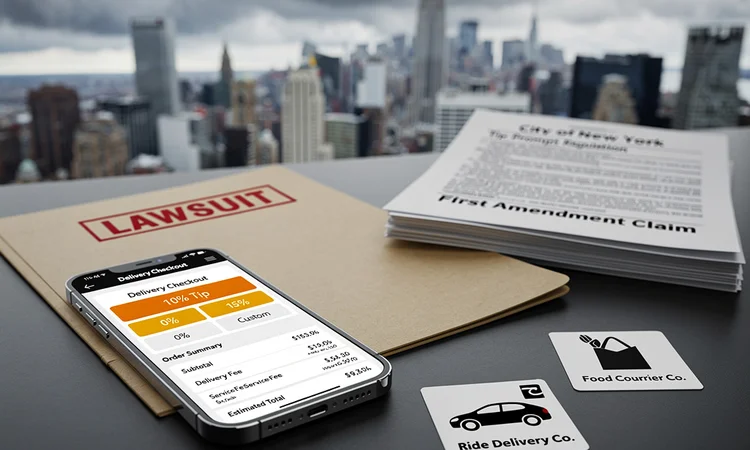
Uber and DoorDash sue NYC over a law mandating 10% default tip prompts at checkout, claiming First Amendment violations. The fight follows wage hikes that spiked fees and slashed tips, highlighting tensions in the $40 billion delivery sector.

Tip Screen Tussle: Uber, DoorDash Battle NYC’s Gratuity Mandate in Court

In a bold challenge to New York City’s regulatory reach into app interfaces, Uber Technologies Inc. and DoorDash Inc. have filed a joint federal lawsuit seeking to block a new rule that mandates tipping prompts appear before checkout with a default 10% gratuity option. The litigation, lodged in Manhattan federal court, accuses the city of trampling First Amendment rights by compelling the companies to convey a government-drafted message on their digital platforms. Set to take effect January 26, the regulation stems from Local Law 202, which aims to boost delivery workers’ earnings amid rising operational costs.

The companies argue the mandate forces them to alter their proprietary software in ways that infringe on free speech protections. ‘This law compels apps to speak a government-mandated message,’ the complaint states, echoing broader tensions between tech platforms and local governments over user interface control. DoorDash and Uber, which dominate the $40 billion U.S. food delivery market, previously shifted tip prompts post-checkout in 2023 to mitigate ‘sticker shock’ after NYC enacted a $21.44 hourly minimum wage for drivers, a move that spurred fee hikes and prompted this latest countermeasure.

New York’s Push to Frontload Tips

City officials defend the rule as essential for transparency and worker pay. A New York Times report details how the law requires apps to display tip options at order finalization, pre-set to 10%, 15%, or 20%, with users able to adjust or opt out. This reverses the apps’ post-2023 strategy of delaying prompts until after delivery or even during rating screens, a change implemented after the wage law drove up base fees by up to 46%, per a city-commissioned study.

That study, released last year by the NYC Department of Consumer and Worker Protection, found tips plummeted 68% year-over-year following the wage hike and prompt shift, even as driver earnings rose overall due to mandated minimums. Critics like Uber and DoorDash contend the new rule exacerbates ‘tipping fatigue’ among consumers battered by inflation, potentially curbing order volumes in a sector already squeezed by labor costs and restaurant fees.

Free Speech at the Checkout Counter

The lawsuit invokes landmark Supreme Court precedents like Reed v. Town of Gilbert , positioning app interfaces as protected expressive conduct. ‘The city cannot commandeer private companies’ platforms to push its preferred messaging,’ lawyers for the firms wrote in filings reviewed by Restaurant Dive . This marks the latest salvo in a years-long war: Uber and DoorDash lost a prior suit against the 2023 wage law but succeeded in delaying its full enforcement through appeals.

DoorDash’s public affairs head, Adrian Lappert, framed the stakes in a statement: ‘NYC’s policies are driving up prices and hurting Dashers, restaurants, and customers.’ Meanwhile, labor advocates hail the tip rule as a win for gig workers, who rely on gratuities for up to 70% of income, according to data from the Independent Drivers Guild, a union-backed group.

Fee Spiral and Driver Earnings Data

Post-wage law, average order fees ballooned from $4.50 to $6.60, per the city’s analysis, while tips averaged just 5% of order values down from 12%. A Gothamist investigation notes restaurants have absorbed some costs via lower commissions, but many report 10-15% order drops. Uber’s head of U.S. policy, Chris Nakamoto, told analysts on a recent earnings call that such regulations threaten platform viability in high-cost markets like NYC, where drivers log over 100 million miles annually.

Defendants, represented by the city law department, have yet to respond formally, but Mayor Eric Adams’ administration views the suit as industry pushback against fair pay reforms. ‘Delivery workers deserve every dollar,’ said a spokesperson, citing $500 million in added wages since 2023.

Broader Industry Ripples

The case could set precedents beyond food delivery, testing municipal authority over private app designs in rideshare, e-commerce, and fintech. Similar battles brew in California, where Prop 22’s gig classification faces challenges, and Chicago mulls tip transparency rules. Bloomberg reports investor eyes are on potential impacts: DoorDash shares dipped 2% post-filing, while Uber held steady, buoyed by diversified revenue.

Legal experts predict a drawn-out fight, possibly reaching the Second Circuit or Supreme Court. ‘This pits consumer protection against corporate speech rights,’ said Fordham Law professor Carl Tobias. For insiders, the real wager is on demand elasticity: Will upfront tips deter orders, or stabilize driver retention in a market with 15% annual churn?

Stakeholder Voices and Market Dynamics

Delivery unions like Real Food Workers United back the city, sharing rider testimonials of $2-3 average tips post-shift. Restaurant groups, caught in the crossfire, lobby for exemptions; the New York State Restaurant Association warns of further menu price hikes. On X, sentiment splits: Driver accounts celebrate potential pay bumps, while users decry ‘guilt-trip interfaces’ amid 7% food inflation.

As hearings loom in early 2026, the suit underscores gig economy fault lines—balancing worker protections with platform innovation. With NYC accounting for 10% of U.S. delivery volume, a ruling could reshape fee structures nationwide.

About the Author

Liam Murphy
Liam Murphy

Liam Murphy is a journalist who focuses on fintech innovation. Their approach combines scenario planning and on‑the‑ground reporting. They frequently translate research into action for marketing teams, prioritizing clarity over buzzwords. They also highlight cultural factors that determine whether change sticks. They value transparent sourcing and prefer primary data when it is available. Readers appreciate their ability to connect strategic goals with everyday workflows. They avoid buzzwords, focusing instead on outcomes, incentives, and the human side of technology. They maintain a balanced tone, separating speculation from evidence. Their coverage includes guidance for teams under resource or time constraints. They explore how policies, markets, and infrastructure intersect to create second‑order effects. They look for overlooked details that differentiate sustainable success from short‑term wins. Their perspective is shaped by interviews across engineering, operations, and leadership roles. They emphasize responsible innovation and the constraints teams face when scaling products or services. They often test claims against real deployment stories. Readers return for the clarity, the caution, and the actionable takeaways.

Comments

Join the discussion and share your thoughts.

No comments yet. Be the first to comment.

Leave a Reply

Your email address will not be published.

Related Posts

US Lawmakers Strip Right-to-Repair from 2026 NDAA, Boosting Defense Contractors

US Lawmakers Strip Right-to-Repair from 2026 NDAA, Boosting Defense Contractors

U.S. lawmakers removed right-to-repair provisions from the 2026 NDAA, preventing military personnel from independently fixing equipment and preserving defense contractors' lucrative service contracts. Critics decry industry influence, citing potential cost savings and improved readiness. This setback fuels ongoing advocacy for repair reforms in military and civilian sectors.

Posted on: by Jack Chen
Amazon Prime Air Struggles: Drone Incidents, Regulations, and Rivals

Amazon Prime Air Struggles: Drone Incidents, Regulations, and Rivals

Amazon's Prime Air drone delivery program, launched in 2013, faces setbacks including a 2025 Texas incident where a drone clipped a cable, triggering FAA scrutiny, regulatory hurdles, and technical glitches. Trailing rivals like Walmart and Zipline, Amazon is pivoting strategies amid fierce competition. Recovery hinges on innovations and safer operations.

Posted on: by Grace Wright
DOJ’s Appeal in Google Antitrust Case Signals Protracted Legal Battle Over Search Monopoly Remedies

DOJ’s Appeal in Google Antitrust Case Signals Protracted Legal Battle Over Search Monopoly Remedies

The DOJ and state attorneys general have appealed Judge Mehta's Google antitrust remedies ruling, challenging the decision to reject structural breakups including Chrome divestiture. The appeal argues behavioral restrictions are insufficient to dismantle Google's search monopoly, setting up a multi-year legal battle.

Retail Ecommerce
Google Launches Doppl: AI Virtual Try-Ons Transform Online Shopping

Google Launches Doppl: AI Virtual Try-Ons Transform Online Shopping

Google has launched Doppl, an AI-powered app enabling virtual clothing try-ons with personalized, dynamic models to reduce online shopping uncertainties and returns. Amid expanding AI shopping tools like agentic checkout, it faces regulatory scrutiny over data practices, yet promises to revolutionize e-commerce personalization and consumer behavior.

Retail Ecommerce
Microsoft 365 Prices to Rise Up to 33% in 2026 Amid AI and Security Upgrades

Microsoft 365 Prices to Rise Up to 33% in 2026 Amid AI and Security Upgrades

Microsoft is raising Microsoft 365 prices by up to 33% starting July 1, 2026, for commercial, frontline, and government users, driven by AI enhancements like Copilot and improved security features. This first major hike since 2022 aims to fund innovations amid cyber threats, though it sparks mixed reactions on affordability.

Retail Ecommerce
EU Court Upholds Intel Antitrust Ruling, Slashes Fine to €237M

EU Court Upholds Intel Antitrust Ruling, Slashes Fine to €237M

Europe's General Court upheld Intel's antitrust violation for using rebates and payments to exclude rivals like AMD in the chip market, but slashed the fine from €376 million to €237 million. This ruling, part of a decades-long saga, highlights evolving EU antitrust standards amid Intel's competitive challenges.

Retail Ecommerce
MasterClass 2025 Holiday Deal: 40% Off Annual Subscriptions

MasterClass 2025 Holiday Deal: 40% Off Annual Subscriptions

MasterClass's 2025 holiday promotion offers 40% off annual subscriptions, reducing Standard to $72, Plus to $108, and Premium to $144, including gifts. This strategy enhances accessibility to celebrity-led courses amid market competition. It boosts subscriber growth and democratizes elite education during economic uncertainties.

Retail Ecommerce
NYC’s 2025 Congestion Pricing Slashes Traffic 11%, Pollution 22% in Manhattan

NYC’s 2025 Congestion Pricing Slashes Traffic 11%, Pollution 22% in Manhattan

New York City's 2025 congestion pricing in Manhattan charges drivers to enter south of 60th Street, reducing traffic by 11% and PM2.5 pollution by 22%. This has improved air quality citywide, cut noise and accidents, funded transit upgrades, and serves as a model for urban sustainability.

Retail Ecommerce
2025 RAM Prices Skyrocket Amid AI-Driven Shortages

2025 RAM Prices Skyrocket Amid AI-Driven Shortages

In 2025, RAM prices have skyrocketed due to explosive AI demand for high-bandwidth memory in data centers, causing shortages and doubling or tripling costs for consumer DDR5 and DDR4 modules. This crisis disrupts PC building, smartphones, and industries, with experts forecasting prolonged volatility through 2027-2028 as production lags behind.

Retail Ecommerce
Nvidia Pilots AI Chip Tracking Software to Curb Smuggling to China

Nvidia Pilots AI Chip Tracking Software to Curb Smuggling to China

Nvidia is piloting software that uses telemetry data to track the locations of its AI chips, like the Blackwell series, to combat smuggling into restricted markets such as China amid US export bans. This initiative addresses geopolitical tensions and black-market operations, enhancing compliance without hardware changes.

Retail Ecommerce