Fed’s Steady Hand: Powell Defies Pressure in First 2026 Hold

Elena Brooks
Elena Brooks

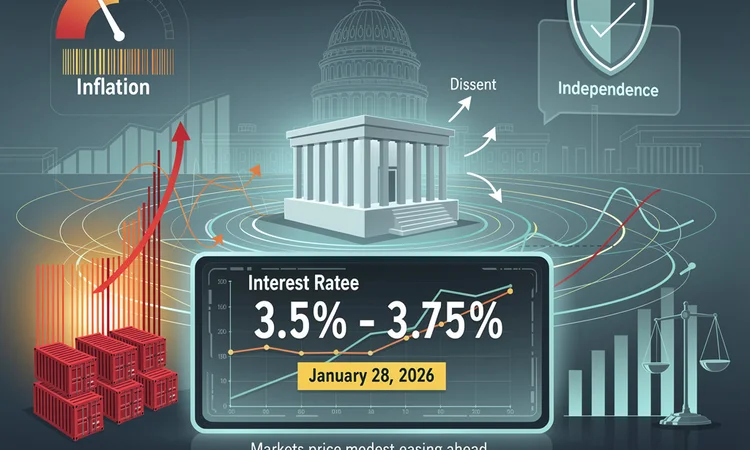
The Federal Reserve held rates at 3.5%-3.75% on January 28, 2026, pausing cuts amid elevated inflation from tariffs and a stable economy. Powell rebuffed politics, dissents surfaced, and markets priced modest easing ahead.

Fed’s Steady Hand: Powell Defies Pressure in First 2026 Hold

In a move that underscored the Federal Reserve’s resolve amid mounting political headwinds, the Federal Open Market Committee on January 28, 2026, held its benchmark federal funds rate steady at 3.5%-3.75%, pausing after three consecutive quarter-point cuts in late 2025. Chair Jerome Powell, facing scrutiny over his impending successor and a Justice Department probe, emphasized data-driven decisions during his post-meeting press conference. “The economy has once again surprised us with its strength, not for the first time,” Powell remarked, as reported by The New York Times .

The decision aligned with market expectations but revealed deepening divisions within the FOMC. Governors Stephen Miran and Christopher Waller dissented, advocating for another 25 basis-point reduction, marking the sixth straight meeting with dissents. For Miran, this represented a shift from prior calls for half-point cuts. Powell noted broad support for the hold, stating there was “broad support on the committee” for maintaining rates, according to CNBC .

Persistent Inflation and Tariff Shadows

FOMC projections highlighted inflation’s stubborn persistence, described as “somewhat elevated” after moving up since earlier in the year. Policymakers attributed much of the overshoot to tariffs, with Powell clarifying, “It’s really tariffs that are causing most of the inflation overshoot,” expecting a one-time price increase to fade by mid-2026, per LiveMint . The statement reflected solid growth forecasts, a stabilizing labor market constrained by lower immigration and steady participation rates, and muted layoffs.

The Fed’s outlook pointed to 2026 GDP growth at 2.3%, unemployment steady at 4.4%, and core PCE inflation easing to 2.5%, upgrades from prior estimates that justified the pause. “We’re well positioned to wait and see how the economy evolves from here,” Powell had signaled in December, a stance reinforced Wednesday, as covered by The Guardian .

Political Crosswinds Test Independence

Powell’s press conference dodged queries on White House tensions five times with variations of “I have nothing for you on that.” Pressed on advice for his May successor—amid President Trump’s search narrowing to candidates like Kevin Hassett or Kevin Warsh—Powell advised, “Stay out of elected politics.” This came days after he labeled a criminal probe into Fed renovations a “pretext” for pressuring rates lower, declaring, “The threat of criminal charges is a consequence of the Federal Reserve setting interest rates based on our best assessment of what will serve the public,” via the Federal Reserve .

The Supreme Court’s recent arguments on Trump’s bid to remove Governor Lisa Cook amplified independence concerns. Yet Powell affirmed, “Monetary policy is not on a preset course. We will make our decisions on a meeting-by-meeting basis,” per CNBC . Economists noted the Fed’s firm footing: “The hurdle to additional cuts has been raised under Chair Powell’s watch,” as Investopedia quoted analysts.

Market Reactions Signal Cautious Optimism

Major stock indexes ended little changed, with traders pricing a 60% chance of two more quarter-point cuts in 2026, per CNBC . Gold surged to record highs near $5,300 as a hedge against uncertainty, while futures eyed a potential June cut. “The Fed delivered a rate cut, but it arrived in a somewhat hawkish package,” said Ellen Zentner of Morgan Stanley Wealth Management.

Charlie Ripley of Allianz Investment Management viewed it as affirmation: “Labor conditions are not worsening, growth has accelerated and inflation has steadied for now. Policy rates are much closer to neutral.” On X, users echoed the pause’s significance, with posts highlighting the 10-2 vote and tariff impacts.

Projections Point to Measured Path Ahead

Though no new dot plot emerged this meeting, December’s median envisioned one 2026 cut to 3.25%-3.5%, aligning with neutral estimates. Powell stressed, “We haven’t made any decisions about future meetings, but the economy is growing at a solid pace,” as in Yahoo Finance . Risks balanced upside for inflation and unemployment, complicating further easing.

Wall Street anticipates a prolonged hold unless labor data softens markedly. Heather Long of Navy Federal Credit Union called it “détente at the Fed for now. But a shakeup is coming with the new Fed Chair in May.” The FOMC’s balance sheet expansion via short-term Treasury purchases aims to maintain ample reserves, signaling no reversal on normalization.

Dissenters and Data Dependency

Miran’s dissent evolved from aggressive easing calls, while Waller’s push reflected dovish concerns over job gains averaging just 40,000 monthly—potentially revised lower. Powell cautioned on revisions: “That figure could be revised lower by as much as 60,000,” implying net job losses, from PBS News .

“What you see is some people feel we should stop here and that we’re at the right place and just wait,” Powell described internal debates. Upcoming jobs reports will test this stance, with markets watching for cracks in the labor stasis amid tariff-driven price pressures.

About the Author

Elena Brooks
Elena Brooks

Known for clear analysis, Elena Brooks follows cloud infrastructure and the people building it. They work through editorial reviews backed by user research to make complex topics approachable. They often cover how organizations respond to change, from process redesign to technology adoption. They believe good analysis should be specific, testable, and useful to practitioners. They maintain a balanced tone, separating speculation from evidence. They value transparent sourcing and prefer primary data when it is available. They avoid buzzwords, focusing instead on outcomes, incentives, and the human side of technology. Their reporting blends qualitative insight with data, highlighting what actually changes decision‑making. They frequently compare approaches across industries to surface patterns that travel well. They write about both the promise and the cost of transformation, including risks that are easy to overlook. They are known for dissecting tools and strategies that improve execution without adding complexity. They watch the policy landscape closely when it affects product strategy. They value transparency, practical advice, and honest uncertainty.

Comments

Join the discussion and share your thoughts.

No comments yet. Be the first to comment.

Leave a Reply

Your email address will not be published.

Related Posts

Atlantic’s $1.2 Billion Staffing Power Play: F1 Tech Talent Fuels Transatlantic Surge

Atlantic’s $1.2 Billion Staffing Power Play: F1 Tech Talent Fuels Transatlantic Surge

Atlantic International Corp. acquires Circle8 Group in an all-stock deal, creating a $1.2 billion global staffing platform blending U.S. industrial and European IT talent. Circle8's Aston Martin F1 partnership highlights its elite capabilities amid cross-selling potential.

Posted on: by Liam Price
Bots at Work: Service Robotics’ $500 Billion Surge Reshapes Labor Markets

Bots at Work: Service Robotics’ $500 Billion Surge Reshapes Labor Markets

Service robotics rockets toward $498 billion by 2033 at 37% CAGR, automating logistics, healthcare, and hospitality amid AI advances and labor crunches. Deals like Serve's Diligent buy propel indoor expansions.

Posted on: by Layla Reed
Aspire-Deel Tie-Up Reshapes Global Hiring for Fintech Startups

Aspire-Deel Tie-Up Reshapes Global Hiring for Fintech Startups

Aspire integrates Deel's EOR services for seamless global hiring and finance management, targeting startups scaling internationally. The partnership addresses compliance hurdles, offering unified insights into workforce costs and cash flow.

Business
Deel’s Record-Breaking Hiring Spectacle: AI-Powered Push Reshapes Global Talent Wars

Deel’s Record-Breaking Hiring Spectacle: AI-Powered Push Reshapes Global Talent Wars

Deel shattered records with 6,848 attendees at its largest online hiring event, blending AI tools and global reach to fill 300+ sales roles. Amid growth to $17.3 billion valuation, the feat highlights innovations in HR and payroll but sparks debate on stunt versus substance.

Business
Deel’s $17 Billion Sprint: From Y Combinator to Global Payroll Powerhouse

Deel’s $17 Billion Sprint: From Y Combinator to Global Payroll Powerhouse

Deel rocketed to a $17.3 billion valuation in seven years by pioneering owned global payroll infrastructure, processing $22 billion annually for 37,000 firms. Amid IPO prep and DOJ scrutiny, COO Dan Westgarth reveals elite ops driving $1 billion revenue.

Business
HR’s AI Superagent Revolution: Reinventing the Workforce Engine

HR’s AI Superagent Revolution: Reinventing the Workforce Engine

Enterprise AI Superagents ignite HR's biggest transformation in decades, automating 30-40% of jobs while birthing full-stack roles and skills-first strategies. Josh Bersin leads the charge amid bias risks and tech trends reshaping hiring, experience, and leadership.

Business
AI’s HR Reckoning: 10 Pivotal Shifts Reshaping Workforce Strategies in 2026

AI’s HR Reckoning: 10 Pivotal Shifts Reshaping Workforce Strategies in 2026

As AI propels organizations into hybrid human-machine teams, HR must master fluency screening, skills-based shifts and agentic governance to thrive amid 2026's disruptions, blending tech efficiency with human resilience.

Business
The Upselling Paradox: How Retailers Walk the Tightrope Between Revenue Growth and Consumer Trust

The Upselling Paradox: How Retailers Walk the Tightrope Between Revenue Growth and Consumer Trust

New research reveals upselling's hidden risks as retailers balance revenue growth with customer trust. While upselling can boost transaction values by 10-30%, approximately 23% of consumers experience post-purchase regret, potentially damaging long-term profitability and brand reputation in an increasingly skeptical marketplace.

Business
Chrome Extensions’ Silent Siege on Enterprise HR Crown Jewels

Chrome Extensions’ Silent Siege on Enterprise HR Crown Jewels

Five malicious Chrome extensions hijacked sessions on Workday, NetSuite, and SAP SuccessFactors, stealing cookies, blocking admin pages, and enabling takeovers. Socket's discovery prompted Google takedowns after 2,300 installs, exposing enterprise browser risks.

Business
AI Proficiency Divide: HR’s Mounting Crisis

AI Proficiency Divide: HR’s Mounting Crisis

Corporate AI adoption surges, but superficial employee use creates a proficiency chasm now demanding HR intervention through targeted training, outcome metrics, and equity for overlooked workers.

Business