
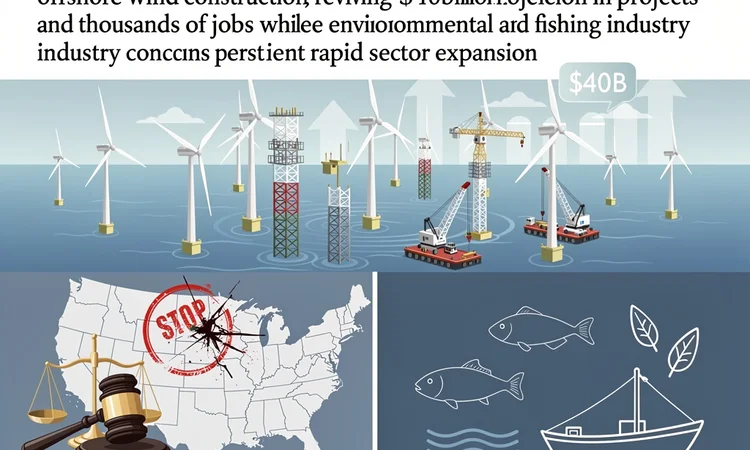
A federal appeals court has overturned a nationwide injunction that had frozen all offshore wind construction along America’s coastlines for nearly eight months, delivering a critical lifeline to an industry that represents billions in investments and thousands of jobs. The ruling, issued by the U.S. Court of Appeals for the District of Columbia Circuit, reverses a lower court decision that had brought the burgeoning sector to a complete standstill, threatening to derail the nation’s renewable energy transition and leaving major energy companies in financial limbo.
According to Ars Technica , the appellate court found that the original injunction, which was based on environmental concerns raised by fishing industry groups and coastal residents, lacked sufficient legal grounding to justify halting an entire sector of the economy. The three-judge panel determined that the plaintiffs failed to demonstrate irreparable harm that would warrant such sweeping relief, particularly given the extensive environmental review processes already required for offshore wind projects under federal law. The decision immediately allows construction to resume on approximately 15 major projects spanning from Massachusetts to North Carolina, representing more than $40 billion in planned investments.
The original injunction, issued in June by a federal district court judge in Virginia, had sent shockwaves through the renewable energy sector and raised questions about the viability of President Biden’s ambitious goal to deploy 30 gigawatts of offshore wind capacity by 2030. The ruling had effectively frozen construction on projects that were already under development, including the massive Vineyard Wind installation off Massachusetts and the Ocean Wind projects near New Jersey. Industry analysts estimated that the delay was costing developers approximately $2 million per day in idle equipment, contract penalties, and financing costs, while also jeopardizing thousands of union jobs in fabrication yards, ports, and installation vessels.
The legal challenge centered on allegations that the Bureau of Ocean Energy Management (BOEM) had failed to adequately assess the cumulative environmental impacts of multiple offshore wind farms, particularly regarding endangered North Atlantic right whales and commercial fishing operations. Environmental groups allied with fishing industry representatives argued that the rapid pace of offshore wind development had outstripped regulatory oversight, creating potential ecological risks that warranted a comprehensive pause. However, the appellate court found these arguments insufficient to overcome the substantial public interest in advancing renewable energy infrastructure and meeting climate goals.
Industry Recovery and Economic Implications
The resumption of offshore wind construction comes at a pivotal moment for the American renewable energy sector, which has faced mounting challenges from supply chain disruptions, rising interest rates, and political opposition in several coastal states. Major developers including Ørsted, Equinor, and BP had warned that prolonged delays could force them to abandon U.S. projects entirely, potentially redirecting billions in capital to European and Asian markets where regulatory frameworks are more established. The court’s decision provides renewed confidence for these international energy giants, which have committed to building out America’s offshore wind capacity as part of the global transition away from fossil fuels.
Financial markets responded positively to the ruling, with shares of publicly traded offshore wind developers and equipment manufacturers rising sharply on the news. The decision also provides relief to coastal states that have signed power purchase agreements for offshore wind electricity, including New York, New Jersey, and Connecticut, which had faced the prospect of energy shortages and higher electricity prices if planned projects failed to come online as scheduled. State officials in these jurisdictions have been vocal advocates for resuming construction, arguing that offshore wind is essential to meeting their renewable energy mandates and reducing carbon emissions.
The economic ripple effects extend beyond energy companies to encompass a vast network of suppliers, manufacturers, and service providers that have emerged to support the offshore wind industry. Port facilities in New Bedford, Massachusetts, and Paulsboro, New Jersey, have undergone hundreds of millions of dollars in upgrades specifically designed to handle massive wind turbine components, and these investments have been sitting idle during the construction freeze. Similarly, specialized installation vessels, which can cost upward of $500 million each, have been anchored offshore without generating revenue, creating financial strain for the maritime companies that operate them.
Environmental Concerns and Regulatory Oversight
Despite the court’s ruling in favor of resuming construction, environmental concerns about offshore wind development remain a contentious issue that is likely to continue shaping the industry’s trajectory. The North Atlantic right whale, with fewer than 350 individuals remaining, has become a focal point of opposition to offshore wind, with critics arguing that construction noise, vessel traffic, and underwater infrastructure pose existential threats to the critically endangered species. Federal agencies have implemented strict mitigation measures, including seasonal construction restrictions and mandatory vessel speed limits, but some environmental advocates argue these protections are insufficient given the scale of planned development.
The fishing industry, which has been among the most vocal opponents of offshore wind expansion, maintains that wind farms will disrupt traditional fishing grounds and interfere with navigation routes that have been used for generations. Commercial fishermen have reported difficulty obtaining clear information about where wind farms will be located and how they will affect fish stocks and fishing practices. Industry representatives argue that the compensation mechanisms offered by wind developers are inadequate and fail to account for long-term impacts on marine ecosystems and fishing communities that depend on them for their livelihoods.
BOEM has responded to these concerns by enhancing its environmental review processes and establishing new protocols for ongoing monitoring of offshore wind projects once they become operational. The agency has committed to adaptive management strategies that would allow for project modifications if monitoring reveals unanticipated environmental impacts. However, critics argue that these assurances ring hollow given the agency’s track record and the political pressure to rapidly expand offshore wind capacity regardless of environmental consequences.
Political Dynamics and Future Challenges
The court ruling arrives amid a shifting political environment for renewable energy, with offshore wind becoming increasingly polarized along partisan lines. Republican lawmakers in several coastal states have introduced legislation to ban or restrict offshore wind development, citing concerns about visual impacts, property values, and environmental risks. This political opposition has created uncertainty for developers, who must navigate not only complex federal permitting processes but also potential state-level obstacles that could emerge even after projects receive federal approval.
The offshore wind industry has sought to counter this opposition by emphasizing job creation and economic development benefits, particularly in regions that have been economically disadvantaged by the decline of traditional manufacturing. Labor unions have been strong supporters of offshore wind, seeing it as an opportunity to create high-paying jobs in fabrication, installation, and maintenance. The industry has also highlighted its commitment to domestic content requirements and workforce development programs designed to ensure that American workers benefit from the offshore wind buildout.
Looking ahead, the industry faces significant challenges in meeting the ambitious deployment targets set by federal and state governments. Even with construction resuming, developers must contend with a limited supply of specialized vessels and equipment, a shortage of trained workers, and continuing uncertainty about long-term power purchase agreements in an era of volatile electricity markets. The supply chain constraints are particularly acute, as most offshore wind components are currently manufactured overseas, and efforts to establish domestic manufacturing capacity have been slow to materialize despite substantial federal incentives.
Technological Innovation and Market Evolution
The temporary construction halt has, paradoxically, provided some developers with an opportunity to reassess their technology choices and project designs in light of rapid advances in turbine efficiency and installation methods. The latest generation of offshore wind turbines, with capacities exceeding 15 megawatts, offers significantly improved economics compared to earlier models, potentially allowing projects to generate more electricity with fewer turbines. This technological evolution could help address some visual impact concerns while also reducing the overall footprint of wind farms and potentially minimizing environmental effects.
Installation techniques have also advanced considerably, with new vessel designs and foundation systems that promise to reduce construction timelines and costs. Floating offshore wind platforms, which can be deployed in deeper waters where fixed-bottom foundations are impractical, represent a particularly promising frontier that could dramatically expand the available resource area for offshore wind development. Several demonstration projects for floating wind are currently in various stages of planning along the Pacific Coast and in the Gulf of Maine, regions where water depths have previously precluded offshore wind development.
The court’s decision to allow construction to resume sets the stage for a critical test of whether the American offshore wind industry can overcome its challenges and deliver on the ambitious promises that have attracted tens of billions in investment. The coming months will reveal whether developers can execute their construction plans efficiently, whether environmental mitigation measures prove effective, and whether the industry can build the political and social support necessary for long-term success. For an industry that has faced repeated setbacks and skepticism, the appellate court ruling represents not a conclusion but rather the beginning of a new chapter in America’s complex relationship with offshore renewable energy.


Leave a Reply
Your email address will not be published.