
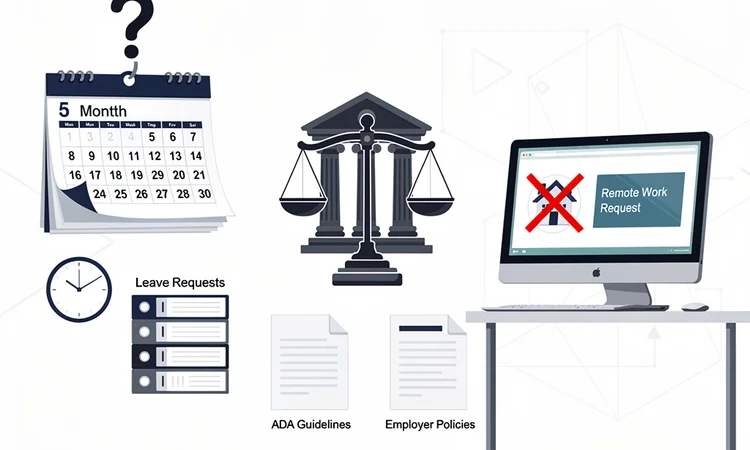
Leanna Coffman, an account executive at Nexstar Media Inc.’s Beckley, West Virginia, news station, faced a cascade of medical challenges after delivering twins in early 2022. Approved for eight weeks of remote work due to pregnancy complications from placenta previa, she then took 12 weeks of Family and Medical Leave Act leave for bonding. But severe complications from a cesarean section—including ureter damage, infections, a nephrostomy bag, and mobility limitations—extended her absence. Short-term disability benefits carried her through June 27, 2022, yet she provided no return-to-work clearance.
Nexstar repeatedly sought updates. On July 28, the company noted her FMLA had expired in May and requested a return date, emphasizing that disability benefits were separate from job-protected leave. Coffman replied on August 4: she remained under “intense care,” faced surgery on August 8 with 4-6 weeks recovery, and had a tentative October procedure. Nexstar terminated her effective August 19, citing the “critical nature” of her sales role after six months away. Coffman sued under the West Virginia Human Rights Act—mirroring the Americans with Disabilities Act—for failure to accommodate, discriminatory and retaliatory discharge, plus FMLA retaliation.
The U.S. District Court for the Southern District of West Virginia granted summary judgment to Nexstar. On appeal, the Fourth Circuit affirmed in an unpublished per curiam opinion dated July 22, 2025, before Judges Wynn, Thacker, and Senior Judge Floyd. Applying ADA standards to WVHRA claims, the panel ruled Coffman failed to identify any reasonable accommodation enabling her to perform essential functions “now or in the near future.”
Indefinite Leave Crosses the Threshold
“An employer is not required to give a disabled employee an indefinite period of time to correct a disabling condition that renders him unqualified,” the court stated, echoing precedents. While the ADA demands no precise return date, an approximate timeline is essential. Coffman’s vague “September or October” projection after six months, amid pending surgeries, equated to indefinite leave—unreasonable as a matter of law, per the opinion in Coffman v. Nexstar Media Inc.
Even paid parental leave was off-limits; Nexstar’s policy required exhausting disability first, which Coffman hadn’t. The court rejected her bid for more unpaid time, noting employers needn’t hold positions open endlessly. This aligns with EEOC guidance allowing leave as accommodation but not indefinitely if it precludes essential duties.
HR Dive reported the decision underscores that “indefinite leave is not a reasonable accommodation,” quoting the panel: “At bottom, unpaid leave amounted to indefinite leave.” The outlet, in its July 25, 2025, article, highlighted how Coffman’s two-month window offered “meaningful uncertainty,” dooming her claim ( HR Dive ).
Remote Work Demands Actual Ability to Perform
Prior remote approval during pregnancy didn’t bind Nexstar post-surgery. The court found Coffman’s communications and STD status—benefits granted only for those unable to work—proved she couldn’t perform duties remotely or otherwise. “Remote work is not a reasonable accommodation for an employee who is receiving short-term disability insurance benefits, which typically are awarded only when an employee cannot work at all,” noted attorneys Fiona W. Ong and Charles L. Thompson IV in their analysis.
Essential functions of her sales job—client meetings, relationship-building—required work capacity she lacked. No evidence showed remote feasibility amid pain and restrictions. The Fourth Circuit dismissed interactive process failures, as no viable option existed regardless.
Ogletree Deakins emphasized shifting circumstances: “Although an employee may have previously been allowed to work remotely, that does not mean that remote work continues to be a reasonable accommodation” ( Ogletree Deakins ). The firm’s January 22, 2026, post, cross-published in The National Law Review , warned employers against assuming past accommodations persist.
Broader Claims Collapse Without Qualification
Coffman wasn’t a “qualified individual” under WVHRA/ADA—unable, even accommodated, to perform essentials. Discriminatory discharge failed for the same reason. Retaliatory claims under WVHRA lacked protected activity; FMLA retaliation showed no causation, with three months between leave end and firing weakening inference. Nexstar’s early FMLA mention was precautionary, not adverse.
Amundsen Davis law firm noted: “Nothing in the text of the reasonable accommodation provision requires an employer to wait an indefinite period for an accommodation to achieve its intended effect” ( Amundsen Davis ). The decision reinforces that STD receipt signals non-qualification.
Steptoe & Johnson PLLC advised documenting communications, as Nexstar did, to counter retaliation suits: Nexstar waited post-FMLA, approved extras, and only acted after repeated outreach ( Steptoe & Johnson ).
Navigating Post-Coffman Realities for Employers
The ruling, binding in Maryland, North Carolina, South Carolina, Virginia, and West Virginia, guides nationwide via persuasion. Employers must engage interactively but can demand timelines and medical details. Refusal to provide them, as here, justifies denial. KJK stressed: “The interactive process has limits… Documenting efforts is critical” ( KJK ).
Remote work’s post-pandemic rise complicates matters, but Coffman clarifies: feasibility turns on ability, not preference. Sands Anderson urged: “Employees owe employers some degree of certainty” ( Sands Anderson ). ComPsych added even “probably September or October” may falter if too vague ( ComPsych ).
As of January 2026, no further appeals or related filings appear in dockets. Nexstar, a media giant, emerges unscathed, bolstering defenses against open-ended requests. The Employer Handbook blog noted courts reject three common pitches—leave, remote, restructuring—when indefinite ( The Employer Handbook ). Industry insiders now wield this precedent to balance ADA duties with operational needs.


Leave a Reply
Your email address will not be published.