
Gemini’s Local Lens: Google’s AI Reveals How It Sees Your Business

Layla Reed
Layla Reed

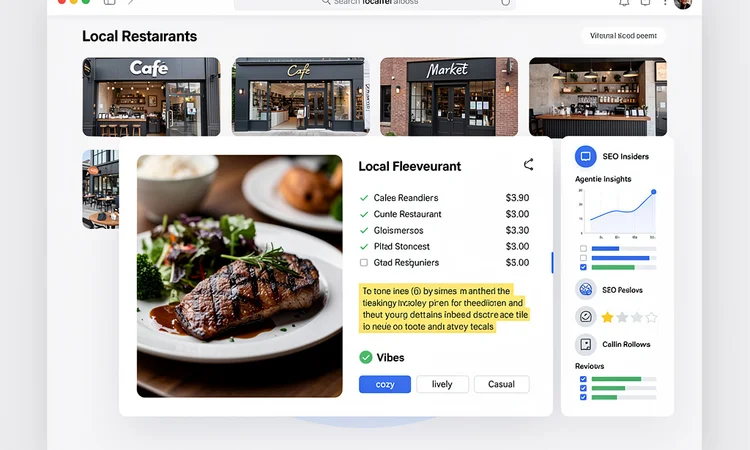
Google's Gemini AI exposes its view of local businesses through structured previews of menus, review tips and vibes, offering SEO insiders a diagnostic tool amid visual results and agentic calling rollouts.

Gemini’s Local Lens: Google’s AI Reveals How It Sees Your Business

Google’s Gemini AI is peeling back the curtain on its internal understanding of local businesses, delivering structured insights that blend review data, menu highlights and venue vibes into concise previews. Spotted in early 2026 tests, these outputs challenge business owners to align their profiles with Google’s perceptions—or risk mismatched representations in AI-driven search.

Local SEO consultant Claudia Tomnia first highlighted the feature on LinkedIn, sharing a video of Gemini’s response to a query for the best sushi in Michigan. “I was convinced AI Mode was going to be Google’s AI-powered future for local search,” she wrote, before noting, “Take a look at how Gemini is interpreting your business.” The results featured novel sections like “People talk most about,” listing items such as omakase, sake and nigiri.

Executive Editor Barry Schwartz at Search Engine Roundtable amplified the discovery, observing that Gemini generates “new headlines and sections about your business” pulled from reviews and other signals. This revelation arrives amid broader Gemini integrations in search, signaling a shift toward interpretive AI summaries over raw listings.

Gemini’s Interpretive Sections Unpacked

The structured previews include “People love to order,” marked by star icons and details like a “generous portion of tuna” in a Michigan Roll. “Tips from reviewers” extracts practical advice, warning of small plates, loud atmospheres or touch-screen kiosks. Finally, “People go here for” categorizes spots by purpose, such as “impressing a date” or “grabbing a casual bite.” Tomnia emphasized these as distinct from Google Maps or local packs, appearing as a pre-view before traditional results.

LinkedIn commenters reinforced the implications. Greg Sterling called it a test, while Saqlain Zafar described the pivot from “where is it?” to “what’s it like?” PG stressed reviews’ role in nuanced AI recommendations. As Schwartz noted in Search Engine Roundtable , such details offer a mirror to Google’s business knowledge base.

This interpretive layer builds on Gemini’s December 2025 visual local results rollout, where the Gemini app began displaying photos, ratings and Maps data in rich formats for local queries. Google stated, “Starting today, Gemini can serve up local results in a rich, visual format. See photos, ratings, and real-world info from @GoogleMaps, right where you need them.”

Visual and Agentic Evolutions Accelerate

Schwartz covered the visual upgrade in another Search Engine Roundtable piece , urging businesses to optimize Google Business Profiles with fresh info and reviews. The feature’s emergence underscores Gemini’s growing role in local discovery, pulling from Maps for immersive previews.

Parallel developments include agentic capabilities in Google Search’s AI Mode. Search Engine Land reported on Gemini 2.5 Pro powering Deep Search and local calling, where users query “pet groomers near me” and select “Have AI check pricing.” Google consolidates call results into service options, available to AI Pro and Ultra subscribers in the U.S. Google explained, “Deep Search is our most advanced research tool… issuing hundreds of searches, reasoning across disparate pieces of information and crafting a comprehensive, fully-cited report in minutes.”

These agentic tools, detailed in Search Engine Land , mark Google’s push into proactive assistance, calling businesses directly. As VP Robby Stein announced via Google’s X account , AI Mode expansions blend real-time data with Gemini for shopping and local planning.

Implications for Local SEO Strategies

Businesses must now audit Gemini outputs to ensure accurate interpretations. Tomnia’s post prompted calls to refine reviews for better tips and vibes, with Shahid Anwer noting Google’s vibe-first prioritization. Wil Reynolds on X critiqued LLM phone number accuracy, urging use of Google Business data over third-party sources like GetHuman.

Digital Trends echoed the visual upgrade’s discovery potential in its coverage , while Barry Schwartz’s X posts drove discussions on profile optimization. For insiders, this means prioritizing structured data, review volume and semantic alignment to shape AI narratives.

Google Maps itself previewed review summaries powered by Gemini, offering TL;DR overviews in app reviews sections, as shared on X . Combined with agentic calling, these evolutions position Gemini as a core local intelligence engine, demanding proactive profile management from marketers.

Testing Phases and Broader Rollouts

The interpretive feature appears in testing, absent from Maps or packs, per Tomnia. Sterling’s comment suggests caution, but rollout patterns—like the reposted visual announcement—hint at expansion. Search Engine Land’s Barry Schwartz noted subscriber-only access for advanced features, predicting wider availability.

X chatter from Reynolds and others highlights data fidelity issues, with only 20% phone match rates in LLMs. Yext warned of AI shifts favoring machine-readable local pages. As Google integrates Gemini 2.5 Pro for complex queries, local SEO pros face a future where AI interpretations dictate visibility.

About the Author

Layla Reed
Layla Reed

Known for clear analysis, Layla Reed follows retail operations and the people building it. They work through long‑form narratives grounded in real‑world metrics to make complex topics approachable. They believe good analysis should be specific, testable, and useful to practitioners. They avoid buzzwords, focusing instead on outcomes, incentives, and the human side of technology. They explore how policies, markets, and infrastructure intersect to create second‑order effects. They frequently compare approaches across industries to surface patterns that travel well. They are known for dissecting tools and strategies that improve execution without adding complexity. A recurring theme in their writing is how teams build repeatable systems and measure impact over time. Their reporting blends qualitative insight with data, highlighting what actually changes decision‑making. They often cover how organizations respond to change, from process redesign to technology adoption. They maintain a balanced tone, separating speculation from evidence. Outside of publishing, they track public datasets and industry benchmarks. Readers return for the clarity, the caution, and the actionable takeaways.

Comments

Join the discussion and share your thoughts.

No comments yet. Be the first to comment.

Leave a Reply

Your email address will not be published.

Related Posts

Atlantic’s $1.2 Billion Staffing Power Play: F1 Tech Talent Fuels Transatlantic Surge

Atlantic’s $1.2 Billion Staffing Power Play: F1 Tech Talent Fuels Transatlantic Surge

Atlantic International Corp. acquires Circle8 Group in an all-stock deal, creating a $1.2 billion global staffing platform blending U.S. industrial and European IT talent. Circle8's Aston Martin F1 partnership highlights its elite capabilities amid cross-selling potential.

Posted on: by Liam Price
Bots at Work: Service Robotics’ $500 Billion Surge Reshapes Labor Markets

Bots at Work: Service Robotics’ $500 Billion Surge Reshapes Labor Markets

Service robotics rockets toward $498 billion by 2033 at 37% CAGR, automating logistics, healthcare, and hospitality amid AI advances and labor crunches. Deals like Serve's Diligent buy propel indoor expansions.

Posted on: by Layla Reed
Aspire-Deel Tie-Up Reshapes Global Hiring for Fintech Startups

Aspire-Deel Tie-Up Reshapes Global Hiring for Fintech Startups

Aspire integrates Deel's EOR services for seamless global hiring and finance management, targeting startups scaling internationally. The partnership addresses compliance hurdles, offering unified insights into workforce costs and cash flow.

Business
Deel’s Record-Breaking Hiring Spectacle: AI-Powered Push Reshapes Global Talent Wars

Deel’s Record-Breaking Hiring Spectacle: AI-Powered Push Reshapes Global Talent Wars

Deel shattered records with 6,848 attendees at its largest online hiring event, blending AI tools and global reach to fill 300+ sales roles. Amid growth to $17.3 billion valuation, the feat highlights innovations in HR and payroll but sparks debate on stunt versus substance.

Business
Deel’s $17 Billion Sprint: From Y Combinator to Global Payroll Powerhouse

Deel’s $17 Billion Sprint: From Y Combinator to Global Payroll Powerhouse

Deel rocketed to a $17.3 billion valuation in seven years by pioneering owned global payroll infrastructure, processing $22 billion annually for 37,000 firms. Amid IPO prep and DOJ scrutiny, COO Dan Westgarth reveals elite ops driving $1 billion revenue.

Business
HR’s AI Superagent Revolution: Reinventing the Workforce Engine

HR’s AI Superagent Revolution: Reinventing the Workforce Engine

Enterprise AI Superagents ignite HR's biggest transformation in decades, automating 30-40% of jobs while birthing full-stack roles and skills-first strategies. Josh Bersin leads the charge amid bias risks and tech trends reshaping hiring, experience, and leadership.

Business
AI’s HR Reckoning: 10 Pivotal Shifts Reshaping Workforce Strategies in 2026

AI’s HR Reckoning: 10 Pivotal Shifts Reshaping Workforce Strategies in 2026

As AI propels organizations into hybrid human-machine teams, HR must master fluency screening, skills-based shifts and agentic governance to thrive amid 2026's disruptions, blending tech efficiency with human resilience.

Business
The Upselling Paradox: How Retailers Walk the Tightrope Between Revenue Growth and Consumer Trust

The Upselling Paradox: How Retailers Walk the Tightrope Between Revenue Growth and Consumer Trust

New research reveals upselling's hidden risks as retailers balance revenue growth with customer trust. While upselling can boost transaction values by 10-30%, approximately 23% of consumers experience post-purchase regret, potentially damaging long-term profitability and brand reputation in an increasingly skeptical marketplace.

Business
Chrome Extensions’ Silent Siege on Enterprise HR Crown Jewels

Chrome Extensions’ Silent Siege on Enterprise HR Crown Jewels

Five malicious Chrome extensions hijacked sessions on Workday, NetSuite, and SAP SuccessFactors, stealing cookies, blocking admin pages, and enabling takeovers. Socket's discovery prompted Google takedowns after 2,300 installs, exposing enterprise browser risks.

Business
AI Proficiency Divide: HR’s Mounting Crisis

AI Proficiency Divide: HR’s Mounting Crisis

Corporate AI adoption surges, but superficial employee use creates a proficiency chasm now demanding HR intervention through targeted training, outcome metrics, and equity for overlooked workers.

Business