
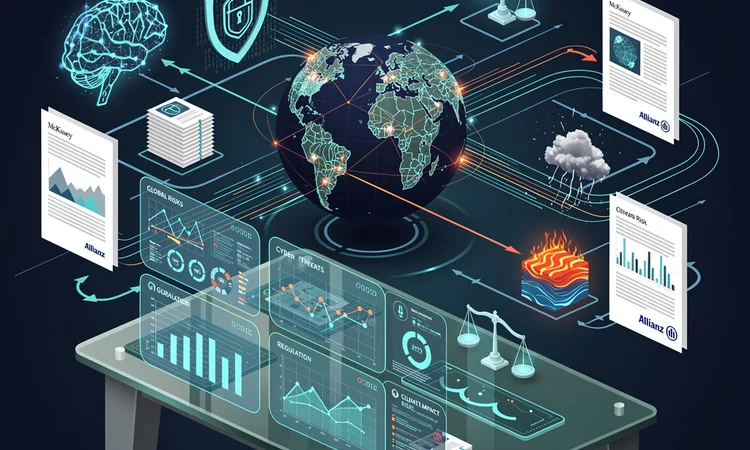
In an era of relentless disruption, risk management is undergoing its most profound overhaul since the 2008 financial crisis. Financial institutions and corporations face a barrage of interconnected threats—from soaring geopolitical volatility to AI-fueled cyber perils—that demand agile, tech-infused strategies. A McKinsey report warns that over the next three to five years, risk functions must evolve into cross-functional powerhouses blending human insight with real-time analytics.
The World Uncertainty Index, tracked by the Federal Reserve Bank of St. Louis, stands nearly nine times higher in Q3 2025 than in Q4 2005, fueled by trade wars, elections and conflicts. This volatility ripples through supply chains, credit markets and cyber defenses, forcing chief risk officers to abandon static models for dynamic simulations. Meanwhile, nonbank financial institutions now hold over 50% of assets in advanced economies—around 80% in the U.S., per the IMF—forcing banks to rethink counterparty oversight.
Technology accelerates the pace. AI reshapes customer journeys in onboarding and lending but also supercharges fraud and contagion risks, as digital threats propagate faster than ever. McKinsey authors Anke Raufuss and colleagues highlight how concentrations in tech providers amplify nth-party vulnerabilities, urging firms to map dependencies rigorously.
Geopolitical Turbulence Redefines Vulnerabilities
Geopolitical flux tops the list of transformative forces. Houthi attacks in the Red Sea and the Francis Scott Key Bridge collapse in 2025 exposed supply chain frailties, with disruptions occurring every 1.4 years and accelerating, according to Allianz Risk Barometer 2025 . These events cascade into credit spikes and counterparty strains, compelling risk teams to integrate nonfinancial risks like operational resilience into core frameworks.
Regulatory fragmentation compounds the challenge. U.S. deregulation clashes with stringent rules elsewhere, turning internal risk appetites into de facto binding constraints. The World Economic Forum’s Global Risks Report 2025 paints a fractured picture, with over 900 experts citing escalating geopolitical, environmental and tech risks as threats to stability.
Cyber incidents reign as the top global business risk for 2026, outpacing even AI by 10 percentage points, per Allianz. Insured losses from natural catastrophes hit $100 billion for the sixth straight year, despite a quieter 2025 hurricane season, underscoring the need for climate-integrated modeling.
AI’s Double-Edged Sword in Risk Arsenal
Artificial intelligence promises to revolutionize risk but introduces fresh perils. In the KPMG Future of Risk Survey of 400 executives, AI and generative AI topped technologies for handling expanded duties over the next three to five years. Agentic AI in credit risk, as noted by ACTICO , delivers faster decisions with fewer errors, transforming analysts into strategic overseers.
Yet AI climbs to No. 2 in Allianz rankings, up from 10th, due to fears of misuse, deepfakes and systemic failures. Moody’s predicts AI-driven scams and deepfakes will dominate financial crime in 2026, with costs under $1 to acquire on the dark web. A Latin America Risk Study flags AI as the top emerging risk, cited by 76% of respondents.
FIS Global Innovation Research, surveying 2,000 firms, reveals 95% of leaders in heavily regulated U.K., Singapore and Hong Kong express high confidence in risk management, versus 87%-90% in the U.S., highlighting regulatory tech’s role. Blockchain and IoT further enhance predictive maintenance and transparency, per Risk Management Strategies .
Reorganizing for Agility and Resilience
McKinsey envisions future risk functions as three pillars: a strategic nerve center for scenario planning and appetite setting; domain-specific pods tackling cyber, financial and entity risks; and an analytics center of excellence fusing AI with human judgment. This hybrid model retains the three lines of defense while enabling continuous monitoring over periodic testing.
Upskilling is critical. CROs must invest in AI literacy, cross-risk analysis and ethical governance, evolving from ‘protectors’ to ‘business accelerators.’ Protiviti’s 2026 Top Risks report notes 31% of executives rank AI integration with processes as a top concern, alongside cyber and data risks, pushing for pilot testing and stakeholder alignment.
Talent shortages loom large, with 32% citing workforce evolution as a long-term risk. Rotational programs and data scientist hires are essential, as PwC emphasizes maintaining core financial risk prowess amid digital shifts.
Climate and Supply Chain Pressures Mount
Climate risks demand terabyte-scale modeling for extreme weather impacts on assets and insurance, per FIS. Aon’s analytics head Megan Hart stresses sustainability in underwriting: “Insurers take into account not just the cost benefit… but also an organization’s approach to sustainability.” Energy transition reduces carbon reliance, bolstering portfolios.
Supply chains face persistent tariffs, conflicts and climate shocks, destabilizing manufacturing and transport, warns Risk Strategies . BNP Paribas’ 2025 outlook flags policy unpredictability driving volatility, urging treasurers to hedge refinancing amid digitalization and green investments.
Everbridge’s 2026 outlook reveals only 31% of leaders feel extremely confident in critical event management, identifying 10 risks from AI to civil unrest. Proactive resilience—via pervasive sensors and real-time controls, as Deloitte predicts—turns threats into edges.
CRO Playbook for the Turbulent Decade
CROs should prioritize four steps: AI upskilling, cross-cutting capabilities like enterprise risk management, transparent AI governance and hybrid talent pipelines. McKinsey advocates scenario-based training and rotations to foster strategic thinkers.
Integrated platforms unify siloed data, per Moody’s, enabling proactive stances on interconnected risks. TechTarget highlights GRC tools, risk maturity models and AI for dynamic cybersecurity, while AuditBoard stresses connecting missed risk links amid strategy shifts.
As X discussions from experts like @fabiolauria92 note, AI analytics surges in climate risk for insurers, demanding superior data quality. Forward-looking firms embedding these shifts will not just survive but thrive amid uncertainty.


Leave a Reply
Your email address will not be published.