
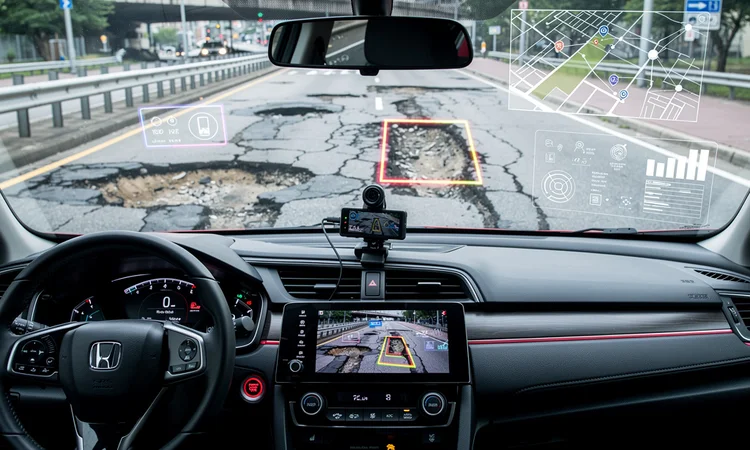
Japanese automaker Honda Motor Company has embarked on a pilot program that could fundamentally alter how cities identify and repair deteriorating infrastructure, deploying artificial intelligence systems that enable vehicles to automatically detect and report road damage without driver intervention. The initiative represents a significant evolution in connected vehicle technology, moving beyond navigation and entertainment to position automobiles as mobile infrastructure inspection platforms that could save municipalities millions in manual surveying costs.
According to Digital Trends , Honda’s experimental system utilizes dashboard-mounted cameras combined with machine learning algorithms to identify potholes, damaged road signs, and other infrastructure deficiencies as vehicles traverse their normal routes. The technology operates autonomously in the background, requiring no action from drivers while continuously scanning road conditions and transmitting data to municipal authorities. This crowdsourced approach to infrastructure monitoring could provide cities with real-time, comprehensive road condition data at a fraction of the cost of traditional inspection methods.
The pilot program, conducted in collaboration with local government agencies, processed thousands of miles of roadway data during its initial testing phase. Honda’s AI system demonstrated the capability to distinguish between various types of road damage, from minor surface cracks to significant potholes that pose immediate safety hazards. The machine learning models were trained on extensive datasets of road conditions, enabling the system to achieve accuracy rates that rival human inspectors while operating at speeds impossible for manual surveys.
The Economics of Deteriorating Infrastructure
American municipalities face a mounting crisis in infrastructure maintenance, with the American Society of Civil Engineers estimating that inadequate road conditions cost U.S. drivers $130 billion annually in vehicle repairs and operating costs. Traditional methods of road inspection rely heavily on manual surveys conducted by municipal employees or contracted firms, processes that are both time-consuming and expensive. Many cities can only afford to comprehensively survey their road networks every few years, meaning that dangerous conditions often persist for extended periods before detection and repair.
Honda’s automated detection system offers a compelling alternative economic model. By leveraging vehicles that are already traversing roadways for their primary transportation purposes, cities could potentially achieve continuous monitoring coverage without deploying dedicated inspection fleets. The distributed nature of the data collection means that high-traffic areas receive more frequent assessment, naturally prioritizing the roads that affect the greatest number of citizens. This dynamic monitoring capability could enable municipalities to shift from reactive repair schedules to proactive maintenance programs that address problems before they escalate into costly major repairs.
Technical Architecture and Machine Learning Capabilities
The Honda system’s technical foundation rests on computer vision algorithms specifically optimized for road condition assessment. The dashboard cameras capture high-resolution imagery at regular intervals, which onboard processors analyze in real-time using convolutional neural networks trained to recognize specific infrastructure defects. The AI models can differentiate between shadows, water puddles, and actual road damage—a critical capability that reduces false positives that could overwhelm municipal maintenance departments with spurious reports.
Beyond simple pothole detection, Honda’s system demonstrates sophisticated classification capabilities. The technology can assess the severity of road damage, categorizing defects by size, depth, and potential safety impact. This granular data enables cities to prioritize repairs based on objective criteria rather than relying solely on citizen complaints, which tend to concentrate in affluent neighborhoods with more engaged residents. The system also timestamps and geotags each detection, creating a comprehensive database that tracks infrastructure degradation over time and helps predict future maintenance needs.
Privacy Considerations and Data Management Protocols
The deployment of vehicle-mounted cameras for infrastructure monitoring inevitably raises privacy concerns, particularly regarding the capture of pedestrians, license plates, and private property. Honda has implemented several technical safeguards to address these issues, including on-device processing that analyzes imagery locally before transmitting only metadata and cropped images of road defects to municipal servers. The system does not retain full-resolution imagery of surroundings, and facial recognition capabilities are explicitly disabled in the software architecture.
Data governance frameworks for the pilot program establish clear boundaries around information usage, stipulating that collected data can only be employed for infrastructure assessment purposes and cannot be shared with law enforcement or other government agencies for unrelated investigations. These protocols mirror privacy protections that have emerged in other connected vehicle initiatives, recognizing that public acceptance of beneficial technologies depends on robust safeguards against mission creep and unauthorized data exploitation.
Municipal Integration and Workflow Optimization
For Honda’s system to deliver practical value, the data it generates must integrate seamlessly with existing municipal maintenance workflows. The pilot program includes software interfaces that connect with common work order management systems used by public works departments, automatically generating repair tickets when road damage exceeds predefined severity thresholds. This automation eliminates manual data entry steps that often create bottlenecks in government operations, enabling faster response times from detection to repair.
Early participating municipalities report that the system’s comprehensive coverage has revealed infrastructure problems in areas that rarely receive attention under traditional inspection regimes. Rural roads and low-traffic residential streets, which might be surveyed only every several years under conventional approaches, now receive the same monitoring frequency as major thoroughfares. This democratization of infrastructure attention could help address longstanding disparities in municipal service delivery that have historically favored well-connected neighborhoods over marginalized communities.
Competitive Developments and Industry Trends
Honda’s initiative arrives amid growing interest across the automotive industry in leveraging connected vehicle data for public benefit. Tesla has previously utilized its fleet’s cameras for mapping and navigation improvements, while Ford has explored similar infrastructure monitoring capabilities through its commercial vehicle division. The convergence of improved camera technology, more powerful onboard computing, and sophisticated AI models has made vehicle-based sensing economically viable for applications beyond traditional automotive functions.
Technology companies have also entered this space, with firms like RoadBotics offering smartphone-based road assessment tools that municipalities can deploy on existing vehicle fleets. However, Honda’s approach offers potential advantages in scale and consistency, as factory-integrated systems can ensure standardized camera positioning, calibration, and data quality across thousands of vehicles. The automaker’s established relationships with government fleet purchasers could accelerate adoption if the technology proves successful in pilot deployments.
Regulatory Framework and Standardization Challenges
The path from successful pilot to widespread deployment faces significant regulatory hurdles, as no standardized frameworks currently exist for crowdsourced infrastructure monitoring data. Questions remain about liability when AI systems fail to detect hazardous road conditions, and about the evidentiary standards municipal attorneys would need to meet when using automated assessments to support infrastructure negligence claims. State and federal transportation agencies will likely need to develop certification standards for road monitoring systems, similar to existing protocols for traffic counting equipment and automated enforcement cameras.
Standardization of data formats represents another critical challenge, as municipalities employ diverse asset management systems with incompatible data structures. Industry consortia may need to establish common protocols for communicating road condition information, ensuring that data from Honda vehicles can integrate with systems from other manufacturers as the technology proliferates. The absence of such standards could fragment the market and reduce the network effects that make crowdsourced monitoring valuable.
Future Implications for Smart City Infrastructure
Honda’s road monitoring system exemplifies a broader trend toward instrumenting urban environments with distributed sensor networks that provide continuous operational intelligence. As vehicles become increasingly connected and autonomous, they represent mobile platforms capable of collecting diverse environmental data beyond road conditions—from air quality measurements to parking availability and traffic flow patterns. This evolution positions the automobile as a critical component of smart city infrastructure rather than merely a beneficiary of it.
The economic implications extend beyond municipal cost savings to encompass new business models and data marketplaces. Automakers could potentially monetize infrastructure data by selling subscriptions to government agencies, while insurance companies might use road condition information to adjust premiums based on the quality of roads policyholders typically traverse. These emerging data economies will require careful regulatory oversight to ensure that public infrastructure information remains accessible to the communities it serves rather than becoming a proprietary asset controlled by private corporations.
The success of Honda’s pilot program could catalyze a fundamental reimagining of how societies maintain public infrastructure. By transforming every connected vehicle into a mobile inspection platform, cities could achieve unprecedented visibility into infrastructure conditions while redirecting resources from manual surveys to actual repairs. As climate change intensifies weather events that accelerate road deterioration, and as deferred maintenance backlogs grow across aging infrastructure networks, automated monitoring systems may transition from experimental novelties to essential tools for municipal management. The question is no longer whether such systems will be deployed, but rather how quickly cities can adapt their operations to leverage the intelligence that connected vehicles are already capable of providing.


Leave a Reply
Your email address will not be published.