
Housing Market’s Spring Thaw Hits a Wall as Mortgage Rates Surge, Sidelining Buyers

Stella Evans
Stella Evans

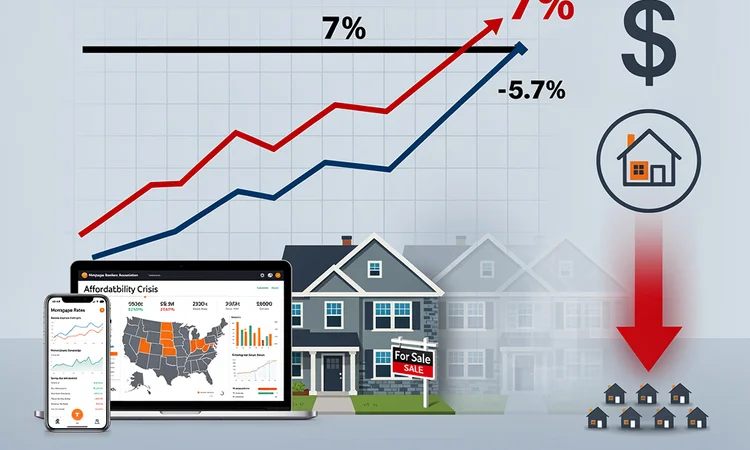
The U.S. housing market's spring rebound has stalled as mortgage rates climbed back above 7%, causing a sharp 5.7% drop in loan applications. This downturn, detailed by the Mortgage Bankers Association, highlights a severe affordability crisis sidelining potential buyers and casting uncertainty over the summer selling season.

Housing Market’s Spring Thaw Hits a Wall as Mortgage Rates Surge, Sidelining Buyers

The U.S. housing market’s anticipated spring revival has been abruptly checked by a familiar adversary: rising mortgage rates. A sharp downturn in mortgage demand, the most significant in three months, signals growing fatigue among potential homebuyers confronting a punishing affordability crunch, casting a pall over what is traditionally the busiest selling season.

Total mortgage application volume plummeted 5.7% on a seasonally adjusted basis for the week ending May 24, according to a report from the Mortgage Bankers Association (MBA) . The decline was a direct reaction to a renewed ascent in borrowing costs, with the average contract interest rate for a 30-year fixed-rate mortgage climbing back over a key psychological threshold to 7.05%. This increase effectively erased the brief relief buyers felt earlier in the month and pushed borrowing costs to their highest point in weeks.

A Chilling Effect on Purchase Activity

The chill was most pronounced in the home purchase market, a critical barometer of housing health. The MBA’s Purchase Index, which tracks mortgage applications for home purchases, sank by 1% for the week and was a stark 12% lower than the same week one year ago. This retreat suggests that even motivated buyers are reaching their financial limits as the combination of high prices and elevated rates makes ownership untenable for a growing segment of the population.

“The market is seeing a more notable slowdown in purchase activity, as the recent rise in rates is dampening affordability,” noted Joel Kan, MBA’s Vice President and Deputy Chief Economist. This environment has become particularly difficult for first-time buyers, who lack the home equity of repeat buyers to cushion the blow of higher financing costs. The data underscores a market dynamic where rate fluctuations of even a few basis points can meaningfully alter buyer behavior and sideline thousands of potential purchasers.

The Federal Reserve’s Long Shadow

The upward pressure on mortgage rates is inextricably linked to the Federal Reserve’s ongoing battle against inflation and the subsequent reaction in the bond markets. Mortgage rates closely track the yield on the 10-year U.S. Treasury note, which serves as a benchmark for various forms of long-term credit. Recent commentary from Fed officials has reinforced a “higher-for-longer” stance on the federal funds rate, dispelling earlier market hopes for imminent rate cuts.

Investors are now parsing every piece of economic data for clues about the Fed’s next move. While the latest Personal Consumption Expenditures (PCE) price index, the Fed’s preferred inflation gauge, showed a slight cooling in April, it wasn’t enough to signal a decisive victory over inflation, as reported by Bloomberg . This persistent, albeit moderating, inflation keeps bond yields elevated, which in turn translates directly to the higher mortgage rates confronting consumers at the lender’s office.

Refinancing Remains in a Deep Freeze

While the purchase market is struggling, the mortgage refinancing sector is nearly dormant. The MBA’s Refinance Index plunged 14% for the week and was 5% lower than the same period last year. This collapse in activity is unsurprising, as the vast majority of current homeowners are locked into mortgage rates secured during the pandemic-era lows, many below 3.5%. With current rates hovering around 7%, there is virtually no financial incentive for these homeowners to refinance.

This “lock-in effect” has broader implications beyond the refinancing business. It contributes significantly to the chronically low inventory of existing homes for sale, as homeowners are reluctant to sell and give up their advantageous mortgage terms. According to the National Association of Realtors , existing-home sales recently slid, in part due to this inventory constraint, which props up prices even as demand softens. The result is a market caught in a stalemate: buyers can’t afford to buy, and sellers can’t afford to move.

The Affordability Squeeze Tightens its Grip

For the average American family, the return of 7% mortgage rates is not an abstract economic indicator but a concrete barrier to homeownership. A rate increase from 6.5% to 7.05% on a $400,000 loan adds approximately $125 to the monthly payment, or $1,500 per year. Over the life of the loan, this seemingly small jump amounts to tens of thousands of dollars in additional interest payments, a daunting prospect for households already squeezed by inflation in other areas.

This persistent affordability crisis is reshaping the very structure of housing demand. According to a CNBC analysis of the MBA data, demand for adjustable-rate mortgages (ARMs) has ticked up slightly as some buyers seek lower initial payments. However, this is a niche solution and carries its own risks. The larger trend is one of buyer withdrawal, with many either postponing their search indefinitely or being priced out of their desired neighborhoods entirely.

A Stalled Market Heading into Summer

The latest drop in mortgage applications represents a significant setback for the real estate sector. Lenders, real estate agents, and homebuilders were all banking on pent-up demand to fuel a more robust spring season. Instead, they are facing a hesitant and financially strained consumer base. As noted by Reuters , the housing market has been a primary victim of the Federal Reserve’s aggressive rate-hiking cycle, and its path forward remains murky.

Industry insiders are now recalibrating their expectations for the summer. Without a substantial and sustained drop in mortgage rates—something that appears unlikely until the Federal Reserve sees conclusive evidence of inflation returning to its 2% target—the housing market is likely to continue its pattern of fits and starts. The dream of a normalized, vibrant market remains deferred, contingent on a macroeconomic environment that is proving stubbornly resistant to change.

About the Author

Stella Evans
Stella Evans

Stella Evans is a journalist who focuses on AI deployment. They work through trend monitoring with careful context and caveats to make complex topics approachable. They believe good analysis should be specific, testable, and useful to practitioners. They examine how customer expectations evolve and how organizations adapt to meet them. Their reporting blends qualitative insight with data, highlighting what actually changes decision‑making. Readers appreciate their ability to connect strategic goals with everyday workflows. They write about both the promise and the cost of transformation, including risks that are easy to overlook. They also highlight cultural factors that determine whether change sticks. Their coverage includes guidance for teams under resource or time constraints. Their perspective is shaped by interviews across engineering, operations, and leadership roles. They often cover how organizations respond to change, from process redesign to technology adoption. They maintain a balanced tone, separating speculation from evidence. They are interested in the economics of scale and operational resilience. They prefer evidence over hype and explain trade‑offs plainly.

Comments

Join the discussion and share your thoughts.

No comments yet. Be the first to comment.

Leave a Reply

Your email address will not be published.

Related Posts

Atlantic’s $1.2 Billion Staffing Power Play: F1 Tech Talent Fuels Transatlantic Surge

Atlantic’s $1.2 Billion Staffing Power Play: F1 Tech Talent Fuels Transatlantic Surge

Atlantic International Corp. acquires Circle8 Group in an all-stock deal, creating a $1.2 billion global staffing platform blending U.S. industrial and European IT talent. Circle8's Aston Martin F1 partnership highlights its elite capabilities amid cross-selling potential.

Posted on: by Liam Price
Bots at Work: Service Robotics’ $500 Billion Surge Reshapes Labor Markets

Bots at Work: Service Robotics’ $500 Billion Surge Reshapes Labor Markets

Service robotics rockets toward $498 billion by 2033 at 37% CAGR, automating logistics, healthcare, and hospitality amid AI advances and labor crunches. Deals like Serve's Diligent buy propel indoor expansions.

Posted on: by Layla Reed
Aspire-Deel Tie-Up Reshapes Global Hiring for Fintech Startups

Aspire-Deel Tie-Up Reshapes Global Hiring for Fintech Startups

Aspire integrates Deel's EOR services for seamless global hiring and finance management, targeting startups scaling internationally. The partnership addresses compliance hurdles, offering unified insights into workforce costs and cash flow.

Business
Deel’s Record-Breaking Hiring Spectacle: AI-Powered Push Reshapes Global Talent Wars

Deel’s Record-Breaking Hiring Spectacle: AI-Powered Push Reshapes Global Talent Wars

Deel shattered records with 6,848 attendees at its largest online hiring event, blending AI tools and global reach to fill 300+ sales roles. Amid growth to $17.3 billion valuation, the feat highlights innovations in HR and payroll but sparks debate on stunt versus substance.

Business
Deel’s $17 Billion Sprint: From Y Combinator to Global Payroll Powerhouse

Deel’s $17 Billion Sprint: From Y Combinator to Global Payroll Powerhouse

Deel rocketed to a $17.3 billion valuation in seven years by pioneering owned global payroll infrastructure, processing $22 billion annually for 37,000 firms. Amid IPO prep and DOJ scrutiny, COO Dan Westgarth reveals elite ops driving $1 billion revenue.

Business
HR’s AI Superagent Revolution: Reinventing the Workforce Engine

HR’s AI Superagent Revolution: Reinventing the Workforce Engine

Enterprise AI Superagents ignite HR's biggest transformation in decades, automating 30-40% of jobs while birthing full-stack roles and skills-first strategies. Josh Bersin leads the charge amid bias risks and tech trends reshaping hiring, experience, and leadership.

Business
AI’s HR Reckoning: 10 Pivotal Shifts Reshaping Workforce Strategies in 2026

AI’s HR Reckoning: 10 Pivotal Shifts Reshaping Workforce Strategies in 2026

As AI propels organizations into hybrid human-machine teams, HR must master fluency screening, skills-based shifts and agentic governance to thrive amid 2026's disruptions, blending tech efficiency with human resilience.

Business
The Upselling Paradox: How Retailers Walk the Tightrope Between Revenue Growth and Consumer Trust

The Upselling Paradox: How Retailers Walk the Tightrope Between Revenue Growth and Consumer Trust

New research reveals upselling's hidden risks as retailers balance revenue growth with customer trust. While upselling can boost transaction values by 10-30%, approximately 23% of consumers experience post-purchase regret, potentially damaging long-term profitability and brand reputation in an increasingly skeptical marketplace.

Business
Chrome Extensions’ Silent Siege on Enterprise HR Crown Jewels

Chrome Extensions’ Silent Siege on Enterprise HR Crown Jewels

Five malicious Chrome extensions hijacked sessions on Workday, NetSuite, and SAP SuccessFactors, stealing cookies, blocking admin pages, and enabling takeovers. Socket's discovery prompted Google takedowns after 2,300 installs, exposing enterprise browser risks.

Business
AI Proficiency Divide: HR’s Mounting Crisis

AI Proficiency Divide: HR’s Mounting Crisis

Corporate AI adoption surges, but superficial employee use creates a proficiency chasm now demanding HR intervention through targeted training, outcome metrics, and equity for overlooked workers.

Business