
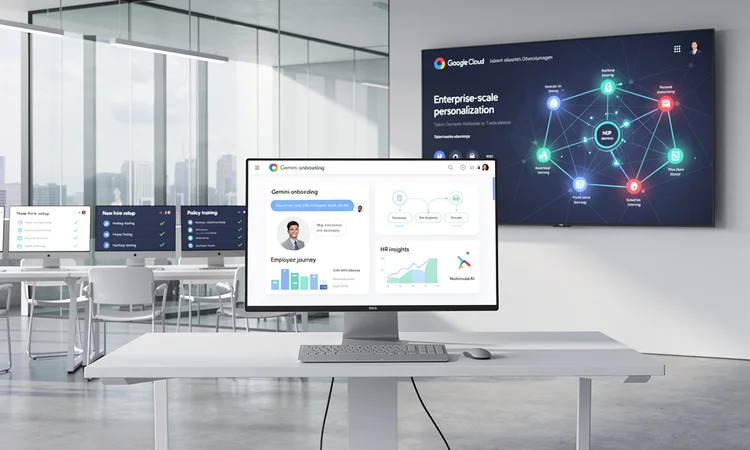
The corporate world is witnessing a fundamental transformation in how organizations welcome and integrate new employees, driven by sophisticated artificial intelligence systems that promise to eliminate the inefficiencies and frustrations that have long plagued employee onboarding processes. Google Cloud’s latest innovations in this space reveal how enterprises are deploying AI agents built on Gemini technology to create personalized, responsive onboarding experiences that adapt to individual employee needs while dramatically reducing the administrative burden on human resources departments.
According to Google Cloud’s technical documentation , organizations can now build intelligent onboarding agents that leverage Gemini’s multimodal capabilities to answer employee questions, guide them through complex processes, and provide contextual information drawn from vast repositories of corporate knowledge. These systems represent a significant departure from traditional onboarding approaches, which typically rely on static documentation, scheduled orientation sessions, and overworked HR personnel struggling to provide individualized attention to each new hire.
The technical architecture underlying these onboarding agents combines several cutting-edge AI capabilities. Gemini’s natural language understanding allows the system to interpret questions posed in conversational language, while its integration with enterprise data sources enables it to retrieve relevant information from employee handbooks, policy documents, benefits information, and organizational charts. The multimodal nature of Gemini means these agents can process and generate not just text, but also images, videos, and other media formats that might be part of comprehensive onboarding materials.
The Technical Foundation: Building Blocks of Intelligent Onboarding
The construction of an effective onboarding agent requires careful orchestration of multiple technical components. According to Google Cloud’s implementation guidance, developers begin by establishing connections to enterprise data sources through secure APIs and data connectors. This foundational step ensures the AI agent has access to authoritative, up-to-date information about company policies, procedures, and resources. The system architecture typically includes integration with human resources information systems (HRIS), learning management systems (LMS), and document management platforms.
Gemini’s grounding capabilities play a crucial role in ensuring that onboarding agents provide accurate, verifiable information rather than generating plausible-sounding but incorrect responses—a phenomenon known as hallucination in AI systems. By grounding responses in actual enterprise documents and databases, organizations can maintain confidence that new employees receive reliable guidance. The technical implementation involves configuring data stores, establishing retrieval mechanisms, and fine-tuning the agent’s behavior to prioritize accuracy over creativity.
The development process also incorporates safety mechanisms and guardrails to ensure the onboarding agent operates within appropriate boundaries. These controls prevent the system from accessing or disclosing sensitive information inappropriately, maintain consistency with corporate policies, and escalate complex or sensitive queries to human HR professionals when necessary. Google Cloud’s framework includes built-in tools for defining these parameters and monitoring agent behavior in production environments.
Transforming the Employee Experience Through Personalization
The impact of AI-powered onboarding extends far beyond mere efficiency gains. These systems fundamentally alter the employee experience by providing immediate, personalized responses to questions that might otherwise require waiting for scheduled meetings or navigating labyrinthine documentation. New hires can interact with the onboarding agent at any time, asking questions in natural language and receiving contextual answers that account for their specific role, department, and location.
This personalization capability represents a significant advancement over previous automated onboarding solutions. Traditional chatbots typically offered scripted responses to predetermined questions, creating frustration when employees asked anything outside the narrow scope of programmed scenarios. Gemini-powered agents, by contrast, can understand context, interpret intent, and synthesize information from multiple sources to construct comprehensive, relevant responses. The system can recognize that a software engineer joining the development team has different onboarding needs than a sales representative joining a regional office, and tailor its guidance accordingly.
The multimodal capabilities of these agents enable richer, more engaging onboarding experiences. Rather than simply providing text-based answers, the system can share relevant video tutorials, display organizational charts with visual representations of team structures, or present interactive walkthroughs of key processes. This variety of content formats accommodates different learning styles and helps new employees absorb and retain critical information more effectively.
Operational Efficiency and Resource Optimization
From an organizational perspective, AI-powered onboarding agents deliver substantial operational benefits. Human resources departments, particularly in large enterprises or rapidly growing companies, often struggle to provide consistent, high-quality onboarding experiences when managing dozens or hundreds of new hires simultaneously. The cognitive load on HR professionals increases exponentially as they field repetitive questions, schedule orientation sessions, and ensure each employee completes necessary paperwork and training modules.
By automating responses to common questions and routine guidance, onboarding agents free HR personnel to focus on higher-value activities that require human judgment, empathy, and relationship-building. Google Cloud’s approach emphasizes this augmentation model, where AI handles scalable, repeatable tasks while humans concentrate on complex situations, sensitive conversations, and strategic initiatives. The result is a more efficient allocation of human capital and improved job satisfaction among HR teams who can escape the tedium of answering the same questions repeatedly.
The scalability of AI-powered onboarding proves particularly valuable for organizations experiencing rapid growth or seasonal hiring surges. Unlike human-dependent processes that require proportional increases in staffing to maintain quality, AI agents can handle virtually unlimited concurrent interactions without degradation in response quality or speed. This scalability ensures that the thousandth new hire receives the same level of attentive, personalized guidance as the first, regardless of timing or volume.
Implementation Challenges and Strategic Considerations
Despite the compelling benefits, organizations face significant challenges when implementing AI-powered onboarding systems. Data quality and accessibility emerge as critical prerequisites—the onboarding agent can only be as effective as the information it can access. Many enterprises discover that their employee documentation exists in fragmented systems, outdated formats, or inconsistent states that require substantial remediation before an AI agent can reliably utilize them.
The technical expertise required to build and maintain these systems also presents barriers, particularly for organizations without robust AI engineering capabilities. While Google Cloud provides frameworks and tools to simplify development, creating a production-ready onboarding agent still demands knowledge of machine learning concepts, API integration, natural language processing, and enterprise architecture. Organizations must decide whether to build internal capabilities, partner with specialized vendors, or adopt hybrid approaches that balance customization with implementation speed.
Privacy and security considerations assume paramount importance when deploying AI systems that access sensitive employee information. Onboarding agents necessarily interact with personal data, compensation details, and confidential corporate information. Organizations must implement rigorous access controls, data encryption, audit logging, and compliance mechanisms to protect this information while still enabling the agent to function effectively. The technical architecture must align with regulatory requirements such as GDPR, CCPA, and industry-specific data protection standards.
The Competitive Implications of AI-Enhanced Onboarding
The adoption of sophisticated onboarding technology carries strategic implications that extend beyond operational efficiency. In competitive talent markets, the onboarding experience significantly influences employee retention, engagement, and time-to-productivity. Organizations that provide seamless, supportive onboarding through AI-powered agents may gain advantages in attracting and retaining top talent, particularly among younger workers who expect digital-first experiences in all aspects of their professional lives.
The data generated by onboarding agents also creates opportunities for continuous improvement and strategic insights. By analyzing the questions new employees ask, the topics that generate confusion, and the resources they access most frequently, organizations can identify gaps in their onboarding materials, unclear policies, or processes that require simplification. This feedback loop enables iterative refinement of both the AI agent and the underlying onboarding program, creating a virtuous cycle of improvement.
As AI technology continues advancing, the capabilities of onboarding agents will expand beyond question-answering to encompass proactive guidance, predictive support, and sophisticated personalization. Future systems might anticipate employee needs based on their role and background, automatically schedule relevant training sessions, or identify potential integration challenges before they become problems. The organizations that establish strong foundations in AI-powered onboarding today position themselves to capitalize on these emerging capabilities as they mature.
The Human Element in an AI-Augmented Process
While AI agents handle many routine aspects of onboarding, the human dimension remains irreplaceable. Successful implementations recognize that technology should enhance rather than replace human connection during the critical early days of employment. The most effective approaches use AI to eliminate friction and provide information, freeing managers and team members to focus on relationship-building, culture transmission, and emotional support that machines cannot replicate.
Organizations must also address the change management challenges that accompany AI adoption. Existing HR staff may view onboarding agents as threats to their roles rather than tools to enhance their effectiveness. Successful implementations involve clear communication about how AI augments human capabilities, training to help staff work effectively alongside AI systems, and redesign of roles to emphasize uniquely human contributions. The transition requires thoughtful leadership and sustained commitment to helping employees adapt to new ways of working.
The evolution of onboarding agents represents a microcosm of broader trends in enterprise AI adoption. As organizations gain experience deploying AI in well-defined domains like employee onboarding, they develop capabilities, confidence, and frameworks that enable expansion into other business processes. The lessons learned—about data preparation, user experience design, change management, and technical architecture—transfer to subsequent AI initiatives, accelerating the overall pace of digital transformation. The onboarding agent thus serves not just as a solution to a specific problem, but as a stepping stone toward more comprehensive AI integration across the enterprise.


Leave a Reply
Your email address will not be published.