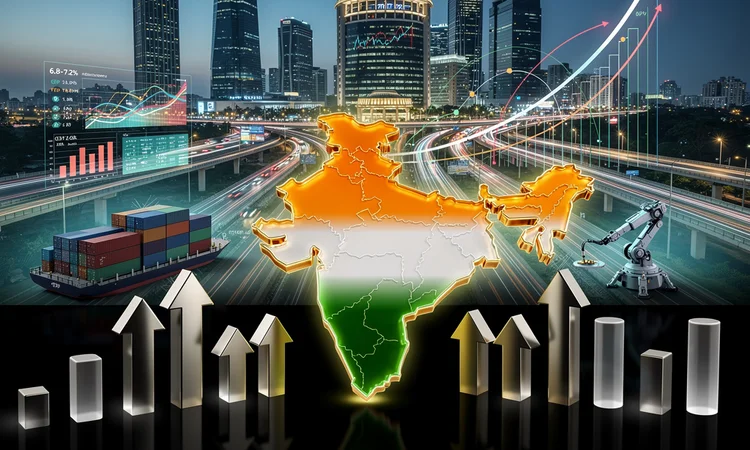
India’s Bold 7.2% Growth Wager Amid Global Trade Storms

Zoe Wright
Zoe Wright

India forecasts 6.8%-7.2% GDP growth for FY27, outpacing global peers amid U.S. tariffs, thanks to domestic demand, reforms, and export pivots. The Economic Survey highlights resilience as the fastest major economy persists.

India’s Bold 7.2% Growth Wager Amid Global Trade Storms

NEW DELHI—India’s finance ministry forecast economic expansion of 6.8% to 7.2% for fiscal year 2027, positioning the world’s fourth-largest economy to outstrip most peers despite U.S. tariffs and global headwinds. The projection, detailed in the Economic Survey 2026 tabled by Finance Minister Nirmala Sitharaman, underscores resilience driven by domestic demand and policy reforms. Chief Economic Adviser V. Anantha Nageswaran stated, “Given the strong growth performance and the foundation laid for sustained growth into the second half of this decade, we are projecting FY27 growth at between 6.8% and 7.2%.”

The survey aligns with upbeat assessments from international bodies, though some temper expectations. The International Monetary Fund pegged India’s growth at 6.4% for both 2026 and 2027, while expecting global output to rise just 3.3% in 2026 and dip to 3.2% in 2027. Major economies like Germany, the U.K., and Japan face low single-digit gains, per CNBC .

For the current fiscal year ending March 2026, first advance estimates point to 7.4% growth, surpassing the prior year’s 6.5%, fueled by robust private consumption at 7% and government spending up 5.2%, according to Reuters .

Domestic Engines Power Through Tariffs

India’s growth accelerated despite over 50% U.S. tariffs on key exports like textiles, marine products, gems, jewelry, auto components, and leather since August 2025. The survey notes redirection to markets such as China, Malaysia, and the UAE mitigated impacts. Merchandise exports rose 2.4% in April-December 2025, with services exports up 6.5%, as reported by Business Standard .

Structural reforms bolstered momentum: September 2025 GST rate cuts spurred consumption, alongside new trade pacts diversifying outlets. The Reserve Bank of India upgraded its FY26 forecast to 7.3% from 6.8%, citing benign inflation at 2.0%, per Reuters . Second-quarter FY26 GDP hit 8.2%, with manufacturing and services both near 9%.

Private final consumption expenditure grew 7.9%, gross fixed capital formation 7.3%, reflecting balanced demand, according to EY India .

Global Forecasts Vary on Trade Risks

Optimism spans forecasters: World Bank lifted FY26 to 7.2%, seeing limited U.S. tariff drag; Asian Development Bank matched at 7.2%; IMF raised FY26 to 7.3% on strong Q3 momentum. United Nations projects 6.6% in 2026, citing resilient consumption offsetting tariffs comprising 18% of exports, via Business Today .

Deloitte eyes 7.5%-7.8% for FY26 in its upbeat scenario, crediting GST tweaks and cooling inflation. Yet risks loom: prolonged U.S. tariffs could weigh if unresolved, though services and remittances keep current account deficit at 0.8% of GDP in H1 FY26.

The survey describes the outlook as “steady growth amid global uncertainty, requiring caution, but not pessimism.” Forex reserves cover over 11 months of imports, per Business Standard .

Rupee Woes and Capital Flight Pressures

India’s goods trade deficit persists, offset partially by services surplus and remittances, but foreign capital is crucial for balance of payments. The rupee weakened as Asia’s worst performer in 2025 amid record outflows. Anubhuti Sahay of Standard Chartered Bank noted, “If an investor can make 4%-4.5% in the U.S. without currency risk,” inflows stall despite growth allure.

Sahay urged easing business setup to counter eroded returns from delays, as covered by CNBC . Medium-term potential growth rose to 7% from 6.5%, buoyed by reforms.

On X, users hailed resilience: @MeghUpdates posted, “First advance estimate predicts that India’s GDP growth in FY26 will stand at 7.4%.” @Mrsinha affirmed, “India’s GDP is pegged to grow by 7.4% in FY26.”

Sectoral Surge and Reform Momentum

Agriculture stabilized, manufacturing strengthened, services dominated supply-side gains. Electronics manufacturing drew ₹41,863 crore investments under schemes, creating 33,791 jobs by January 2026. Public capex at 3.4% of GDP targeted infrastructure and renewables.

Fiscal deficit aims at 4.4% of GDP, down from pandemic peaks. Ahead of February 1 Budget, the survey signals continuity in consolidation, per Deloitte . India eyes U.S. trade deal closure in 2026 to ease uncertainties.

Chris Garroway, UN economist, called India “the bright spot in a challenging global economy,” powered by demand and investment, via United Nations in India .

Path Forward: Stability Meets Ambition

India’s trajectory reflects post-COVID rebound averaging 7.8% from FY23-FY25, double global 3.5%. Potential hinges on sustaining capex, exports, and ease of business. As Nageswaran emphasized, momentum “remains intact” via domestic accomplishments. With GDP poised at $7.3 trillion by 2030, per IMF, India cements its role as growth engine.

About the Author

Zoe Wright
Zoe Wright

As a writer, Zoe Wright covers retail operations with an eye for detail. Their approach combines field reporting paired with technical explainers. They write about both the promise and the cost of transformation, including risks that are easy to overlook. They explore how policies, markets, and infrastructure intersect to create second‑order effects. Their perspective is shaped by interviews across engineering, operations, and leadership roles. They examine how customer expectations evolve and how organizations adapt to meet them. A recurring theme in their writing is how teams build repeatable systems and measure impact over time. They look for overlooked details that differentiate sustainable success from short‑term wins. Their coverage includes guidance for teams under resource or time constraints. They believe good analysis should be specific, testable, and useful to practitioners. They maintain a balanced tone, separating speculation from evidence. They value transparency, practical advice, and honest uncertainty. They avoid buzzwords, focusing instead on outcomes, incentives, and the human side of technology.

Comments

Join the discussion and share your thoughts.

No comments yet. Be the first to comment.

Leave a Reply

Your email address will not be published.

Related Posts

Atlantic’s $1.2 Billion Staffing Power Play: F1 Tech Talent Fuels Transatlantic Surge

Atlantic’s $1.2 Billion Staffing Power Play: F1 Tech Talent Fuels Transatlantic Surge

Atlantic International Corp. acquires Circle8 Group in an all-stock deal, creating a $1.2 billion global staffing platform blending U.S. industrial and European IT talent. Circle8's Aston Martin F1 partnership highlights its elite capabilities amid cross-selling potential.

Posted on: by Liam Price
Bots at Work: Service Robotics’ $500 Billion Surge Reshapes Labor Markets

Bots at Work: Service Robotics’ $500 Billion Surge Reshapes Labor Markets

Service robotics rockets toward $498 billion by 2033 at 37% CAGR, automating logistics, healthcare, and hospitality amid AI advances and labor crunches. Deals like Serve's Diligent buy propel indoor expansions.

Posted on: by Layla Reed
Aspire-Deel Tie-Up Reshapes Global Hiring for Fintech Startups

Aspire-Deel Tie-Up Reshapes Global Hiring for Fintech Startups

Aspire integrates Deel's EOR services for seamless global hiring and finance management, targeting startups scaling internationally. The partnership addresses compliance hurdles, offering unified insights into workforce costs and cash flow.

Business
Deel’s Record-Breaking Hiring Spectacle: AI-Powered Push Reshapes Global Talent Wars

Deel’s Record-Breaking Hiring Spectacle: AI-Powered Push Reshapes Global Talent Wars

Deel shattered records with 6,848 attendees at its largest online hiring event, blending AI tools and global reach to fill 300+ sales roles. Amid growth to $17.3 billion valuation, the feat highlights innovations in HR and payroll but sparks debate on stunt versus substance.

Business
Deel’s $17 Billion Sprint: From Y Combinator to Global Payroll Powerhouse

Deel’s $17 Billion Sprint: From Y Combinator to Global Payroll Powerhouse

Deel rocketed to a $17.3 billion valuation in seven years by pioneering owned global payroll infrastructure, processing $22 billion annually for 37,000 firms. Amid IPO prep and DOJ scrutiny, COO Dan Westgarth reveals elite ops driving $1 billion revenue.

Business
HR’s AI Superagent Revolution: Reinventing the Workforce Engine

HR’s AI Superagent Revolution: Reinventing the Workforce Engine

Enterprise AI Superagents ignite HR's biggest transformation in decades, automating 30-40% of jobs while birthing full-stack roles and skills-first strategies. Josh Bersin leads the charge amid bias risks and tech trends reshaping hiring, experience, and leadership.

Business
AI’s HR Reckoning: 10 Pivotal Shifts Reshaping Workforce Strategies in 2026

AI’s HR Reckoning: 10 Pivotal Shifts Reshaping Workforce Strategies in 2026

As AI propels organizations into hybrid human-machine teams, HR must master fluency screening, skills-based shifts and agentic governance to thrive amid 2026's disruptions, blending tech efficiency with human resilience.

Business
The Upselling Paradox: How Retailers Walk the Tightrope Between Revenue Growth and Consumer Trust

The Upselling Paradox: How Retailers Walk the Tightrope Between Revenue Growth and Consumer Trust

New research reveals upselling's hidden risks as retailers balance revenue growth with customer trust. While upselling can boost transaction values by 10-30%, approximately 23% of consumers experience post-purchase regret, potentially damaging long-term profitability and brand reputation in an increasingly skeptical marketplace.

Business
Chrome Extensions’ Silent Siege on Enterprise HR Crown Jewels

Chrome Extensions’ Silent Siege on Enterprise HR Crown Jewels

Five malicious Chrome extensions hijacked sessions on Workday, NetSuite, and SAP SuccessFactors, stealing cookies, blocking admin pages, and enabling takeovers. Socket's discovery prompted Google takedowns after 2,300 installs, exposing enterprise browser risks.

Business
AI Proficiency Divide: HR’s Mounting Crisis

AI Proficiency Divide: HR’s Mounting Crisis

Corporate AI adoption surges, but superficial employee use creates a proficiency chasm now demanding HR intervention through targeted training, outcome metrics, and equity for overlooked workers.

Business