
Merger Messages: Mastering Employee Dialogue in Deal Chaos

Stella Evans
Stella Evans

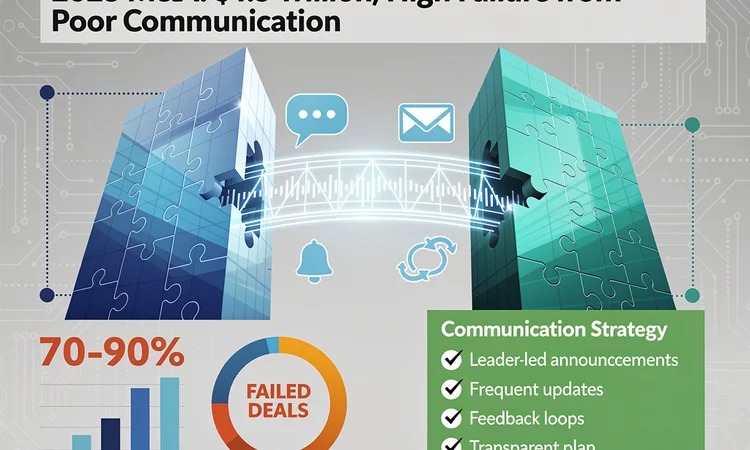
Amid 2025's $1.5 trillion M&A surge, poor employee communication sinks 70-90% of deals. Experts like IMAA's David Olsson advocate pre-planned, transparent strategies with leader-led announcements, frequent updates, and feedback loops to retain talent and fuse cultures.

Merger Messages: Mastering Employee Dialogue in Deal Chaos

In the high-stakes arena of mergers and acquisitions, where deals worth trillions reshape industries, the true battle often unfolds not in boardrooms but on factory floors and office Slack channels. As global M&A value hit $1.5 trillion in the first half of 2025, up 15% from the prior year, executives face a stark reality: poor communication dooms most transactions. Studies show 70% to 90% of deals fail to deliver expected value, with breakdowns in employee trust and integration cited as primary culprits, according to analyses from Harvard Business School and NYU Stern’s Baruch Lev and Feng Gu in The M&A Failure Trap , which reviewed 40,000 acquisitions.

David Olsson, managing director at the Institute for Mergers, Acquisitions and Alliances, warns that without precise messaging, “gossip and rumors…come into play.” His February 2025 IMAA post stresses articulating the deal’s strategic purpose upfront, addressing concerns head-on, and delivering continuous updates to curb anxiety. This approach, echoed across recent expert guidance, underscores a shift: in 2025’s purpose-driven mid-market surge per PwC’s Global M&A Industry Trends, people synergies eclipse tech gains, as noted by Jessica Ciccozzi of East Executive.

Christopher Kummer, IMAA founder and CEO, insists leaders deliver tough news personally: “I think it’s a matter of leadership to go there and deliver this message yourself, even if it’s not a nice one.” Such candor preserved morale in deals like RHI Magnesita’s merger, where a dedicated app replaced outdated newsletters, eased cultural shifts, and drove 11% revenue growth post-integration, as detailed by theEMPLOYEEapp.

Pre-Deal Planning Locks In Alignment

Effective strategies begin long before announcements. Assemble cross-functional teams from HR, legal, IT, and communications to craft unified plans, as outlined in Cerkl’s 10-step framework and YourThoughtPartner’s nine-step guide. Identify audiences—segmenting by role, department, and tenure—ensures tailored delivery. PwC notes 2025’s strategic deals demand this precision amid economic flux.

Jo Sutherland of Magenta Associates emphasizes a “crisp messaging framework” with three pillars: deal rationale, benefits, and timelines. “M&A touches people emotionally—employees worry about jobs, teams, and culture,” she says in Financier Worldwide. Pre-empt questions with FAQs and leader toolkits; train managers to field queries consistently, avoiding the vacuum that breeds speculation.

Timing proves critical. Brief influencers first, cascade via ‘Day 1’ timelines legally permissible. McKinsey’s 2024 report flags delays hitting 30% of major acquisitions, urging contingency plans to sustain momentum. Gallup’s 2025 State of the Global Workplace reveals engagement dipping to 21%, amplifying the need for empowered managers in transitions.

Announcement Precision Cuts Through Fog

The initial reveal demands top-leader delivery via town halls, videos, or emails matching external statements. Business.com’s guide, updated January 2026 by Julie Thompson, structures it thus: state the fact and timeline; explain the ‘why’ like market expansion; tackle job security and benefits directly; route questions to HR. Olsson reinforces: “Whatever you’re saying externally has got to match what you’re saying internally.”

Video emerges as a 2025 staple, per Tribe Pictures, humanizing leaders in deals like BD’s CareFusion acquisition. For employees, highlight opportunities—promotions, growth—over threats. WTW’s Josephine Gartrell notes 72% of firms use retention agreements, communicated transparently, to stem exits.

Greencrest’s March 2025 best practices urge swift rumor countermeasures: multiple channels from webinars to Slack, with a central contact ensuring consistency. Engage influencers early for buy-in, turning potential resistors into advocates.

Sustaining Cadence Builds Lasting Trust

Post-announcement, frequency trumps volume. Cerkl advocates weekly updates tied to milestones, celebrating wins and admitting hurdles with “we’re still working on that.” Two-way channels—surveys, forums—foster feedback loops, adjusting plans dynamically as in the professional services merger case where task forces co-created values, yielding a 100-page client playbook and 1,500-employee buy-in, per YourThoughtPartner.

ROI Communication’s six phases—pre-close collaboration to integration monitoring—stress avoiding the ‘go-dark’ trap. Deloitte finds effective communicators 3.5 times more likely to retain talent; KPMG reports 91% of aligned-leadership deals hit financial targets.

Cultural fusion demands deliberate effort. Octanner highlights recognition programs signaling priorities, while Forbes councils urge ‘better together’ narratives. In cross-border complexities, Aventis Advisors’ Marcin Majewski calls sequencing vital: “Acquirer’s employees should view it as an opportunity for promotion.”

Metrics and Adaptation Drive Execution

Measure via sentiment polls, engagement rates, turnover metrics. Cerkl’s tools enable real-time tracking; adjust if gaps emerge. Financier Worldwide warns volatile 2025 geopolitics demands empathetic, proactive tones ready for social media speed.

Mercer data shows 73% of employees value comms for anxiety reduction; 67% of rewarding firms succeed in integration. EY’s nine-step integration urges integration management offices to communicate rationales clearly, cutting uncertainty.

Forbes contributors like Tribe Inc.’s CEO stress early acquired-employee outreach to counter limbo disengagement. As M&A pipelines swell into 2026 per Harvard Corporate Governance, disciplined dialogue—transparent, consistent, empathetic—turns disruption into durable value.

About the Author

Stella Evans
Stella Evans

Stella Evans is a journalist who focuses on AI deployment. They work through trend monitoring with careful context and caveats to make complex topics approachable. They believe good analysis should be specific, testable, and useful to practitioners. They examine how customer expectations evolve and how organizations adapt to meet them. Their reporting blends qualitative insight with data, highlighting what actually changes decision‑making. Readers appreciate their ability to connect strategic goals with everyday workflows. They write about both the promise and the cost of transformation, including risks that are easy to overlook. They also highlight cultural factors that determine whether change sticks. Their coverage includes guidance for teams under resource or time constraints. Their perspective is shaped by interviews across engineering, operations, and leadership roles. They often cover how organizations respond to change, from process redesign to technology adoption. They maintain a balanced tone, separating speculation from evidence. They are interested in the economics of scale and operational resilience. They prefer evidence over hype and explain trade‑offs plainly.

Comments

Join the discussion and share your thoughts.

No comments yet. Be the first to comment.

Leave a Reply

Your email address will not be published.

Related Posts

Atlantic’s $1.2 Billion Staffing Power Play: F1 Tech Talent Fuels Transatlantic Surge

Atlantic’s $1.2 Billion Staffing Power Play: F1 Tech Talent Fuels Transatlantic Surge

Atlantic International Corp. acquires Circle8 Group in an all-stock deal, creating a $1.2 billion global staffing platform blending U.S. industrial and European IT talent. Circle8's Aston Martin F1 partnership highlights its elite capabilities amid cross-selling potential.

Posted on: by Liam Price
Bots at Work: Service Robotics’ $500 Billion Surge Reshapes Labor Markets

Bots at Work: Service Robotics’ $500 Billion Surge Reshapes Labor Markets

Service robotics rockets toward $498 billion by 2033 at 37% CAGR, automating logistics, healthcare, and hospitality amid AI advances and labor crunches. Deals like Serve's Diligent buy propel indoor expansions.

Posted on: by Layla Reed
Aspire-Deel Tie-Up Reshapes Global Hiring for Fintech Startups

Aspire-Deel Tie-Up Reshapes Global Hiring for Fintech Startups

Aspire integrates Deel's EOR services for seamless global hiring and finance management, targeting startups scaling internationally. The partnership addresses compliance hurdles, offering unified insights into workforce costs and cash flow.

Business
Deel’s Record-Breaking Hiring Spectacle: AI-Powered Push Reshapes Global Talent Wars

Deel’s Record-Breaking Hiring Spectacle: AI-Powered Push Reshapes Global Talent Wars

Deel shattered records with 6,848 attendees at its largest online hiring event, blending AI tools and global reach to fill 300+ sales roles. Amid growth to $17.3 billion valuation, the feat highlights innovations in HR and payroll but sparks debate on stunt versus substance.

Business
Deel’s $17 Billion Sprint: From Y Combinator to Global Payroll Powerhouse

Deel’s $17 Billion Sprint: From Y Combinator to Global Payroll Powerhouse

Deel rocketed to a $17.3 billion valuation in seven years by pioneering owned global payroll infrastructure, processing $22 billion annually for 37,000 firms. Amid IPO prep and DOJ scrutiny, COO Dan Westgarth reveals elite ops driving $1 billion revenue.

Business
HR’s AI Superagent Revolution: Reinventing the Workforce Engine

HR’s AI Superagent Revolution: Reinventing the Workforce Engine

Enterprise AI Superagents ignite HR's biggest transformation in decades, automating 30-40% of jobs while birthing full-stack roles and skills-first strategies. Josh Bersin leads the charge amid bias risks and tech trends reshaping hiring, experience, and leadership.

Business
AI’s HR Reckoning: 10 Pivotal Shifts Reshaping Workforce Strategies in 2026

AI’s HR Reckoning: 10 Pivotal Shifts Reshaping Workforce Strategies in 2026

As AI propels organizations into hybrid human-machine teams, HR must master fluency screening, skills-based shifts and agentic governance to thrive amid 2026's disruptions, blending tech efficiency with human resilience.

Business
The Upselling Paradox: How Retailers Walk the Tightrope Between Revenue Growth and Consumer Trust

The Upselling Paradox: How Retailers Walk the Tightrope Between Revenue Growth and Consumer Trust

New research reveals upselling's hidden risks as retailers balance revenue growth with customer trust. While upselling can boost transaction values by 10-30%, approximately 23% of consumers experience post-purchase regret, potentially damaging long-term profitability and brand reputation in an increasingly skeptical marketplace.

Business
Chrome Extensions’ Silent Siege on Enterprise HR Crown Jewels

Chrome Extensions’ Silent Siege on Enterprise HR Crown Jewels

Five malicious Chrome extensions hijacked sessions on Workday, NetSuite, and SAP SuccessFactors, stealing cookies, blocking admin pages, and enabling takeovers. Socket's discovery prompted Google takedowns after 2,300 installs, exposing enterprise browser risks.

Business
AI Proficiency Divide: HR’s Mounting Crisis

AI Proficiency Divide: HR’s Mounting Crisis

Corporate AI adoption surges, but superficial employee use creates a proficiency chasm now demanding HR intervention through targeted training, outcome metrics, and equity for overlooked workers.

Business