Microsoft’s AI Cloud Boom Masks Gaming Drag in Record $81B Quarter

Roman Grant
Roman Grant

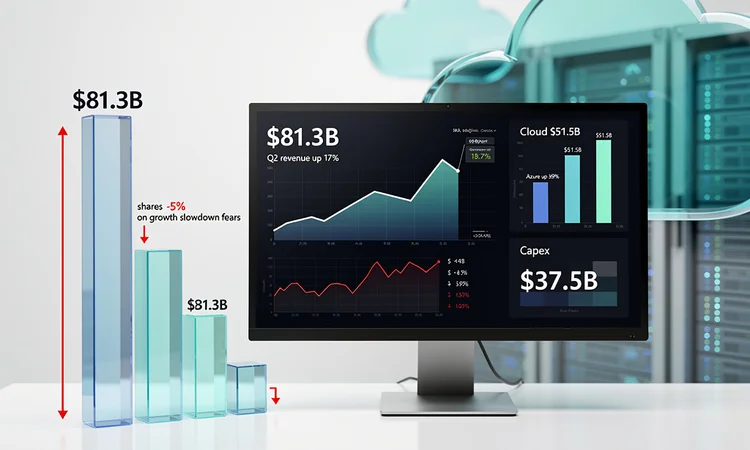
Microsoft's Q2 revenue hit $81.3B, up 17%, with Cloud at $51.5B and Azure up 39%, but shares fell 5% on growth slowdown fears and $37.5B capex.

Microsoft’s AI Cloud Boom Masks Gaming Drag in Record $81B Quarter

Microsoft Corp. posted blockbuster fiscal second-quarter results on Tuesday, with revenue surging 17% to $81.3 billion and Microsoft Cloud revenue crossing $50 billion for the first time, propelled by 39% growth in Azure and other cloud services. Yet shares tumbled 5% in after-hours trading as investors fretted over a slight slowdown in cloud acceleration and soaring capital expenditures.

Operating income climbed 21% to $38.3 billion, while GAAP net income rocketed 60% to $38.5 billion, boosted by $7.6 billion in gains from investments in OpenAI after its restructuring. Non-GAAP net income rose 23% to $30.9 billion, with diluted EPS hitting $5.16 on a GAAP basis and $4.14 adjusted, trouncing estimates of $3.92. “Microsoft Cloud revenue crossed $50 billion this quarter, reflecting the strong demand for our portfolio of services,” said CFO Amy Hood, as reported by Microsoft Investor Relations .

CEO Satya Nadella emphasized the early stages of AI’s spread: “We are only at the beginning phases of AI diffusion and already Microsoft has built an AI business that is larger than some of our biggest franchises.” Commercial remaining performance obligations ballooned 110% to $625 billion, with 45% tied to OpenAI including its $250 billion cloud commitment, per CNBC .

Azure’s Relentless Surge Powers Intelligent Cloud

The Intelligent Cloud segment delivered $32.9 billion in revenue, up 29% year-over-year, beating StreetAccount estimates of $32.4 billion. Azure’s 39% growth—38% in constant currency—met expectations but dipped slightly from 40% in the prior quarter, fueling the stock sell-off. Demand far outstrips supply, with Hood noting confidence in long-lived AI assets lasting 15 to 20 years, according to Tom’s Guide .

Analyst Brent Thill of Jefferies highlighted risks around OpenAI’s backlog contribution: “The backlog is really good, but the disclosure that OpenAI is 45% of their backlog, it goes back to the situation where, Can OpenAI achieve these financial goals?” Capital expenditures and finance leases hit $37.5 billion, exceeding Visible Alpha consensus of $34.3 billion, underscoring massive AI infrastructure bets.

Microsoft’s new Maia 200 chip for AI inference is now live globally on Azure, aiming to cut costs versus rivals and older models, as noted in pre-earnings coverage by Tom’s Guide . This positions the company to handle the inference economy’s demands.

Productivity Segment Delivers Steady Gains

Productivity and Business Processes revenue reached $34.1 billion, up 16% and topping estimates of $33.48 billion. Microsoft 365 Commercial cloud revenue grew 17%, Consumer subscribers 29%, LinkedIn 11%, and Dynamics 365 19%. Copilot adoption continues, with Nadella pushing agentic AI: “I feel actually, pretty good about both the progress in AI,” per Tom’s Guide .

Microsoft returned $12.7 billion to shareholders via dividends and buybacks, up 32% year-over-year. On X, analyst Ben Bajarin observed: “Investors wanted north of 40% Cloud business growth but still 39% is solid,” via @benbajarin .

Recent patches for Copilot vulnerabilities and a 48-hour Microsoft 365 outage underscore execution challenges amid rapid scaling.

Gaming and Devices Weigh on Personal Computing

More Personal Computing revenue fell 3% to $14.3 billion, missing estimates of $14.38 billion. Xbox content and services dropped 5%, amid reports of ongoing struggles including a next-gen console in development and Game Pass updates, as covered by Tom’s Guide . Windows OEM grew 1%, Search advertising ex-TAC rose 10%.

PC shipments rose 9.3% per Gartner, yet the segment lagged, highlighting divergence from cloud strength. Xbox faces competition from Sony’s PS5 and potential multi-store integration like Steam.

Post-earnings, X users like @Finsee_main noted: “Cloud Juggernaut Rolls On, Consumer Hardware Brakes Hard.”

Investor Jitters Amid Skyrocketing Spend

Despite beats, shares slid as Azure’s tick down signaled potential moderation. Capex ramp reflects data center builds with custom chips, leasing from CoreWeave and Nebius. Anthropic’s $30 billion cloud deal adds to momentum.

Microsoft raised commercial Office prices, betting on AI upsell. X reactions mix optimism on backlog with capex concerns: “Demand remains significantly ahead of capacity,” echoed in posts.

The quarter validates Microsoft’s AI pivot, but physics—supply constraints—and costs test investor patience. Forward guidance from the call will shape the narrative.

About the Author

Roman Grant
Roman Grant

Roman Grant is a journalist who focuses on AI deployment. They work through comparative reviews and hands‑on testing to make complex topics approachable. They often cover how organizations respond to change, from process redesign to technology adoption. They are known for dissecting tools and strategies that improve execution without adding complexity. They maintain a balanced tone, separating speculation from evidence. They value transparent sourcing and prefer primary data when it is available. They look for overlooked details that differentiate sustainable success from short‑term wins. They also highlight cultural factors that determine whether change sticks. They explore how policies, markets, and infrastructure intersect to create second‑order effects. Their coverage includes guidance for teams under resource or time constraints. They frequently compare approaches across industries to surface patterns that travel well. A recurring theme in their writing is how teams build repeatable systems and measure impact over time. They watch the policy landscape closely when it affects product strategy. Their work aims to be useful first, timely second.

Comments

Join the discussion and share your thoughts.

No comments yet. Be the first to comment.

Leave a Reply

Your email address will not be published.

Related Posts

Atlantic’s $1.2 Billion Staffing Power Play: F1 Tech Talent Fuels Transatlantic Surge

Atlantic’s $1.2 Billion Staffing Power Play: F1 Tech Talent Fuels Transatlantic Surge

Atlantic International Corp. acquires Circle8 Group in an all-stock deal, creating a $1.2 billion global staffing platform blending U.S. industrial and European IT talent. Circle8's Aston Martin F1 partnership highlights its elite capabilities amid cross-selling potential.

Posted on: by Liam Price
Bots at Work: Service Robotics’ $500 Billion Surge Reshapes Labor Markets

Bots at Work: Service Robotics’ $500 Billion Surge Reshapes Labor Markets

Service robotics rockets toward $498 billion by 2033 at 37% CAGR, automating logistics, healthcare, and hospitality amid AI advances and labor crunches. Deals like Serve's Diligent buy propel indoor expansions.

Posted on: by Layla Reed
Aspire-Deel Tie-Up Reshapes Global Hiring for Fintech Startups

Aspire-Deel Tie-Up Reshapes Global Hiring for Fintech Startups

Aspire integrates Deel's EOR services for seamless global hiring and finance management, targeting startups scaling internationally. The partnership addresses compliance hurdles, offering unified insights into workforce costs and cash flow.

Business
Deel’s Record-Breaking Hiring Spectacle: AI-Powered Push Reshapes Global Talent Wars

Deel’s Record-Breaking Hiring Spectacle: AI-Powered Push Reshapes Global Talent Wars

Deel shattered records with 6,848 attendees at its largest online hiring event, blending AI tools and global reach to fill 300+ sales roles. Amid growth to $17.3 billion valuation, the feat highlights innovations in HR and payroll but sparks debate on stunt versus substance.

Business
Deel’s $17 Billion Sprint: From Y Combinator to Global Payroll Powerhouse

Deel’s $17 Billion Sprint: From Y Combinator to Global Payroll Powerhouse

Deel rocketed to a $17.3 billion valuation in seven years by pioneering owned global payroll infrastructure, processing $22 billion annually for 37,000 firms. Amid IPO prep and DOJ scrutiny, COO Dan Westgarth reveals elite ops driving $1 billion revenue.

Business
HR’s AI Superagent Revolution: Reinventing the Workforce Engine

HR’s AI Superagent Revolution: Reinventing the Workforce Engine

Enterprise AI Superagents ignite HR's biggest transformation in decades, automating 30-40% of jobs while birthing full-stack roles and skills-first strategies. Josh Bersin leads the charge amid bias risks and tech trends reshaping hiring, experience, and leadership.

Business
AI’s HR Reckoning: 10 Pivotal Shifts Reshaping Workforce Strategies in 2026

AI’s HR Reckoning: 10 Pivotal Shifts Reshaping Workforce Strategies in 2026

As AI propels organizations into hybrid human-machine teams, HR must master fluency screening, skills-based shifts and agentic governance to thrive amid 2026's disruptions, blending tech efficiency with human resilience.

Business
The Upselling Paradox: How Retailers Walk the Tightrope Between Revenue Growth and Consumer Trust

The Upselling Paradox: How Retailers Walk the Tightrope Between Revenue Growth and Consumer Trust

New research reveals upselling's hidden risks as retailers balance revenue growth with customer trust. While upselling can boost transaction values by 10-30%, approximately 23% of consumers experience post-purchase regret, potentially damaging long-term profitability and brand reputation in an increasingly skeptical marketplace.

Business
Chrome Extensions’ Silent Siege on Enterprise HR Crown Jewels

Chrome Extensions’ Silent Siege on Enterprise HR Crown Jewels

Five malicious Chrome extensions hijacked sessions on Workday, NetSuite, and SAP SuccessFactors, stealing cookies, blocking admin pages, and enabling takeovers. Socket's discovery prompted Google takedowns after 2,300 installs, exposing enterprise browser risks.

Business
AI Proficiency Divide: HR’s Mounting Crisis

AI Proficiency Divide: HR’s Mounting Crisis

Corporate AI adoption surges, but superficial employee use creates a proficiency chasm now demanding HR intervention through targeted training, outcome metrics, and equity for overlooked workers.

Business