
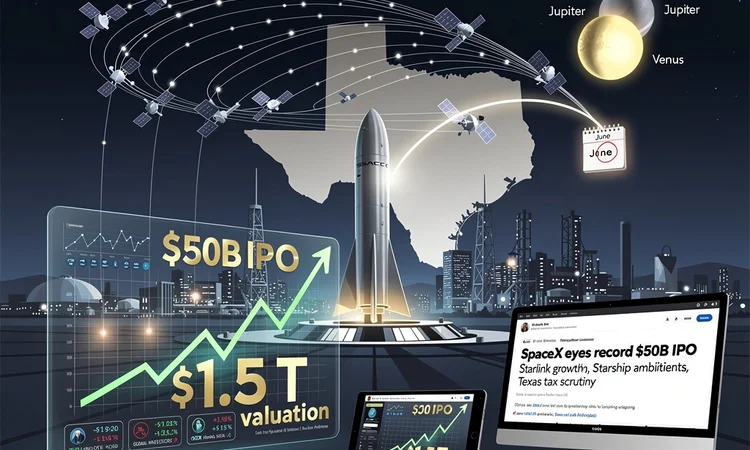
Musk’s Cosmic IPO: SpaceX Eyes $1.5 Trillion Debut Under Aligned Planets

Isabella Reed
Isabella Reed

SpaceX plans a record $50 billion IPO at $1.5 trillion valuation in mid-June, timed to Jupiter-Venus alignment and Elon Musk's birthday, per FT sources. Starlink growth and Starship fuel ambitions amid Texas tax scrutiny.

Musk’s Cosmic IPO: SpaceX Eyes $1.5 Trillion Debut Under Aligned Planets

Elon Musk, the world’s richest man, is blending astronomy and ambition as SpaceX targets a mid-June initial public offering timed to a rare conjunction of Jupiter and Venus, coinciding with his 55th birthday on June 28. The rocket company aims to raise as much as $50 billion at a staggering $1.5 trillion valuation, eclipsing Saudi Aramco’s $29 billion record from 2019, according to five people familiar with the matter cited by the Financial Times .

SpaceX Chief Financial Officer Bret Johnsen has held talks and Zoom calls with existing private investors since mid-December to explore this mid-2026 listing, the Guardian reported, drawing from the same FT sources. The planetary alignment on June 8-9 marks the closest approach of the two planets in over three years, a symbolic nod fitting Musk’s penchant for blending whimsy with business—Musk famously tweeted about taking Tesla private at $420 a share in 2018, a nod to cannabis culture.

The Bloomberg article echoed the FT, noting the timing’s surreal logic for most firms but alignment with Musk’s symbolic style. SpaceX generates revenue from reusable Falcon rockets for satellite launches and NASA missions, plus its Starlink constellation of over 9,400 satellites providing high-speed internet.

Valuation Surge Fuels Mega-Listing Ambitions

SpaceX’s valuation has doubled from nearly $400 billion in recent private rounds to this proposed $1.5 trillion peak, driven by Starlink’s commercial traction and Starship development, per Reuters reporting on the FT details. The company reported $15.5 billion in annual revenue last year, including $1.1 billion from NASA, positioning it to fund ambitious projects like space-based data centers linked to Musk’s xAI efforts against rivals like Google and OpenAI.

Analyst Neil Wilson of Saxo Capital Markets described the $1.5 trillion tag as a “monster premium,” telling the Guardian : “A valuation that big reflects not just a tech and AI premium but Elon Musk’s stardust and a frothy market, plus a heck of a lot of media narrative around this. It is to some degree a kind of bet on the future space economy.” Musk owns 42% of SpaceX, per the Guardian.

Musk long resisted public markets, citing Tesla’s scrutiny and conflicts with his Mars colonization vision, but Starlink’s success has softened that stance. Recent private talks valued shares at $800 billion, with employees selling $2 billion worth at $420 per share.

Texas Tax Breaks Amid Expansion Push

As IPO buzz builds, SpaceX seeks Texas tax incentives under the Enterprise Zone program for low-income areas, targeting refunds for its Starbase Gigabay facility—a 700,000-square-foot site for 1,000 annual Starship rockets—and launch infrastructure, the Texas Tribune reported. The governor’s office granted preliminary approval in September for Gigabay, started in April 2025.

Critics like Kasia Tarczynska of Good Jobs First question eligibility, arguing: “By already having this company within that town, and then retroactively giving it subsidies, it doesn’t meet the definition of an incentive,” per the Texas Tribune. SpaceX promises 500 new jobs, 25% for locals, with $506 million investment qualifying for up to $3.75 million refunds as a “triple jumbo project.”

The firm eyes reinvesting refunds into Starship operations. Past incentives include a 10-year Cameron County tax abatement ending this year and state funds, underscoring Texas’s role in SpaceX’s growth near impoverished Brownsville.

Starlink and Starship Drive Revenue Rocket

Starlink’s expansion underpins the valuation, with SpaceX launching a record 3,200 satellites in 2025, up 60% year-over-year, and 971 low-Earth orbit missions in Q4 alone, per X posts citing CNBC. Revenue projections hit $22-24 billion in 2026 from $15 billion in 2025, fueled by satellite internet and AI data center ambitions.

Investors like Ron Baron, with a quarter of his portfolio in SpaceX, and Cathie Wood’s ARK Venture Fund see massive upside, projecting $2.5 trillion by 2030. X discussions highlight orbital data centers as key, with Musk racing OpenAI and Anthropic to market by July.

The IPO could trigger ETF rebalances, pressuring rivals like Rocket Lab, as SpaceX leads a wave including Anthropic and OpenAI listings, per Reuters.

Market Ripples from Historic Float

Risk remains: Starship tests must succeed amid regulatory hurdles. China eyes space-based AI data centers, challenging Musk’s vision. Yet, with flawless Falcon cadence and Starlink dominance, SpaceX positions as infrastructure superpower.

On X, users like @DavidDTawil noted the planetary-Musk birthday sync, while @StockSavvyShay predicted ecosystem boosts for peers. Chamath Palihapitiya speculated a Tesla reverse-merger, though unconfirmed.

The float would dwarf Aramco’s $1.7 trillion cap, injecting $1.5 trillion liquidity and validating space as core to global economy, as analysts bet on Musk’s orbit-conquering conglomerate.

About the Author

Isabella Reed
Isabella Reed

Isabella Reed is a journalist who focuses on sustainability in business. Their approach combines long‑form narratives grounded in real‑world metrics. Their perspective is shaped by interviews across engineering, operations, and leadership roles. They believe good analysis should be specific, testable, and useful to practitioners. They frequently translate research into action for policy readers, prioritizing clarity over buzzwords. They examine how customer expectations evolve and how organizations adapt to meet them. They often cover how organizations respond to change, from process redesign to technology adoption. Readers appreciate their ability to connect strategic goals with everyday workflows. They write about both the promise and the cost of transformation, including risks that are easy to overlook. They are known for dissecting tools and strategies that improve execution without adding complexity. Their reporting blends qualitative insight with data, highlighting what actually changes decision‑making. They watch the policy landscape closely when it affects product strategy. They value transparency, practical advice, and honest uncertainty.

Comments

Join the discussion and share your thoughts.

No comments yet. Be the first to comment.

Leave a Reply

Your email address will not be published.

Related Posts

Microsoft’s AI Empire Faces Existential Challenge as Anthropic Emerges From OpenAI’s Shadow

Microsoft’s AI Empire Faces Existential Challenge as Anthropic Emerges From OpenAI’s Shadow

Microsoft's $13 billion OpenAI partnership faces unprecedented pressure as Anthropic's Claude models gain enterprise traction, forcing the software giant to reassess its AI-exclusive strategy amid growing concerns about competitive vulnerability and strategic inflexibility in the rapidly evolving generative AI market.

Posted on: by Liam Price
Snap’s Bold Gambit: Why Spinning Off AR Glasses Could Redefine Silicon Valley’s Hardware Playbook

Snap’s Bold Gambit: Why Spinning Off AR Glasses Could Redefine Silicon Valley’s Hardware Playbook

Snap Inc. is spinning off its augmented reality glasses division into a separate business entity, a strategic move that could reshape how social media companies approach hardware innovation while providing financial flexibility and longer development timelines for AR technology.

Posted on: by Roman Grant
The Silent Epidemic: How Medical Device Failures Are Reshaping Patient Safety Standards in Modern Healthcare

The Silent Epidemic: How Medical Device Failures Are Reshaping Patient Safety Standards in Modern Healthcare

The global medical device industry faces mounting scrutiny as regulatory frameworks struggle to balance rapid innovation with patient safety. Recent investigations reveal systemic weaknesses in device approval, monitoring, and recall processes, raising fundamental questions about oversight.

Emerging Tech
SAP’s Cloud Backlog Shock Triggers Steepest Plunge Since 2020

SAP’s Cloud Backlog Shock Triggers Steepest Plunge Since 2020

SAP shares cratered 14% on January 29, 2026, after Q4 cloud backlog growth missed at 16%, disappointing expectations of 26%. Solid revenue and AI-driven gains offered solace, but guidance for deceleration sparked selloff fears.

Emerging Tech
OpenAI’s Writing Quality Crisis: How ChatGPT-5.2 Stumbled and What It Means for AI’s Future

OpenAI’s Writing Quality Crisis: How ChatGPT-5.2 Stumbled and What It Means for AI’s Future

Sam Altman's admission that OpenAI compromised writing quality in ChatGPT-5.2 reveals critical tensions in AI development. The incident exposes trade-offs between advancing technical capabilities and maintaining user experience, raising questions about industry practices and competitive dynamics.

Emerging Tech
EU’s Tariff Triumph: India Opens Luxury Auto Doors, Leaving U.S. Brands in the Dust

EU’s Tariff Triumph: India Opens Luxury Auto Doors, Leaving U.S. Brands in the Dust

India's EU free trade deal slashes car import duties from 110% to 10%, boosting Mercedes, BMW, and Audi in the premium segment while shielding mass-market locals. EU gains first-mover edge over U.S., with quotas and EV delays balancing access amid stock dips for Tata and Mahindra.

Emerging Tech
ASML: The Dutch Monopoly Powering Nvidia’s AI Dominance

ASML: The Dutch Monopoly Powering Nvidia’s AI Dominance

ASML's monopoly on EUV lithography machines underpins Nvidia's AI chips, driving record 2025 bookings of 13.2 billion euros and a raised 2026 sales outlook to 34-39 billion euros amid surging demand from TSMC and others.

Emerging Tech
Starmer-Xi Thaw: UK Bets Big on China Reset Amid Trump Turbulence

Starmer-Xi Thaw: UK Bets Big on China Reset Amid Trump Turbulence

UK Prime Minister Keir Starmer's Beijing summit with Xi Jinping secured visa-free travel for Britons and business pacts, thawing ties strained by espionage rows and Hong Kong. Amid Trump tariff threats, Starmer balances growth with security in a high-stakes reset.

Emerging Tech
Microsoft’s $80 Billion Cloud Computing Backlog Signals Unprecedented AI Infrastructure Strain

Microsoft’s $80 Billion Cloud Computing Backlog Signals Unprecedented AI Infrastructure Strain

Microsoft's $80 billion Azure backlog extending to 2026 reveals unprecedented strain on cloud infrastructure driven by AI demand. The capacity crisis, stemming from GPU shortages and data center construction timelines, is reshaping competitive dynamics and forcing enterprises to fundamentally reconsider their AI deployment strategies.

Emerging Tech
Advantest’s AI Tester Surge: Record Profits Amid Chip Complexity Boom

Advantest’s AI Tester Surge: Record Profits Amid Chip Complexity Boom

Advantest's shares soared 14% on record Q3 sales from AI chip testing demand, lifting full-year profit forecast to $2.98 billion. SoC testers for AI/HPC drive 80% of growth amid rising chip complexity.

Emerging Tech