
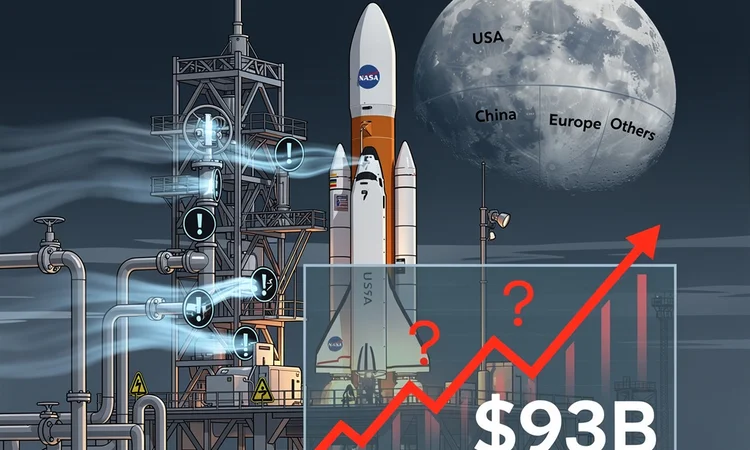
The American space agency’s ambitious return to the Moon faces mounting technical challenges that extend far beyond simple engineering setbacks, revealing systemic issues in how NASA approaches large-scale space exploration in an era of tightening budgets and accelerated timelines. The Space Launch System (SLS), NASA’s most powerful rocket since the Saturn V, has encountered persistent fueling problems that have delayed the Artemis program and raised fundamental questions about the agency’s readiness to establish a sustainable lunar presence.
According to Futurism , NASA engineers have struggled with hydrogen fuel leaks during multiple wet dress rehearsal attempts, a critical pre-launch test that simulates the entire countdown sequence without actual liftoff. These hydrogen leaks, occurring at connection points between fuel lines and the rocket’s core stage, have proven remarkably resistant to conventional fixes. The volatile nature of liquid hydrogen—which must be maintained at approximately minus 423 degrees Fahrenheit—creates extreme thermal stresses on seals and connectors, making even microscopic gaps potentially catastrophic.
The fueling difficulties represent more than mere technical hiccups; they underscore the challenges of reviving technology and expertise that has languished for decades. The last time NASA successfully launched astronauts beyond low Earth orbit was December 1972, during the Apollo 17 mission. The institutional knowledge accumulated during that era has largely retired or passed away, leaving current engineers to rediscover solutions to problems their predecessors had mastered. This knowledge gap has manifested in unexpected ways, from seal failures to procedural uncertainties that have extended testing timelines by months.
The Engineering Complexity Behind Cryogenic Fuel Management
Liquid hydrogen serves as the primary fuel for the SLS core stage, paired with liquid oxygen as an oxidizer—a combination that provides tremendous thrust but demands exacting handling procedures. The extreme cold causes metal components to contract, while the transition from ambient temperature to cryogenic conditions during fueling creates thermal gradients that can compromise seal integrity. NASA’s engineers have attempted multiple seal replacements and procedural modifications, yet leaks have persisted at what industry insiders term “unacceptable levels” for launch safety protocols.
The core stage, built by Boeing at the Michoud Assembly Facility in Louisiana, incorporates four RS-25 engines—the same engine design used on the Space Shuttle but modified for single-use rather than reusability. This adaptation has introduced its own complications, as systems designed for refurbishment and reuse must now function flawlessly on their first and only flight. The propellant feed system includes miles of plumbing, thousands of welds, and hundreds of connection points, each representing a potential failure mode.
Financial Implications and Program Sustainability
The Artemis program’s budget has swelled to approximately $93 billion through 2025, according to NASA’s Office of Inspector General reports. Each delay in the launch schedule adds millions in operational costs, facility maintenance, and contractor expenses. The SLS itself costs roughly $4.1 billion per launch when development costs are amortized—a figure that has drawn criticism from commercial space advocates who point to SpaceX’s Falcon Heavy, which launches for approximately $150 million despite carrying less payload to deep space destinations.
These cost disparities have intensified debates within aerospace policy circles about NASA’s approach to lunar exploration. Critics argue that the agency’s reliance on traditional cost-plus contracting, where contractors receive payment for expenses plus a profit margin, creates perverse incentives that reward schedule extensions and complexity rather than efficiency. Supporters counter that the SLS represents capabilities that commercial providers cannot yet match, particularly for crewed missions beyond Earth orbit where redundancy and reliability outweigh cost considerations.
The Broader Context of America’s Lunar Ambitions
NASA’s fueling troubles occur against a backdrop of intensifying international competition in space exploration. China has announced plans for crewed lunar missions by 2030, while its Chang’e program has successfully demonstrated robotic sample return capabilities and deployed a rover to the Moon’s far side. Russia, despite economic constraints, maintains its partnership with China on lunar exploration initiatives. India’s Chandrayaan program has achieved notable successes, including the recent Chandrayaan-3 landing near the lunar south pole.
The Artemis program aims to establish a permanent human presence on the Moon, utilizing the lunar surface as a proving ground for technologies needed for eventual Mars exploration. This vision requires not just successful launches but a sustainable cadence of missions, something the SLS’s cost structure and production timeline may struggle to support. NASA plans to launch Artemis missions approximately once per year, but this schedule assumes resolution of current technical issues and smooth operations—assumptions that recent experience suggests may be optimistic.
Technological Heritage and Modern Challenges
The SLS represents a paradox in modern aerospace engineering: a rocket utilizing proven technologies that nonetheless faces novel integration challenges. The RS-25 engines have accumulated over a million seconds of test firing and flight time from the Shuttle era, yet their application in the SLS configuration has revealed unexpected issues. The solid rocket boosters, derived from Shuttle boosters but scaled up significantly, have performed well in testing but add their own constraints to launch windows and abort scenarios.
NASA’s approach contrasts sharply with SpaceX’s iterative development philosophy, where rapid prototyping and acceptance of early failures accelerate learning curves. The SLS underwent extensive ground testing and computer modeling before its first wet dress rehearsal, yet still encountered problems that simulations failed to predict. This highlights an enduring tension in aerospace engineering between comprehensive upfront analysis and empirical testing—a tension that different organizations resolve in markedly different ways.
Workforce and Expertise Considerations
The human capital challenges facing NASA extend beyond simple knowledge transfer from Apollo-era veterans. The agency’s workforce has evolved significantly, with many experienced engineers reaching retirement age while younger recruits often view positions at commercial space companies as more dynamic and innovative. This perception, whether accurate or not, affects NASA’s ability to attract and retain top talent in critical specialties like cryogenic systems engineering and propulsion integration.
Contractor workforces face similar challenges. Boeing, the prime contractor for the SLS core stage, has experienced significant turnover in its space division, with engineers moving to competitors or leaving aerospace entirely. Aerojet Rocketdyne, which refurbishes the RS-25 engines, maintains specialized facilities and expertise that exist nowhere else in American industry—a single point of failure that concerns program managers and policymakers alike.
Path Forward and Strategic Implications
NASA has implemented several corrective measures following the fueling failures, including redesigned seals, modified loading procedures, and enhanced monitoring systems. Engineers have also explored alternative fueling timelines that reduce thermal shock to critical components, though these modifications extend the overall countdown sequence and complicate launch window planning. The agency maintains that these issues, while frustrating, represent normal challenges in developing complex spaceflight systems.
However, the persistent nature of the problems suggests deeper systemic issues that procedural changes alone may not resolve. Some aerospace analysts advocate for a fundamental reassessment of the SLS program, potentially incorporating more commercial partnerships or alternative architectures. Others argue that abandoning the SLS after billions in investment would set the Artemis program back years and cede lunar leadership to international competitors. This debate reflects broader questions about how America should organize and fund its space exploration efforts in an era of fiscal constraint and emerging private sector capabilities.
The resolution of NASA’s fueling challenges will significantly impact not just the Artemis timeline but America’s broader space policy trajectory. Success would validate the agency’s traditional approach and demonstrate that government-led programs can still achieve ambitious goals despite cost and schedule pressures. Continued failures might accelerate the shift toward commercial providers and fundamentally alter NASA’s role in human spaceflight. As the agency works to resolve these technical issues, the stakes extend far beyond engineering—encompassing national prestige, scientific discovery, and the future architecture of American space exploration for decades to come.


Leave a Reply
Your email address will not be published.