Norway’s Oil Fund Hits Record Haul: $247 Billion Windfall Fuels Tech-Bank Boom

Zoe Patel
Zoe Patel

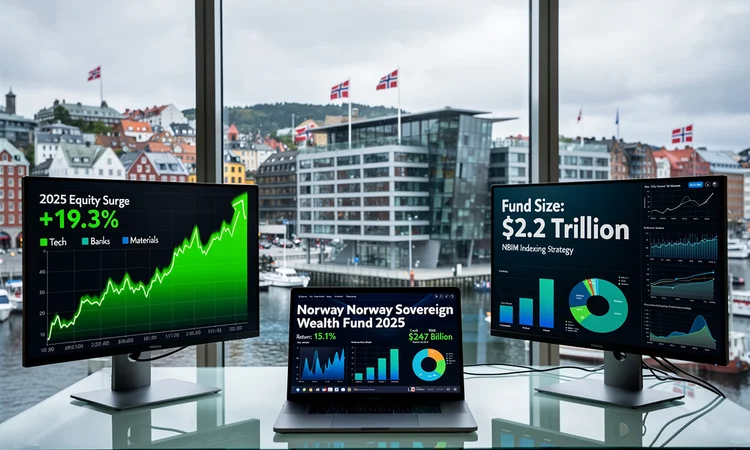
Norway's $2.2 trillion sovereign wealth fund notched a record 15.1% return in 2025, yielding $247 billion from tech, banks, and materials amid equity surge of 19.3%. NBIM's indexing strategy delivered despite benchmark shortfall.

Norway’s Oil Fund Hits Record Haul: $247 Billion Windfall Fuels Tech-Bank Boom

Norway’s Government Pension Fund Global, the world’s largest sovereign wealth fund, delivered a staggering 15.1% return on investment in 2025, generating 2.36 trillion Norwegian kroner—or about $247 billion—in profits, according to Norges Bank Investment Management (NBIM). The fund’s value swelled to 21.27 trillion kroner ($2.2 trillion) by year-end, up 1.53 trillion kroner from the prior year. This marked the highest annual gain since the fund’s inception in the 1990s, though it trailed its benchmark index by 0.28 percentage points.

Equities, comprising 71% of the portfolio, powered the performance with a 19.3% return. Fixed income added 5.4%, unlisted real estate 4.4%, and renewable energy infrastructure a robust 18.1%. NBIM CEO Nicolai Tangen highlighted the drivers in a statement: “Stocks in technology, financials and basic materials stood out, making a significant contribution to the overall return.” CNBC detailed how these sectors propelled the record results amid a global rally in AI-driven tech and resilient banking stocks.

Tech Titans Anchor Equity Surge

The fund holds significant stakes in U.S. tech giants, including 1.3% of Nvidia, 1.2% of Apple, and 1.3% of Microsoft, positions that benefited from continued AI enthusiasm. Europe’s banking sector also shone, with holdings in Bank of America, JPMorgan Chase, Goldman Sachs, Santander, UBS, HSBC, and UniCredit delivering outsized gains. A standout was Fresnillo, which rocketed 452.5% on a silver price boom and its acquisition of Probe Gold, underscoring basic materials’ role. The same CNBC report noted these specific contributors.

From a turbulent start—marked by a $40 billion first-quarter loss amid tech volatility, as reported by IDNFinancials citing NBIM CEO Tangen—the fund rebounded strongly. Q3 saw a 5.8% return, or $103 billion profit, driven by basic materials, telecoms, and financials, per CNBC . Deputy CEO Trond Grande emphasized equity strength at 7.7% for the quarter.

Strategic Allocations Amid Volatility

NBIM’s passive, index-tracking approach—investing in over 8,700 companies across 44 countries via the FTSE Global All Cap index—minimized risk while capturing market upside. U.S. equities, nearly 40% of holdings, remained pivotal, as NBIM data shows annualized returns of 6.59% since 1998, outpacing the benchmark by 0.24 points through Q3 2025. The fund’s 700 staff manage $2.5 billion per employee, per Reddit discussions on r/stocks citing Q3 figures.

Renewables proved resilient, contrasting 2024’s -10% dip noted in prior reports. Unlisted real estate steadied after earlier losses. Transaction costs totaled $2 billion in 2024, with equities at 71.4% of assets returning 18.2%, according to Global Trading . Active management added value, with NBIM reporting outperformance over five years in a letter to Norway’s Ministry of Finance, as covered by IPE .

Ethical Guardrails and Global Scrutiny

Ethical mandates shaped decisions, including divestments from Israeli firms in August 2025 over military ties, per Wikipedia and NBIM updates. The fund targets net-zero by 2050, expanding climate engagements in its 2030 plan, as ESG Today reported. U.S. holdings in US Treasuries rose to $199 billion (9.4% of assets), defying geopolitical tensions.

Norway’s fund, born from oil surpluses in 1990, now generates more income than petroleum production for its 5.6 million citizens—$244,000 per capita at earlier valuations, per Robert Eccles . A 3% annual withdrawal cap preserves intergenerational wealth. In December 2025, NBIM overtook Japan’s GPIF as the largest asset owner at 20.44 trillion kroner, Top1000Funds noted.

Benchmark Discipline in Boom Times

Slightly underperforming the benchmark reflects disciplined indexing, with relative returns averaging positive long-term. 2025’s 15.1% topped 2024’s 13% ($222 billion), continuing a record streak after 2023’s gains. X posts from @CNBC and @business amplified the news, confirming equity dominance at 19.3%.

Challenges persist: Q1 2025 losses from tech downturns, per Tangen, and debates over 71% equity exposure’s volatility. Yet, diversification across 63 countries and sectors buffered risks. Bloomberg highlighted the fund’s index fidelity versus peers’ strategic bets in its analysis .

Implications for Global Capital Flows

As 1.5% owner of global listed equities, NBIM influences governance, voting at 6,078 meetings in past years. Its 2025 success validates heavy tech-financial weighting amid AI and rate stabilization. Fortune noted average 7.45% over 2019-2023 versus peers, underscoring steady compounding in its profile . X reactions, like from @CGTNEurope , echoed the 15.1% figure.

The fund’s trajectory signals investor confidence in U.S.-centric growth, renewables rebound, and banking resilience. With assets surpassing $2 trillion, Norway exemplifies prudent oil-to-asset transformation, setting benchmarks for sovereign investors worldwide.

About the Author

Zoe Patel
Zoe Patel

Zoe Patel writes about marketing performance, translating complex ideas into practical insight. Their approach combines field reporting paired with technical explainers. They explore how policies, markets, and infrastructure intersect to create second‑order effects. They frequently translate research into action for founders and operators, prioritizing clarity over buzzwords. They are known for dissecting tools and strategies that improve execution without adding complexity. Readers appreciate their ability to connect strategic goals with everyday workflows. Their coverage includes guidance for teams under resource or time constraints. They frequently compare approaches across industries to surface patterns that travel well. They write about both the promise and the cost of transformation, including risks that are easy to overlook. They value transparent sourcing and prefer primary data when it is available. A recurring theme in their writing is how teams build repeatable systems and measure impact over time. They focus on what changes decisions, not just what makes headlines.

Comments

Join the discussion and share your thoughts.

No comments yet. Be the first to comment.

Leave a Reply

Your email address will not be published.

Related Posts

Atlantic’s $1.2 Billion Staffing Power Play: F1 Tech Talent Fuels Transatlantic Surge

Atlantic’s $1.2 Billion Staffing Power Play: F1 Tech Talent Fuels Transatlantic Surge

Atlantic International Corp. acquires Circle8 Group in an all-stock deal, creating a $1.2 billion global staffing platform blending U.S. industrial and European IT talent. Circle8's Aston Martin F1 partnership highlights its elite capabilities amid cross-selling potential.

Posted on: by Liam Price
Bots at Work: Service Robotics’ $500 Billion Surge Reshapes Labor Markets

Bots at Work: Service Robotics’ $500 Billion Surge Reshapes Labor Markets

Service robotics rockets toward $498 billion by 2033 at 37% CAGR, automating logistics, healthcare, and hospitality amid AI advances and labor crunches. Deals like Serve's Diligent buy propel indoor expansions.

Posted on: by Layla Reed
Aspire-Deel Tie-Up Reshapes Global Hiring for Fintech Startups

Aspire-Deel Tie-Up Reshapes Global Hiring for Fintech Startups

Aspire integrates Deel's EOR services for seamless global hiring and finance management, targeting startups scaling internationally. The partnership addresses compliance hurdles, offering unified insights into workforce costs and cash flow.

Business
Deel’s Record-Breaking Hiring Spectacle: AI-Powered Push Reshapes Global Talent Wars

Deel’s Record-Breaking Hiring Spectacle: AI-Powered Push Reshapes Global Talent Wars

Deel shattered records with 6,848 attendees at its largest online hiring event, blending AI tools and global reach to fill 300+ sales roles. Amid growth to $17.3 billion valuation, the feat highlights innovations in HR and payroll but sparks debate on stunt versus substance.

Business
Deel’s $17 Billion Sprint: From Y Combinator to Global Payroll Powerhouse

Deel’s $17 Billion Sprint: From Y Combinator to Global Payroll Powerhouse

Deel rocketed to a $17.3 billion valuation in seven years by pioneering owned global payroll infrastructure, processing $22 billion annually for 37,000 firms. Amid IPO prep and DOJ scrutiny, COO Dan Westgarth reveals elite ops driving $1 billion revenue.

Business
HR’s AI Superagent Revolution: Reinventing the Workforce Engine

HR’s AI Superagent Revolution: Reinventing the Workforce Engine

Enterprise AI Superagents ignite HR's biggest transformation in decades, automating 30-40% of jobs while birthing full-stack roles and skills-first strategies. Josh Bersin leads the charge amid bias risks and tech trends reshaping hiring, experience, and leadership.

Business
AI’s HR Reckoning: 10 Pivotal Shifts Reshaping Workforce Strategies in 2026

AI’s HR Reckoning: 10 Pivotal Shifts Reshaping Workforce Strategies in 2026

As AI propels organizations into hybrid human-machine teams, HR must master fluency screening, skills-based shifts and agentic governance to thrive amid 2026's disruptions, blending tech efficiency with human resilience.

Business
The Upselling Paradox: How Retailers Walk the Tightrope Between Revenue Growth and Consumer Trust

The Upselling Paradox: How Retailers Walk the Tightrope Between Revenue Growth and Consumer Trust

New research reveals upselling's hidden risks as retailers balance revenue growth with customer trust. While upselling can boost transaction values by 10-30%, approximately 23% of consumers experience post-purchase regret, potentially damaging long-term profitability and brand reputation in an increasingly skeptical marketplace.

Business
Chrome Extensions’ Silent Siege on Enterprise HR Crown Jewels

Chrome Extensions’ Silent Siege on Enterprise HR Crown Jewels

Five malicious Chrome extensions hijacked sessions on Workday, NetSuite, and SAP SuccessFactors, stealing cookies, blocking admin pages, and enabling takeovers. Socket's discovery prompted Google takedowns after 2,300 installs, exposing enterprise browser risks.

Business
AI Proficiency Divide: HR’s Mounting Crisis

AI Proficiency Divide: HR’s Mounting Crisis

Corporate AI adoption surges, but superficial employee use creates a proficiency chasm now demanding HR intervention through targeted training, outcome metrics, and equity for overlooked workers.

Business