
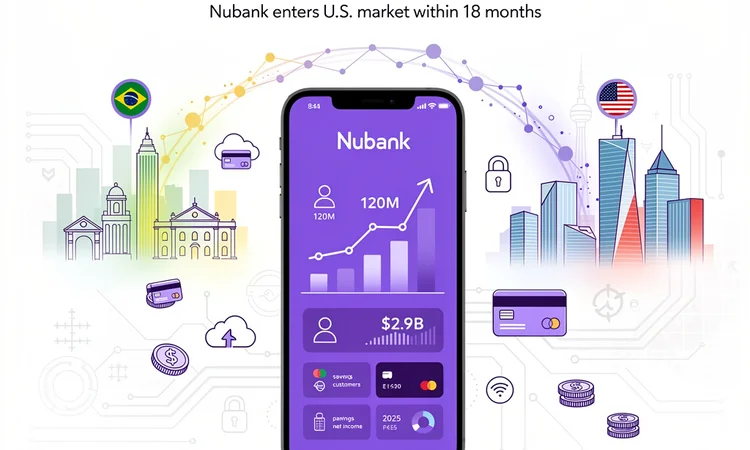
As traditional banking institutions continue to grapple with digital transformation, a formidable challenger from an unexpected quarter is preparing to reshape the competitive dynamics of American consumer finance. Nubank, the São Paulo-based digital banking powerhouse that has revolutionized financial services across Latin America, has set its sights on the United States market with plans to launch operations within the next 18 months. With more than 120 million customers already under its belt and analysts projecting $2.9 billion in net income for 2025, the company’s northward expansion represents one of the most significant cross-border fintech initiatives in recent memory.
The Brazilian neobank’s trajectory from startup to regional dominance offers a compelling case study in financial innovation. Founded in 2013 by Colombian entrepreneur David Vélez alongside Brazilian co-founders Cristina Junqueira and Edward Wible, Nubank emerged from a simple observation: Brazil’s traditional banking sector was among the world’s most expensive and least customer-friendly. According to the Financial Times , the company has transformed this market inefficiency into a business model that now serves customers across Brazil, Mexico, and Colombia, making it Latin America’s most valuable financial institution.
What distinguishes Nubank from the crowded field of digital banking upstarts is not merely its scale but its profitability. While many fintech companies have struggled to translate user growth into sustainable earnings, Nubank has demonstrated a rare ability to monetize its massive customer base effectively. The company’s path to profitability has been marked by disciplined expansion and a relentless focus on customer experience, factors that will prove crucial as it attempts to penetrate the notoriously competitive U.S. banking market.
The Economics of Digital Banking Dominance
Nubank’s financial performance tells a story of remarkable growth and operational efficiency. The projected $2.9 billion in net income for 2025 represents a significant milestone for a company that only achieved profitability in recent years. This financial strength stems from a business model that eliminates the overhead costs associated with physical branches while leveraging technology to serve customers at a fraction of traditional banking costs. The company’s average cost to serve each customer is reportedly less than $1 per month, compared to $200-$300 for traditional banks in Latin America.
The neobank’s revenue streams have diversified beyond simple transaction fees. Credit cards remain a core product, but Nubank has successfully expanded into personal loans, investment products, life insurance, and even cryptocurrency trading. This ecosystem approach has increased customer lifetime value while reducing dependence on any single product line. The company’s net promoter score consistently ranks among the highest in the financial services industry, suggesting that customer satisfaction translates into organic growth and reduced marketing costs.
Navigating Regulatory Complexity and Market Saturation
The planned U.S. expansion comes at a moment when American neobanks face increasing scrutiny from regulators and mounting pressure to demonstrate profitability. Companies like Chime, Current, and Varo have captured significant market share among younger consumers, but the sector remains fragmented and intensely competitive. Nubank’s entry strategy will need to differentiate itself in a market where digital banking features have become commoditized and customer acquisition costs continue to rise.
Regulatory navigation presents another formidable challenge. The U.S. banking regulatory framework, with its complex interplay of federal and state oversight, differs dramatically from the systems Nubank has mastered in Latin America. The company will need to secure appropriate banking licenses, establish compliance infrastructure, and build relationships with regulatory bodies including the Office of the Comptroller of the Currency, the Federal Reserve, and the Consumer Financial Protection Bureau. This process alone could consume significant resources and management attention during the critical launch phase.
The Latin American Playbook and American Adaptation
Nubank’s success in Brazil and Mexico offers valuable lessons but may not translate directly to the American market. In Latin America, the company capitalized on widespread dissatisfaction with incumbent banks, limited financial inclusion, and a younger demographic eager to adopt digital solutions. The United States presents a different context: higher banking penetration, more sophisticated competitors, and consumers who already have access to numerous digital banking options.
The company’s competitive advantages in its home markets—including superior user experience, transparent pricing, and mobile-first design—are table stakes in the U.S. market. To succeed, Nubank will likely need to identify underserved segments or unmet needs within American consumer finance. Potential targets could include immigrant communities, particularly those with ties to Latin America, or younger consumers seeking alternatives to both traditional banks and existing neobanks. The company’s experience serving emerging middle-class customers could prove valuable if adapted thoughtfully to American demographics.
Technology Infrastructure and Scalability Considerations
Nubank’s technological foundation has been central to its ability to scale rapidly while maintaining service quality. The company built its core banking system from scratch, eschewing legacy technology that burdens traditional financial institutions. This approach has enabled rapid product iteration and the ability to process millions of transactions daily with minimal downtime. However, entering the U.S. market will require significant infrastructure investment, including data centers compliant with American regulations, enhanced cybersecurity measures, and integration with U.S. payment networks.
The company’s data analytics capabilities represent another potential competitive advantage. Nubank has developed sophisticated machine learning models for credit underwriting that have enabled it to extend credit to customers who might be rejected by traditional banks while maintaining healthy default rates. These models were trained on Latin American data, however, and will need substantial refinement to account for different credit behaviors, economic conditions, and regulatory requirements in the United States. The company’s ability to adapt its risk models quickly and effectively could determine whether its U.S. venture achieves profitability or becomes a costly experiment.
Strategic Timing and Market Conditions
The timing of Nubank’s U.S. expansion reflects both opportunity and necessity. The company’s strong financial position provides the resources needed for international expansion, while its mature Latin American operations offer a stable foundation that can support investment in new markets. Additionally, the company’s public listing on the New York Stock Exchange in 2021 has increased its visibility among American consumers and investors, potentially easing market entry.
However, macroeconomic headwinds complicate the expansion timeline. Rising interest rates have increased funding costs for all financial institutions, while economic uncertainty has made consumers more cautious about switching banks. The venture capital funding that fueled rapid growth among American neobanks has largely dried up, forcing companies to focus on unit economics rather than growth at any cost. This environment could actually favor Nubank’s disciplined approach, but it also means the company will face heightened scrutiny of its U.S. operations from investors accustomed to its profitable Latin American business.
The Competitive Response and Industry Implications
Nubank’s entry into the U.S. market is unlikely to go unchallenged. Established neobanks will view the Brazilian giant as a well-funded competitor with proven execution capabilities. Traditional banks, already investing billions in digital transformation, may accelerate their efforts to retain younger customers who might be attracted to Nubank’s brand. The company’s arrival could also catalyze consolidation among smaller neobanks seeking scale to compete more effectively.
For the broader financial services industry, Nubank’s expansion represents a test of whether digital banking models can successfully cross international boundaries. While European neobanks like Revolut and N26 have attempted global expansion with mixed results, no Latin American fintech has yet achieved significant scale in the United States. Success would validate the thesis that superior execution and customer experience can overcome geographic and cultural barriers. Failure would reinforce the notion that banking remains fundamentally local, requiring deep market knowledge and established relationships that cannot be easily replicated.
Looking Ahead: Execution Challenges and Success Metrics
As Nubank prepares for its American debut, the company faces critical decisions about market positioning, product offerings, and customer acquisition strategy. The 18-month timeline suggests an aggressive approach, but successful execution will require assembling a team with deep U.S. market expertise, establishing partnerships with payment networks and other infrastructure providers, and developing marketing strategies that resonate with American consumers. The company will also need to manage investor expectations, balancing the short-term costs of market entry against long-term growth potential.
The metrics by which Nubank’s U.S. venture will be judged extend beyond simple customer counts. Investors will scrutinize customer acquisition costs, engagement levels, revenue per user, and the pathway to profitability in the new market. Given the company’s profitable operations in Latin America, any sustained losses in the United States will face particular scrutiny. The company’s leadership has demonstrated patience and strategic discipline in its existing markets, qualities that will be tested as it ventures into unfamiliar territory. Whether Nubank can replicate its Latin American success in the world’s most competitive banking market remains one of the most intriguing questions in global fintech, with implications extending far beyond the company itself to the future of digital banking worldwide.


Leave a Reply
Your email address will not be published.