OpenAI’s Q4 Sprint: Racing Anthropic to AI’s First Mega-IPO

Claire Bell
Claire Bell

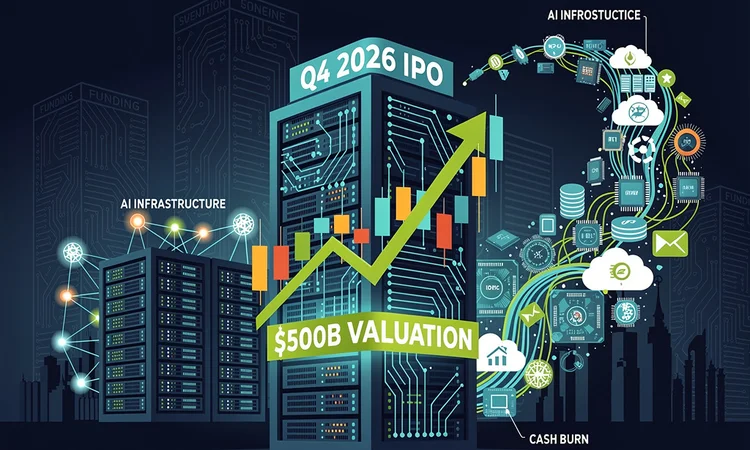
OpenAI targets a Q4 2026 IPO to preempt Anthropic, amid $500 billion valuations, massive funding pursuits, and infrastructure bets testing public market tolerance for AI's cash burn.

OpenAI’s Q4 Sprint: Racing Anthropic to AI’s First Mega-IPO

OpenAI is accelerating preparations for a fourth-quarter initial public offering, positioning itself to outpace rival Anthropic in the dash to become the first major generative-AI company to list on public markets. The ChatGPT maker, valued at $500 billion following recent funding, has initiated informal talks with Wall Street banks and bolstered its finance team with hires including Ajmere Dale as chief accounting officer and Cynthia Gaylor as corporate business finance officer, according to The Wall Street Journal .

Executives at OpenAI have voiced private worries that Anthropic, backed by Amazon and Google, could beat them to the punch amid intensifying rivalry. This push comes as both firms grapple with soaring compute costs and ambitious infrastructure builds, with OpenAI committing to at least 10 gigawatts of Nvidia systems over a decade and Anthropic securing $30 billion in Azure capacity plus up to one gigawatt.

OpenAI’s Valuation Surge and Funding Frenzy

Recent reports highlight OpenAI’s pursuit of massive private capital ahead of any listing, with discussions for up to $100 billion from Nvidia, Microsoft, Amazon, and SoftBank, potentially lifting its valuation to $730 billion or higher. Runtime News notes this round aims to address investor concerns over cash burn, quoting The Information: “If this extraordinary funding round comes together, it would calm investors worried about the company’s cash burn.” Meanwhile, Anthropic eyes $350 billion in funding talks, doubling from $183 billion in months, per The New York Times .

Anthropic hired law firm Wilson Sonsini in December to kick off IPO groundwork and has held early discussions with investment banks, signaling a potential 2026 debut. The firm projects $20-26 billion in annualized revenue run rate next year, with 80% from enterprise API customers across 300,000 business accounts, including $1 billion from Claude Code alone.

OpenAI, projecting $30 billion in 2026 revenue against $14 billion losses, relies more on consumer usage from ChatGPT’s 800 million weekly active users. Its path to profitability stretches to 2029 or later, contrasting Anthropic’s cash flow positive target by 2028.

Rivals Gear Up Amid Market Scrutiny

The IPO race extends beyond these two, with SpaceX eyeing a 2026 listing at $800 billion valuation after telling investors it plans to go public within 12 months barring disruptions, as reported by multiple outlets including CNBC . Combined, these firms could test public market appetite for nearly $2 trillion in value, dwarfing 2025 U.S. IPO proceeds.

Analysts question if investors will stomach the valuations. Renaissance Capital’s Nick Einhorn told Gizmodo that household names like these could draw interest despite economic headwinds like tariffs or elections. Yet, enterprise software stocks have plunged amid AI cost fears, with Microsoft’s capex hitting $37.5 billion and Amazon laying off thousands at AWS.

MarketWatch and Benzinga echo the WSJ on OpenAI’s timeline, while Sherwood News flags Amazon’s potential $50 billion stake in OpenAI’s pre-IPO raise.

Enterprise Traction Fuels Anthropic’s Edge

Anthropic’s enterprise focus, with Claude favored for coding and research, positions it as a steadier bet. X posts from insiders like @aakashgupta note its 39x ARR multiple at $350 billion versus OpenAI’s similar ratio on consumer-heavy revenue. Kalshi markets peg a 50% chance of OpenAI listing in 2026, per @StockMKTNewz.

Broader skepticism emerges on X, with @xpasky arguing OpenAI lacks a moat against Google and Anthropic’s superior post-training, calling its capex a potential “pyramid scheme.” @PPLXfinance highlights the trio’s $1.5 trillion combined value prepping for IPOs.

OpenAI’s restructuring to a public benefit corporation, retaining nonprofit oversight with a $130 billion stake, resolved a $40 billion SoftBank deal but drew lawsuits from Elon Musk and scrutiny from California’s attorney general.

Investor Tests and Infrastructure Gambles

Public markets will demand clarity on profitability beyond enterprise deals and compute management. AInvest details Nvidia’s $100 billion OpenAI commitment for 10 gigawatts versus Anthropic’s smaller scale, projecting AI infrastructure from $90 billion in 2026 to $465 billion by 2033.

Runtime News captures Wall Street’s AI reckoning, with Ben Reitzes of Melius Research noting Anthropic’s rapid innovations like Claude Cowork embarrassing incumbents. Microsoft’s Azure grew 39%, yet stocks like ServiceNow fell 11% on cost fears.

As Q4 approaches, OpenAI’s finance expansion signals seriousness, but volatility, midterm elections, or unreadiness could delay. The first AI IPO will set the tone for the sector’s public verdict.

About the Author

Claire Bell
Claire Bell

Claire Bell specializes in retail operations and reports on the systems behind modern business. Their approach combines scenario planning and on‑the‑ground reporting. Their coverage includes guidance for teams under resource or time constraints. They are known for dissecting tools and strategies that improve execution without adding complexity. They maintain a balanced tone, separating speculation from evidence. They frequently compare approaches across industries to surface patterns that travel well. Their perspective is shaped by interviews across engineering, operations, and leadership roles. They look for overlooked details that differentiate sustainable success from short‑term wins. They write about both the promise and the cost of transformation, including risks that are easy to overlook. They examine how customer expectations evolve and how organizations adapt to meet them. They emphasize responsible innovation and the constraints teams face when scaling products or services. They prefer concrete examples and dislike vague generalities. They focus on what changes decisions, not just what makes headlines.

Comments

Join the discussion and share your thoughts.

No comments yet. Be the first to comment.

Leave a Reply

Your email address will not be published.

Related Posts

Microsoft’s AI Empire Faces Existential Challenge as Anthropic Emerges From OpenAI’s Shadow

Microsoft’s AI Empire Faces Existential Challenge as Anthropic Emerges From OpenAI’s Shadow

Microsoft's $13 billion OpenAI partnership faces unprecedented pressure as Anthropic's Claude models gain enterprise traction, forcing the software giant to reassess its AI-exclusive strategy amid growing concerns about competitive vulnerability and strategic inflexibility in the rapidly evolving generative AI market.

Posted on: by Liam Price
Snap’s Bold Gambit: Why Spinning Off AR Glasses Could Redefine Silicon Valley’s Hardware Playbook

Snap’s Bold Gambit: Why Spinning Off AR Glasses Could Redefine Silicon Valley’s Hardware Playbook

Snap Inc. is spinning off its augmented reality glasses division into a separate business entity, a strategic move that could reshape how social media companies approach hardware innovation while providing financial flexibility and longer development timelines for AR technology.

Posted on: by Roman Grant
The Silent Epidemic: How Medical Device Failures Are Reshaping Patient Safety Standards in Modern Healthcare

The Silent Epidemic: How Medical Device Failures Are Reshaping Patient Safety Standards in Modern Healthcare

The global medical device industry faces mounting scrutiny as regulatory frameworks struggle to balance rapid innovation with patient safety. Recent investigations reveal systemic weaknesses in device approval, monitoring, and recall processes, raising fundamental questions about oversight.

Emerging Tech
SAP’s Cloud Backlog Shock Triggers Steepest Plunge Since 2020

SAP’s Cloud Backlog Shock Triggers Steepest Plunge Since 2020

SAP shares cratered 14% on January 29, 2026, after Q4 cloud backlog growth missed at 16%, disappointing expectations of 26%. Solid revenue and AI-driven gains offered solace, but guidance for deceleration sparked selloff fears.

Emerging Tech
OpenAI’s Writing Quality Crisis: How ChatGPT-5.2 Stumbled and What It Means for AI’s Future

OpenAI’s Writing Quality Crisis: How ChatGPT-5.2 Stumbled and What It Means for AI’s Future

Sam Altman's admission that OpenAI compromised writing quality in ChatGPT-5.2 reveals critical tensions in AI development. The incident exposes trade-offs between advancing technical capabilities and maintaining user experience, raising questions about industry practices and competitive dynamics.

Emerging Tech
EU’s Tariff Triumph: India Opens Luxury Auto Doors, Leaving U.S. Brands in the Dust

EU’s Tariff Triumph: India Opens Luxury Auto Doors, Leaving U.S. Brands in the Dust

India's EU free trade deal slashes car import duties from 110% to 10%, boosting Mercedes, BMW, and Audi in the premium segment while shielding mass-market locals. EU gains first-mover edge over U.S., with quotas and EV delays balancing access amid stock dips for Tata and Mahindra.

Emerging Tech
ASML: The Dutch Monopoly Powering Nvidia’s AI Dominance

ASML: The Dutch Monopoly Powering Nvidia’s AI Dominance

ASML's monopoly on EUV lithography machines underpins Nvidia's AI chips, driving record 2025 bookings of 13.2 billion euros and a raised 2026 sales outlook to 34-39 billion euros amid surging demand from TSMC and others.

Emerging Tech
Starmer-Xi Thaw: UK Bets Big on China Reset Amid Trump Turbulence

Starmer-Xi Thaw: UK Bets Big on China Reset Amid Trump Turbulence

UK Prime Minister Keir Starmer's Beijing summit with Xi Jinping secured visa-free travel for Britons and business pacts, thawing ties strained by espionage rows and Hong Kong. Amid Trump tariff threats, Starmer balances growth with security in a high-stakes reset.

Emerging Tech
Microsoft’s $80 Billion Cloud Computing Backlog Signals Unprecedented AI Infrastructure Strain

Microsoft’s $80 Billion Cloud Computing Backlog Signals Unprecedented AI Infrastructure Strain

Microsoft's $80 billion Azure backlog extending to 2026 reveals unprecedented strain on cloud infrastructure driven by AI demand. The capacity crisis, stemming from GPU shortages and data center construction timelines, is reshaping competitive dynamics and forcing enterprises to fundamentally reconsider their AI deployment strategies.

Emerging Tech
Advantest’s AI Tester Surge: Record Profits Amid Chip Complexity Boom

Advantest’s AI Tester Surge: Record Profits Amid Chip Complexity Boom

Advantest's shares soared 14% on record Q3 sales from AI chip testing demand, lifting full-year profit forecast to $2.98 billion. SoC testers for AI/HPC drive 80% of growth amid rising chip complexity.

Emerging Tech