
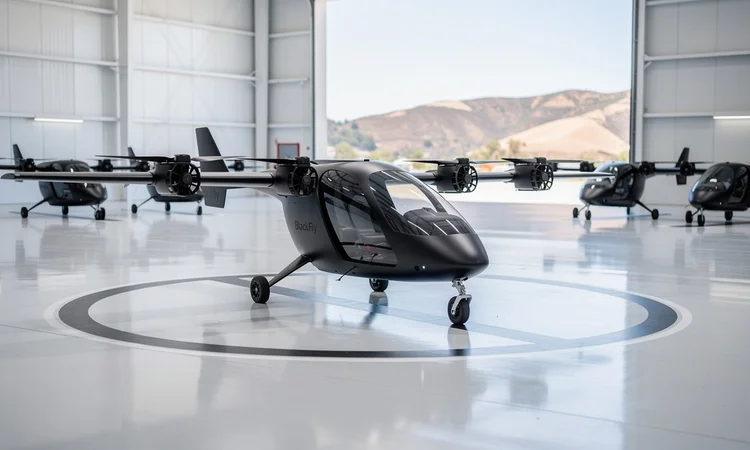
The era of personal flying vehicles has officially transitioned from science fiction to commercial reality. California-based Pivotal has begun delivering its BlackFly electric vertical takeoff and landing (eVTOL) aircraft to customers, marking a watershed moment in the aviation industry. Priced at $190,000, the single-seat aircraft represents the culmination of decades of engineering ambition and regulatory navigation, positioning itself as the first truly accessible personal flying vehicle available for purchase in the United States.
According to Slashdot , Pivotal’s BlackFly has secured Federal Aviation Administration approval under the ultralight category, a classification that eliminates the need for a pilot’s license. This regulatory pathway has proven crucial to the company’s commercial strategy, dramatically lowering the barrier to entry for prospective buyers who might be intimidated by traditional aviation certification requirements. The aircraft’s eight electric motors and distributed propulsion system enable vertical takeoff and landing capabilities, allowing operation from spaces as compact as a residential driveway.
The BlackFly’s technical specifications reveal an aircraft designed for practical, short-range transportation rather than extended aerial journeys. With a maximum range of approximately 25 miles and a top speed of 63 miles per hour, the vehicle targets urban and suburban commuters seeking to bypass ground-level traffic congestion. The aircraft’s amphibious design includes flotation capabilities, adding a layer of safety for operations over water bodies. Its compact dimensions—measuring roughly 13 feet in length with a wingspan of approximately 13 feet—enable storage in standard residential garages, addressing one of the fundamental challenges of personal aircraft ownership.
Regulatory Framework and Safety Certifications
The path to commercial availability required Pivotal to navigate a complex regulatory environment that has historically stymied personal aviation ventures. The FAA’s ultralight classification, established under Part 103 regulations, permits single-seat vehicles weighing less than 254 pounds (excluding safety equipment) to operate without traditional pilot certification. BlackFly’s engineering team achieved this weight target through extensive use of carbon fiber composites and advanced battery technology, demonstrating the critical role of materials science in making personal aviation economically viable.
Safety protocols embedded within the BlackFly’s design include triple-redundant flight control systems, automated return-to-home functionality, and a ballistic parachute system capable of safely lowering the entire aircraft in emergency situations. These features address fundamental concerns about personal aviation safety, particularly for operators without extensive flight training. The aircraft’s fly-by-wire controls translate pilot inputs into optimized motor commands, simplifying the flying experience while maintaining stability across various weather conditions within its operational envelope.
Market Positioning and Economic Implications
At $190,000, the BlackFly positions itself in a unique market segment—substantially more expensive than luxury automobiles but accessible compared to traditional aircraft ownership, which typically requires investments exceeding $300,000 before accounting for hangar fees, maintenance, and fuel costs. Pivotal’s pricing strategy reflects the economics of limited production volumes combined with the premium associated with pioneering technology. Industry analysts suggest that as production scales and battery technology advances, prices for similar vehicles could decline by 30-40% over the next decade.
The company’s business model extends beyond aircraft sales to encompass a comprehensive ecosystem of training, maintenance, and community development. Pivotal has established a training facility in California where buyers complete approximately 90 minutes of instruction before taking delivery of their aircraft. This abbreviated training period, made possible by the aircraft’s automated systems and intuitive controls, contrasts sharply with the months-long commitment required for traditional pilot certification. The company also maintains a network of service centers and has developed proprietary diagnostic software that enables remote troubleshooting and predictive maintenance scheduling.
Technical Innovation and Performance Characteristics
The BlackFly’s distributed electric propulsion system represents a significant departure from conventional aircraft design philosophy. Eight independent motor-propeller units provide redundancy while enabling precise thrust vectoring for enhanced maneuverability. This configuration allows the aircraft to maintain controlled flight even with multiple motor failures, a safety margin impossible in single-engine designs. The electric powertrain delivers instantaneous torque response and near-silent operation, producing approximately 45 decibels during cruise flight—quieter than typical highway traffic.
Battery technology constitutes both the aircraft’s greatest strength and its primary limitation. Current lithium-ion battery packs provide sufficient energy density for the 25-mile range while maintaining the weight requirements for ultralight classification. However, recharge times of approximately 90 minutes using standard 240-volt outlets constrain operational flexibility. Pivotal’s engineering team has indicated that future iterations may incorporate rapid-charging capabilities and battery-swapping infrastructure, potentially extending daily operational range through multiple flight cycles.
Competitive Environment and Industry Trajectory
Pivotal enters a increasingly crowded eVTOL market that includes well-funded competitors such as Joby Aviation, Archer Aviation, and Lilium, though most competitors focus on larger, multi-passenger aircraft intended for commercial air taxi services rather than personal ownership. This strategic differentiation may prove advantageous as regulatory pathways for commercial passenger operations remain uncertain and timeline-dependent. By targeting the ultralight category and individual ownership model, Pivotal has circumvented some of the most challenging regulatory hurdles facing the broader advanced air mobility sector.
The company’s founder, who previously worked on Google’s self-driving car project, brought Silicon Valley’s iterative development methodology to aircraft design. This approach emphasized rapid prototyping and extensive flight testing, with the BlackFly accumulating over 12,000 test flights before receiving regulatory approval. The development process incorporated lessons from both aerospace engineering and consumer electronics, resulting in an aircraft that prioritizes user experience alongside technical performance. Touch-screen interfaces, automated pre-flight checks, and smartphone integration reflect this consumer-oriented design philosophy.
Infrastructure Requirements and Operational Considerations
Unlike traditional aircraft requiring dedicated runways and airport infrastructure, the BlackFly’s vertical takeoff capabilities enable operation from virtually any clear space meeting minimum dimensional requirements. However, this operational flexibility introduces complex questions about airspace management, noise regulations, and local zoning ordinances. Many municipalities lack regulatory frameworks addressing personal eVTOL operations, creating potential legal uncertainties for early adopters. Pivotal has engaged with local governments and homeowners associations to develop operational guidelines that balance innovation with community concerns.
Energy infrastructure represents another consideration for widespread adoption. While the aircraft can recharge from standard electrical outlets, optimal charging requires dedicated 240-volt circuits similar to those used for electric vehicles. The relatively modest energy consumption—approximately 15 kilowatt-hours for a full charge—places minimal strain on residential electrical systems, though widespread adoption could influence local grid planning. Some analysts project that personal eVTOL adoption may follow similar patterns to electric vehicle deployment, with early adopters concentrated in affluent communities featuring robust electrical infrastructure and favorable regulatory environments.
Future Developments and Industry Outlook
Pivotal has indicated that the current BlackFly model represents the first generation of what the company envisions as an evolving product line. Future iterations may incorporate enhanced battery technology enabling extended range, autonomous flight capabilities for hands-free operation, and potentially multi-seat configurations pending regulatory approval. The company has also explored subscription-based ownership models and shared-usage programs that could reduce individual ownership costs while maximizing aircraft utilization rates.
The broader implications of personal eVTOL availability extend beyond individual transportation convenience. Urban planners and transportation economists are beginning to model scenarios where three-dimensional mobility reduces pressure on ground-level infrastructure, potentially influencing residential development patterns and commercial real estate valuations. However, realizing this vision requires not only technological advancement but also comprehensive regulatory frameworks, public acceptance, and integration with existing air traffic management systems. The BlackFly’s commercial availability represents a tangible first step toward this future, transforming what was recently considered futuristic speculation into present-day reality. As production volumes increase and operational experience accumulates, the personal aviation sector may finally achieve the mainstream viability that has eluded it for generations, fundamentally altering how society conceptualizes personal mobility.


Leave a Reply
Your email address will not be published.