
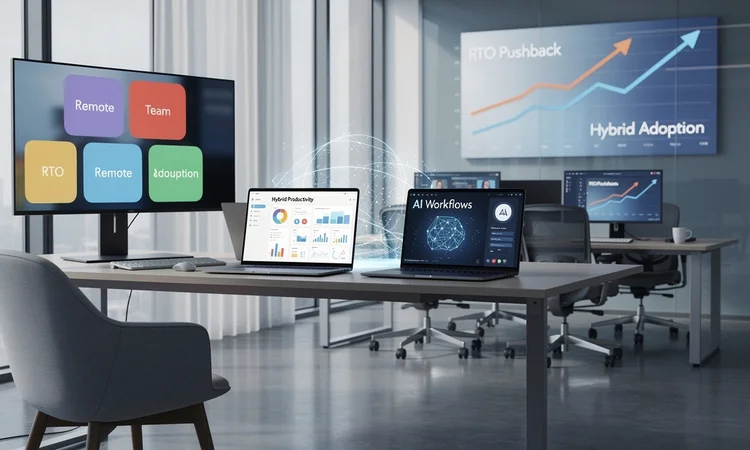
Remote work, once a pandemic necessity, has solidified into a permanent fixture of corporate America, with hybrid arrangements now comprising nearly a quarter of new job postings. Yet, as companies grapple with mandates for office returns, researchers warn of trade-offs in innovation and mentorship that could reshape career trajectories for years to come. A January 2025 study from Binghamton University underscores that while flexibility boosts accessibility, virtual teams often miss the serendipitous sparks of in-person encounters.
Hiroki Sayama, distinguished professor of systems science at Binghamton University, notes, “There are things you can accomplish more effectively online and things that work better in person, so instead of viewing it as one option being better than the other, managers would benefit by looking at which option is best suited to meet the objective.” His research, co-authored with Shelley Dionne, dean of the School of Management, reveals that larger diverse teams generate conservative ideas through rigorous vetting, while smaller virtual groups foster bolder concepts but risk isolation ( Binghamton News ).
U.S. Bureau of Labor Statistics data shows remote work elevated total factor productivity growth across 61 industries from 2019 to 2022, even after adjusting for pre-pandemic trends. Firms like those in finance and tech sustained over 30% remote workers into 2022, per BLS reports, signaling enduring economic gains despite pushback from return-to-office policies.
Hybrid Models Surge Amid RTO Resistance
Robert Half’s 2025 research tracks hybrid postings climbing from 15% in Q2 2023 to 24% in Q2 2025, with 12% fully remote in Q3. “One of the most significant remote work trends… is the growth in hybrid job postings,” the report states, reflecting employer adaptations to worker demands ( Robert Half ). FlexJobs’ 2026 Trends Report adds that 85% of workers prioritize flexibility over salary, with remote and hybrid roles remaining top preferences since 2020.
Pew Research Center surveys indicate 35% of remote-capable workers remain fully home-based three years post-pandemic, while 72% of hybrid employees prefer that balance. Yet, compliance lags: between Q1 2024 and Q3 2025, required office days rose 12%, but attendance increased only 1-3%, per Remotive’s State of Remote Work 2026.
Tech giants like Amazon and Dell enforced five-day office mandates in 2025, joining Meta and others, as Fortune 100 firms shifted dramatically from minimal RTO in 2023. Employees, however, signal resistance; 46% would seek new jobs if forced fully onsite, according to Pew.
Leadership Challenges in Virtual Teams
Chou-Yu (Joey) Tsai, Osterhout Associate Professor of Entrepreneurship at Binghamton, co-authored a 2024 study finding that dominating virtual discussions does not equate to leadership. “In virtual teams, where people cannot pick up on nonverbal cues as easily, a person’s responsiveness to other team members plays a significant role in whether they’re perceived as a leader,” Tsai explains. Hybrid setups excel by enabling direct engagement, with verbal cues replacing facial expressions ( Binghamton News ).
Younger generations, shaped by remote learning, expect flexibility but face mentorship gaps. Tsai warns, “If we don’t reinforce those skills… you could run the risk of people losing a sense of meaning to their work. It can be much harder to mimic the close mentorship among colleagues in a virtual space.” McKinsey research echoes this, noting junior workers struggle with networks essential for growth.
Sayama predicts clashes between entrenched younger workers and older managers, with the trend persisting a decade. AI tools like transcription could enhance efficiency without supplanting human bonds, he suggests.
Productivity Gains and Cost Savings
BLS economists Sabrina Wulff Pabilonia and Jill Janocha Redmond found remote work positively linked to productivity, with experiments showing hybrid models improving retention sans performance dips. Nicholas Bloom’s 2024 Nature study confirms hybrid work boosts retention without harming output.
Yu Wang’s analysis of 200 top U.S. law firms shows remote policies slashing rent costs, expanding talent pools for disabled workers and parents, and retaining autonomy-valuing professionals. “Providing remote or hybrid options helps organizations retain talent, especially in industries such as law firms or technology,” Wang states. HR support for promotions and training is crucial for equity.
Global stats paint a robust picture: 52% of the workforce remote by 2026, per Yomly, with 97 of top 100 employee-satisfaction firms offering flexible models. Upwork forecasts 36.2 million U.S. remote workers by 2025, 22% of the workforce.
AI and Tech Reshape Remote Dynamics
Forbes’ 2026 Work Trends predicts AI fluency as key, with HR prioritizing unified tech stacks. Kara Ayers of Xplor Technologies views remote as a “competitive benefit” for talent attraction. The collaboration software market hits $24.48 billion by 2025, fueling global teams where 73% will include remote workers by 2028 (Gini Talent).
Cybersecurity rises in priority, with zero-trust frameworks essential amid distributed risks. Sustainability benefits emerge too: reduced commuting cuts carbon footprints, per Splashtop’s 2026 trends.
Binghamton researchers advocate tailored strategies—no one-size-fits-all. Sayama laments lost serendipity: “We’re perhaps missing… ‘serendipity’ moments that could have happened if you’re in the physical office.” Optimizing team sizes and objectives remains key for sustained success.
Generational and Global Fault Lines
Gen Z and millennials drive demands, with FlexJobs noting a “quarter-life career crisis” hitting 55% amid uncertainty. UNC research links remote flexibility to startup surges, while global surveys show U.S. WFH at 1.27 days weekly, stabilized post-2023 dips.
In Europe and Asia, flexibility varies: France at 7% fully remote, Japan retreating post-pandemic. Yet, BLS data affirms 23.3% of U.S. workers telecommute some, 10.9% fully, well above pre-2020 levels.
As 2026 unfolds, firms blending hybrid with AI and robust support will thrive. Researchers like those at Binghamton emphasize complementary use of remote and in-person to harness strengths, ensuring productivity, innovation, and satisfaction endure.


Leave a Reply
Your email address will not be published.